

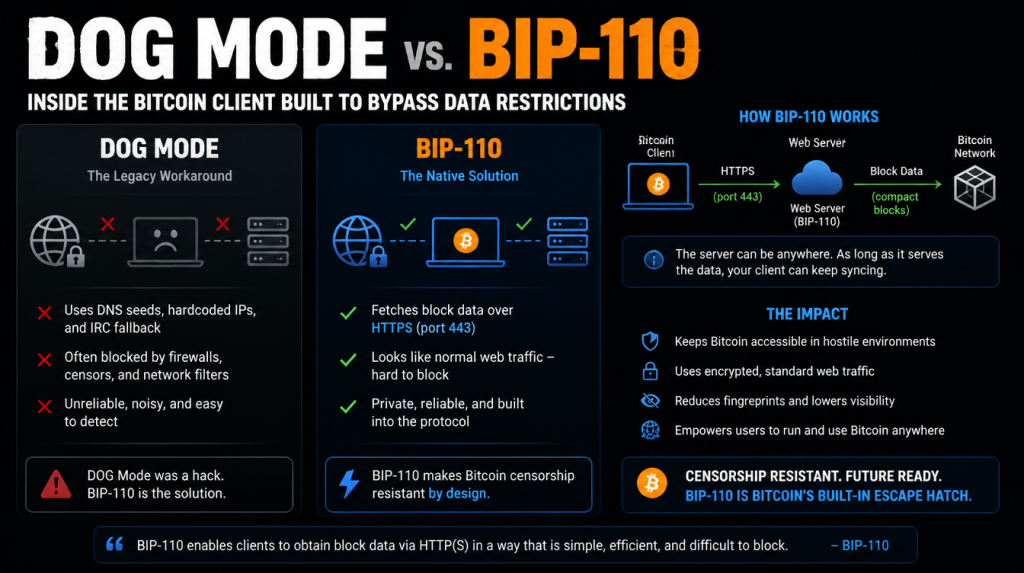
While BIP-110 aims to limit non-financial data through a consensus-level change—despite having virtually no support from miners—a newly proposed DOG Mode client takes the opposite approach and does not require any voting process.
Just five days after CoinDesk highlighted that the proposal to remove non-financial data from Bitcoin lacked meaningful miner backing, some developers introduced an alternative strategy that bypasses consensus entirely.
Leonidas, co-founder of the Runestone project and a key figure in the Ordinals and Runes ecosystem, announced plans to launch an open-source Bitcoin client named DOG Mode.
This client would remove two restrictions enforced by Bitcoin Core, the software used by most Bitcoin nodes. One restriction limits the maximum transaction size that nodes will relay, while the other defines the minimum value an output must hold.
Consensus rules determine whether a block is valid, and violating them would isolate a node from the network. In contrast, relay policy is more flexible, governing which transactions a node chooses to forward. Bitcoin Core labels certain transactions as “non-standard” and refuses to relay them, even if they comply with consensus rules.
Since most nodes run Bitcoin Core, its default settings effectively shape Bitcoin’s operational rules. Although miners can still include such transactions if they receive them directly, Core does not relay them, meaning users must submit them straight to miners. Platforms like MARA’s Slipstream facilitate this process for large or complex transactions.
DOG Mode proposes increasing the maximum standard transaction size from 400,000 weight units to 3.9 million. Given that a full Bitcoin block can hold up to four million weight units, Core currently relays transactions no larger than about 10% of a block, whereas DOG Mode would allow transactions that nearly fill an entire block.
Additionally, DOG Mode would lower the “dust limit”—the minimum output value worth relaying—from roughly 294–546 satoshis down to just one satoshi. A satoshi is the smallest unit of Bitcoin, equal to one hundred millionth of a BTC.
Protocols like Ordinals, which embed data such as images and text into transactions, and Runes, which create tradable tokens on Bitcoin, currently require extra bitcoin to meet this threshold. Leonidas argues that removing the dust limit could free up around $25 million currently locked as padding in these ecosystems.
BIP-110, which seeks to restrict arbitrary data, is a user-activated soft fork requiring 55% miner approval. However, it has received no support in the current signaling period and has never exceeded about 1% historically, according to tracking data. This highlights the lack of network consensus for the proposal.
DOG Mode, on the other hand, avoids the need for broad approval. It simply alters how individual nodes relay transactions. If enough nodes adopt it and at least one miner accepts the fees, those transactions can still be confirmed—without any formal voting, signaling window, or deadline.
Support for BIP-110 remains minimal and is largely confined to Bitcoin Knots, an alternative client preferred by advocates of stricter data limits. DOG Mode would represent the opposite approach—a fork of Bitcoin Core designed to loosen restrictions—while still remaining closer to Core than Knots does.
At present, DOG Mode remains conceptual. There is no codebase, repository, or official release. Leonidas has called on developers to help build it, miners to support it, and users to promote it, but the project is still in its early stages.
Leonidas, known for promoting the Runes protocol and co-founding Runestone (which launched the DOG token), is now proposing this new client while relying on others to develop it. Notably, the proposed dust limit change could inject funds back into markets where his own token is traded.
In essence, BIP-110 seeks to change Bitcoin’s core rules and requires broad miner approval, which it currently lacks. DOG Mode, however, only modifies node behavior and would need just one miner willing to include the transactions. One approach depends on collective agreement, while the other operates independently of it.
Following the announcement, DOG token prices remained relatively stable, declining by about 1.2% over the past 24 hours.
About The Author




More Stories
CFTC Warns Prediction Platforms of Manipulation Risks in ‘Mention Markets’
Lummis Says Trump Opposition Helped Derail Crypto Clarity Act
XRP Ledger Retries Upgrade Designed to Split Payments and Compliance Roles