

Here’s a clear paraphrased version of your text:
The nonbinding resolution was approved without any objections after Sam Bankman-Fried requested clemency, months following former President Donald Trump’s pardons of several high-profile crypto figures, including Changpeng Zhao and Ross Ulbricht.
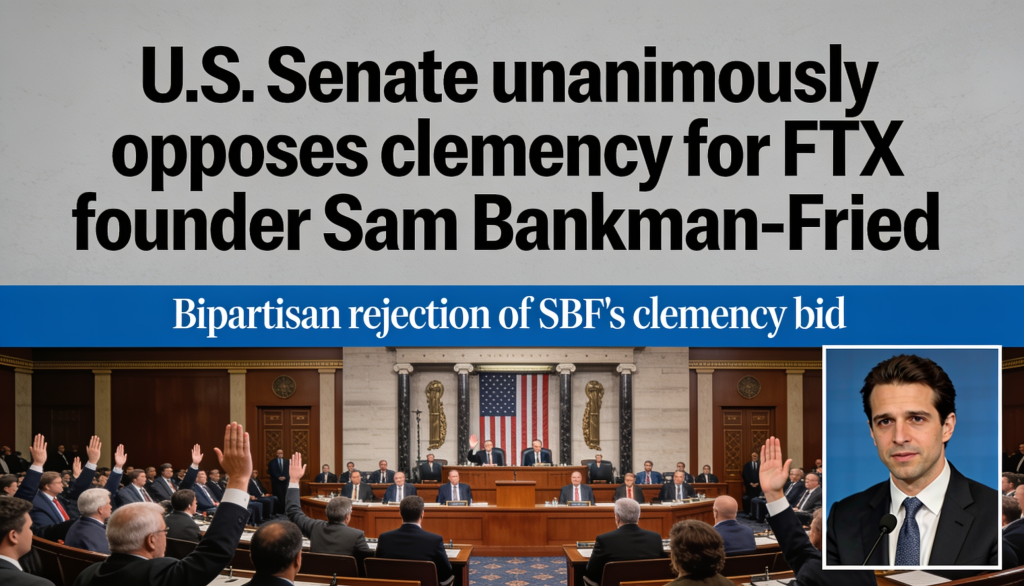
On Wednesday, the Senate reached a consensus that Bankman-Fried should never be granted clemency, passing a resolution declaring that the FTX founder must not receive a pardon or sentence reduction under any circumstances.
The measure was adopted through unanimous consent, a process that allows legislation to pass as long as no senator raises an objection.
Senators Cynthia Lummis, a Republican from Wyoming, and Ruben Gallego, a Democrat from Arizona, are the leading members of the Senate Banking Committee’s digital assets subcommittee for their respective parties.
Lummis, known as one of Congress’s strongest supporters of the crypto industry, has spent years working on legislation favorable to the sector while also leading efforts to ensure one of its most notorious figures remains incarcerated.
“He had his day in court,” Lummis said when the resolution was introduced on June 17. Gallego concluded his remarks with a blunt statement: “Keep him locked up.”
Bankman-Fried is not expected to be eligible for release until approximately 2044. In November 2023, a jury found him guilty on seven charges related to FTX’s collapse, which prosecutors described as one of the largest financial fraud cases in U.S. history, resulting in losses exceeding $8 billion for American customers.
In January, Donald Trump stated he had no intention of granting a pardon to Bankman-Fried, even though he had previously pardoned Binance founder Changpeng Zhao, Silk Road creator Ross Ulbricht, and other individuals convicted of white-collar crimes.
Bankman-Fried simultaneously operated two entities. FTX functioned as a cryptocurrency exchange, responsible for safeguarding customer funds like a broker and not using them for other purposes. Alameda Research, another firm he owned, was a trading company. He transferred billions of dollars from FTX customer accounts to Alameda, which then used the funds for trading, venture investments, political contributions, and real estate purchases in the Bahamas. Meanwhile, FTX’s system gave Alameda special privileges, exempting it from rules that would have required it to cover losses like other traders.
The scheme began to unravel in November 2022 when CoinDesk obtained Alameda’s balance sheet, revealing that a significant portion of its assets consisted of FTT, a token created and controlled by FTX.
This meant the collateral supporting Alameda was largely based on a token issued by its affiliated company. The situation worsened when Binance announced it would liquidate its FTT holdings, triggering a sharp decline in the token’s value.
As panic spread, customers rushed to withdraw their funds, but FTX was unable to meet the demand because the money had already been used. The exchange ultimately filed for bankruptcy on November 11, 2022, just over a week after the initial report was published.
About The Author





More Stories
CFTC Warns Prediction Platforms of Manipulation Risks in ‘Mention Markets’
Lummis Says Trump Opposition Helped Derail Crypto Clarity Act
XRP Ledger Retries Upgrade Designed to Split Payments and Compliance Roles