

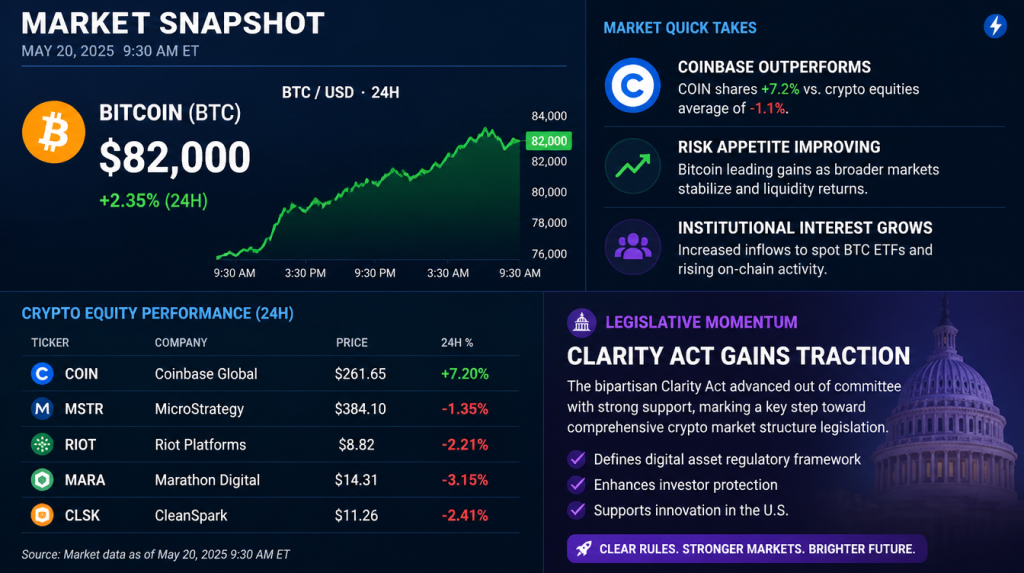
Crypto markets advanced on Thursday after the Senate Banking Committee moved forward the long-anticipated digital asset market structure legislation, known as the Clarity Act, marking a major step toward establishing federal oversight for the industry.
The bill passed the committee in a 15–9 vote, with support from two Democratic senators, and now heads to the full Senate for further deliberation.
Bitcoin climbed to $82,000 on the news as traders reacted positively to regulatory progress in Washington. The asset later eased to around $81,500, still posting a 2.5% gain over the past 24 hours.
The rally extended into crypto-linked equities. Coinbase (COIN) led the sector higher, surging 8% as investors bet that clearer regulatory frameworks could accelerate institutional adoption of digital assets. Strategy (MSTR) gained 7%, while Ethereum-focused treasury firm Bitmine (BMNR) rose 5.6%.
Stablecoin issuer Circle (CRCL) and Bullish (BLSH), CoinDesk’s owner, also recovered from earlier losses, contributing to a broadly positive tone across crypto equities.
The risk-on sentiment wasn’t limited to digital assets. The Nasdaq 100 and S&P 500 both reached fresh record highs as broader equity markets extended their rally.
Adding to the momentum, AI chipmaker Cerebras (CBRS) made a strong public market debut, trading as much as 100% above its IPO price, fueling further enthusiasm around artificial intelligence stocks.
That AI-driven strength also lifted companies tied to data center infrastructure, including former Bitcoin miners that have shifted toward high-performance computing. Keel Infrastructure (KEEL), formerly Bitfarms, gained 9%, while IREN (IREN) rose 5% and Hive Digital (HIVE) added 8%, as investors continued to rotate into AI-linked infrastructure plays.
About The Author





More Stories
Bitcoin Starts New Quarter Stuck in Familiar $82K-$85K Range
Citigroup Lifts 12-Month Bitcoin Target to $113K as ETF Inflows Return
Bitcoin’s Inflation-Fueled Jump to $85.5K Fades as Yields Stay High