

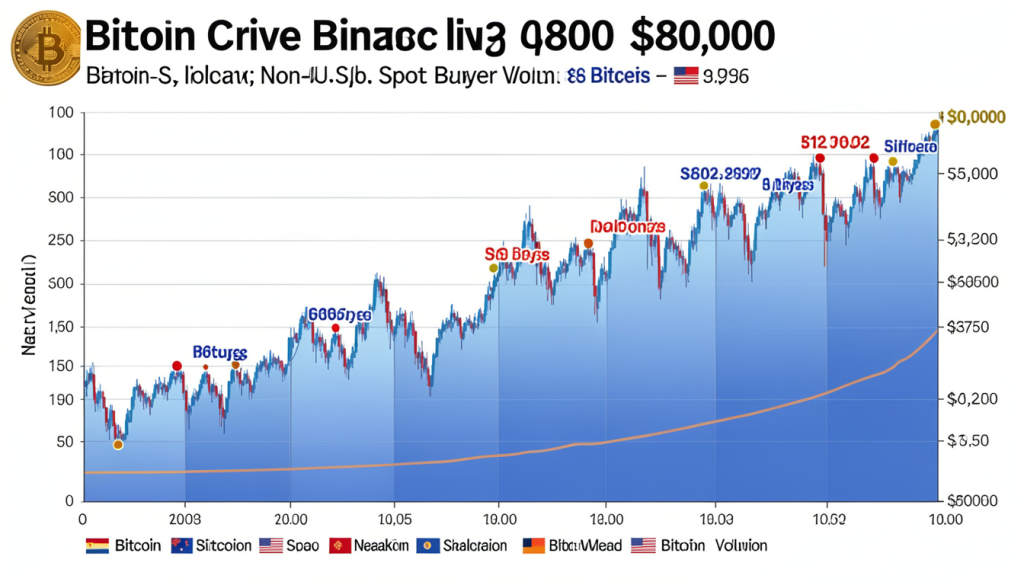
Bitcoin’s move above $80,000 appears to have been driven largely by leveraged positioning rather than strong spot demand, raising concerns about the durability of the rally.
Data shows limited participation from U.S.-based investors—typically a key force behind sustained bullish trends. This is reflected in the Coinbase Premium, which tracks the price difference between Coinbase and offshore exchanges. According to CryptoQuant, the metric has remained in negative territory since late April.
A negative premium indicates that offshore traders are willing to pay more for bitcoin than U.S. investors, suggesting the rally has been led by non-U.S. demand. Under normal conditions, a positive premium signals stronger institutional buying through Coinbase, a primary gateway for American capital.
Despite this divergence, bitcoin still managed to climb roughly 5%, briefly surpassing $82,000 before retreating below $80,000 following a hotter-than-expected U.S. producer price index release. The cryptocurrency was last trading near $79,500.
Importantly, the entire rally unfolded while the Coinbase Premium remained negative—a shift first observed on April 29, when a surge in realized losses suggested underwater holders were selling into strength.
Other on-chain indicators point to a similar trend. CryptoQuant’s apparent demand metric, which measures how effectively the market absorbs new supply, has improved significantly—from -91,000 BTC in April to around -11,000 BTC. However, it remains slightly negative, indicating that demand still trails supply.
Much of the recent buying activity has instead come from the derivatives market, particularly perpetual futures. These instruments allow traders to take leveraged positions without expiry, amplifying both gains and risks.
Unlike spot accumulation, which tends to be more stable, leveraged positions can unwind quickly if market conditions shift, making rallies driven by futures activity inherently more fragile. That vulnerability appears to be playing out as bitcoin has slipped back below the $80,000 level.
CryptoQuant analysts describe the current setup as a relief rally rather than the start of a new accumulation phase. They draw comparisons to March 2022, when bitcoin surged 43% before stalling near its 200-day moving average and resuming its downtrend. The current rebound stands at roughly 37% from April lows, with unrealized profit levels approaching similar thresholds.
Looking ahead, the $70,000 level is seen as a critical support zone. This aligns with the Traders’ On-chain Realized Price—the average cost basis of short-term holders—and represents a point where profit margins compress, potentially reducing selling pressure and stabilizing the market.
About The Author





More Stories
Bitcoin Starts New Quarter Stuck in Familiar $82K-$85K Range
Citigroup Lifts 12-Month Bitcoin Target to $113K as ETF Inflows Return
Bitcoin’s Inflation-Fueled Jump to $85.5K Fades as Yields Stay High