

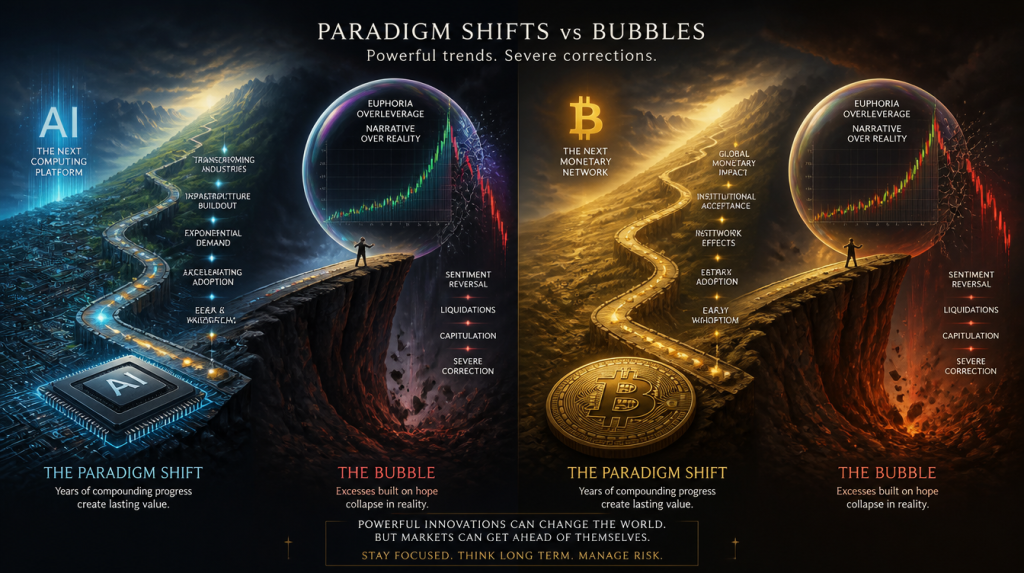
Structural transformations can generate long-term opportunities, but dramatic rallies across semiconductor stocks, commodities, and bitcoin demonstrate how quickly compelling narratives can turn into speculative bubbles.
The phrase “paradigm shift” is frequently used to describe market movements that may simply represent rapid capital shifts into the latest popular investment themes, with the AI-powered semiconductor surge being the most recent example.
Major cloud companies such as Amazon and Google are investing heavily in AI infrastructure, building massive data centers equipped with thousands of AI processors. These facilities require significant amounts of high-bandwidth memory for computing tasks and NAND flash storage, creating supply constraints and driving chip prices higher.
Micron Technology (MU) manufactures DRAM, NAND, and other memory solutions, while Sandisk (SNDK) focuses primarily on NAND flash and solid-state storage products. Micron’s stock climbed nearly 700% year over year, while Sandisk gained more than 4,000%. However, both companies later pulled back sharply from their highs, highlighting how quickly market enthusiasm can fade.
The AI boom also contributed to record-breaking market events, including the largest U.S. IPO ever from SpaceX (SPCX). Meanwhile, SK Hynix (00060), a major supplier of high-bandwidth memory chips, raised $26.5 billion through the largest U.S. listing by a foreign company. Although its ADRs initially surged, later volatility showed the risks of entering markets during periods of extreme optimism, with SK Hynix shares falling 15% during Asian trading hours.
Precious metals experienced a similar cycle. Gold and silver rallied strongly during the so-called “debasement trade,” driven by concerns that rising government debt, monetary expansion, and inflation could weaken fiat currencies. Silver gained more than $120 in January 2026 before giving up as much as half of those gains, while gold saw a smaller but notable correction.
Strategy (MSTR), the largest corporate bitcoin holder, also experienced a major shift in its investment narrative as its “infinite money glitch” strategy lost momentum. The company issued shares at premiums above the value of its bitcoin holdings and used the proceeds to accumulate more BTC. However, Strategy’s stock later declined roughly 80% from its peak as that premium narrowed toward the underlying net asset value.
The broader takeaway is that powerful structural trends can be genuine, but the valuations attached to them can still move through highly cyclical boom-and-bust phases.
About The Author





More Stories
CFTC Warns Prediction Platforms of Manipulation Risks in ‘Mention Markets’
Lummis Says Trump Opposition Helped Derail Crypto Clarity Act
XRP Ledger Retries Upgrade Designed to Split Payments and Compliance Roles