

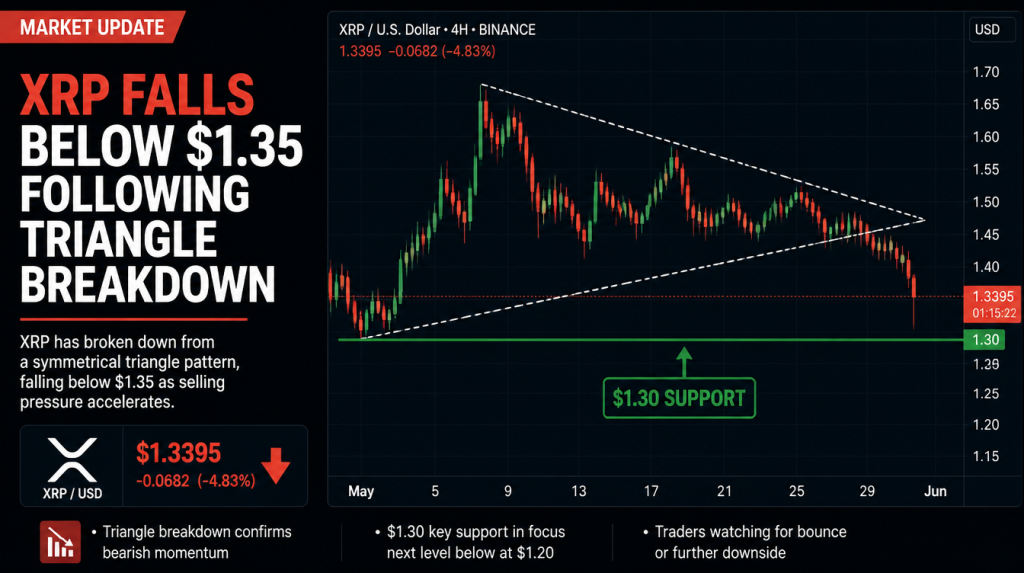
XRP moved lower after losing a key support zone, following yet another failed attempt to break above resistance, raising the risk that its multi-week consolidation pattern may resolve to the downside.
The token had spent several weeks compressing within a tight range, but momentum began to shift after repeated rejections near the $1.36 level. Each failed breakout has gradually weakened buyer conviction, with price now slipping back toward the $1.30 area—a level widely seen as the dividing line between continued consolidation and a broader breakdown.
Analysts remain divided on the structure. Some view the recent move as confirmation of a symmetrical triangle breakdown, opening the door for further downside. Others argue the price action still reflects late-stage compression, suggesting a larger move—potentially in either direction—has yet to fully develop.
Institutional developments are also coming into focus. CME Group is preparing to roll out 24/7 XRP-linked futures later this month, a move that could expand institutional participation and improve market depth.
On-chain trends show declining engagement from large holders. Whale transaction activity dropped more than 57% over a nine-day period, pointing to reduced high-value participation during the recent consolidation phase.
Over the past 24 hours, XRP traded within a relatively narrow 1.9% range, falling from $1.3457 to $1.3366. The most significant move occurred after a failed breakout attempt near $1.3620, where a brief spike in volume quickly reversed into selling pressure.
Price action later broke below $1.35 and stabilized near session lows around $1.336, reinforcing short-term bearish momentum after an extended period of tightening.
From a technical standpoint, XRP is now trading below several key moving averages, while resistance near $1.36 continues to cap upside attempts. Some analysts see potential downside toward $1.14 if the breakdown scenario unfolds.
However, others caution that the broader structure still resembles consolidation rather than a confirmed bearish reversal—especially as long as price holds above the critical $1.30 support zone.
That $1.30–$1.31 range now represents the key inflection point. A decisive move below it could accelerate downside pressure, while a recovery above $1.35 would be needed to restore short-term stability.
Looking ahead, the launch of CME’s XRP futures could act as a catalyst, potentially increasing volatility and improving liquidity as institutional access expands.
About The Author





More Stories
Bitcoin Starts New Quarter Stuck in Familiar $82K-$85K Range
Citigroup Lifts 12-Month Bitcoin Target to $113K as ETF Inflows Return
Bitcoin’s Inflation-Fueled Jump to $85.5K Fades as Yields Stay High