

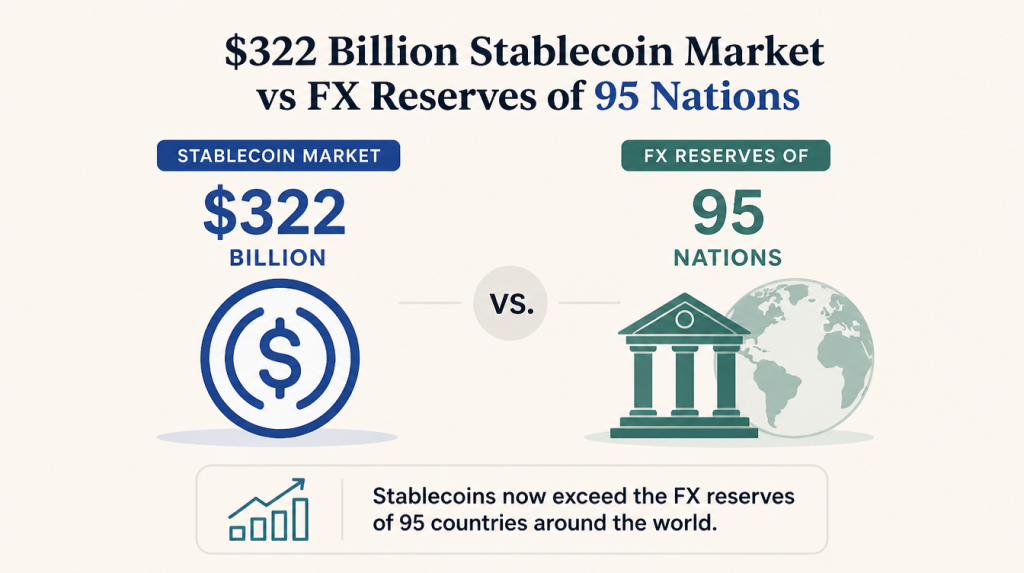
The volume of fiat-linked liquidity circulating outside the traditional banking system has expanded significantly, with stablecoins now collectively exceeding the foreign exchange reserves of most countries.
The total stablecoin market has reached a record $322 billion, placing it above the reserve holdings of 95 nations. This includes not only emerging markets such as Poland, Thailand, and Mexico, but also advanced economies like the United Kingdom and Canada, as well as the United Arab Emirates.
This development highlights a structural shift in global finance, where an increasing share of dollar-denominated value is being held in tokenized form on blockchain networks rather than within central bank-controlled reserves. In practical terms, privately held digital dollars now rival—and in many cases surpass—sovereign reserve buffers.
Stablecoins are blockchain-based representations of fiat currencies, typically pegged 1:1 to assets such as the U.S. dollar, euro, or yen. Growth in the sector has been driven largely by dollar-backed tokens, particularly Tether (USDT) and USD Coin (USDC), which dominate trading and liquidity flows.
Foreign exchange reserves, by contrast, are traditionally held by central banks to stabilize domestic currencies, manage external debt obligations, and fund imports. Despite the rapid expansion of stablecoins, only a limited group of countries—including China, Japan, Russia, India, Taiwan, and Germany—maintain reserves larger than the entire stablecoin market.
The rise of stablecoins reflects their increasing utility across financial markets. They are widely used in crypto trading as a stable intermediary asset, while also serving as a foundational layer in decentralized finance. In cross-border payments, they provide a faster and more cost-efficient alternative to legacy correspondent banking systems.
According to the Bank for International Settlements, stablecoin usage in international transfers has accelerated in recent years, particularly in regions where banking infrastructure is inefficient or expensive. The trend is especially pronounced in economies dealing with high inflation or currency instability.
However, the same characteristics that drive adoption also introduce risks. The ability to move funds quickly and with minimal friction raises concerns around capital flight, particularly in countries with weaker external balances.
The BIS notes that rising stablecoin flows are often associated with downward pressure on domestic currencies, disruptions to traditional exchange rate mechanisms, and widening gaps between official and market-implied exchange rates. These dynamics suggest stablecoins may facilitate the circumvention of capital controls, enabling users to shift wealth into dollar-linked assets more easily.
As stablecoins continue to grow, they are increasingly shaping global liquidity flows—presenting both opportunities for efficiency and challenges for financial stability.
About The Author





More Stories
Bitcoin Starts New Quarter Stuck in Familiar $82K-$85K Range
Citigroup Lifts 12-Month Bitcoin Target to $113K as ETF Inflows Return
Bitcoin’s Inflation-Fueled Jump to $85.5K Fades as Yields Stay High