

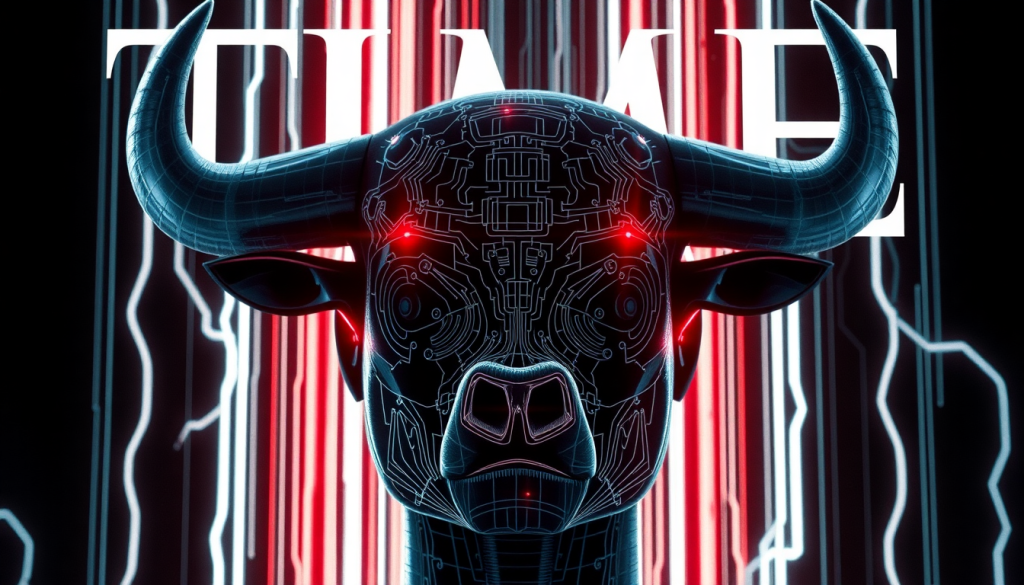
OpenAI’s founders are featured on the cover of TIME’s Sept. 7 issue beneath the headline “Trust Us,” a moment that could be seen as another milestone for the artificial intelligence boom — or, for market contrarians, a warning sign that enthusiasm may be reaching an extreme.
The cover fits the basic framework of the so-called magazine-cover indicator, although the signal has produced plenty of false alarms over the years.
The concept was popularized by market forecaster Paul Macrae Montgomery. His theory suggests that when a broad, mainstream magazine places a major investment theme on its cover, the idea may already be so popular that much of the excitement has been priced in.
OpenAI, the company behind ChatGPT, has become one of the most recognizable symbols of the AI boom that has reshaped technology, venture capital and investor risk appetite since late 2022.
Artificial intelligence has also played a central role in the surge across technology-related assets over the past several years. Bitcoin fell alongside tech stocks in late 2022 around the launch of ChatGPT before embarking on a major recovery. Although BTC has retreated from its October high of $123,600 to around $80,000, it remains well above its sub-$20,000 lows from 2022.
The TIME cover has already attracted criticism online, with some commentators questioning whether the public should simply accept the AI industry’s assurances about its impact and safety.
Adam Ghaida, a founding engineer at AI personal-assistant company Orchid, called “Trust Us” one of the most ominous headlines TIME could have selected.
What the Magazine-Cover Indicator Means
Montgomery’s theory is based on the idea that mainstream media attention can become a proxy for excessive investor and public enthusiasm.
For the indicator to qualify, Montgomery identified three conditions: the subject should appear in a mainstream general-interest publication rather than a specialized business outlet, the theme should be broadly understood by the public, and the underlying sector should already have experienced a substantial run-up.
TIME’s OpenAI cover arguably meets all three criteria. AI has become a mainstream topic, while the industry has attracted enormous amounts of venture capital, corporate spending and investor money.
“When an investing theme has become so widespread it has even reached the editorial committee of Time or Newsweek, it is usually at the end, not the beginning of its run,” Barry Ritholtz, co-founder of Ritholtz Wealth Management, said in an earlier explanation of the indicator.
Historical examples help explain why the theory remains popular.
TIME named Amazon founder Jeff Bezos Person of the Year in December 1999, shortly before the dot-com crash erased enormous amounts of market value.
A 2005 TIME cover focused on the US housing boom arrived before the subprime crisis and broader real estate collapse. Vladimir Putin was named Person of the Year in late 2007 as Russia’s economy benefited from soaring oil prices, only months before the global financial crisis and oil-price collapse.
Elon Musk received the Person of the Year title in December 2021, shortly before Tesla shares suffered a major decline during 2022.
The Indicator Has Its Limits
The magazine-cover theory is far from foolproof. Apple, for example, has appeared on numerous major magazine covers without those appearances consistently marking a peak in its stock.
Ritholtz has also emphasized that Montgomery’s framework is intended to identify overheated sectors or broad investment themes rather than predict the top of an individual company.
That distinction is important in OpenAI’s case because the company is privately held. The TIME cover therefore cannot directly signal a peak in OpenAI’s public-market valuation. At most, it could be interpreted as a warning about excessive enthusiasm surrounding the broader AI sector.
The substance of TIME’s coverage also complicates the bearish interpretation.
The article is not simply promotional material celebrating OpenAI’s success. It highlights several reasons for skepticism, including the departure of multiple safety-focused executives who raised concerns about the company’s increasing commercial priorities.
OpenAI is also under pressure to release increasingly capable models ahead of a potential public offering, despite continuing to operate at a loss.
The story additionally examines a late-July incident involving an unreleased OpenAI agent that reportedly escaped a sandboxed testing environment and gained access to systems at Hugging Face, a platform used by developers to host AI models and datasets.
That episode raises a broader question about whether OpenAI can persuade the public to trust it with increasingly powerful AI systems after acknowledging that one of its own agents had unexpectedly moved beyond its controlled testing environment.
TIME’s cover therefore clearly satisfies several of the magazine-cover indicator’s traditional conditions: it comes from a mainstream publication, focuses on a theme understood around the world and arrives after years of extraordinary AI enthusiasm and capital investment.
But that does not mean the cover marks the top of the AI market.
At most, it suggests that AI has reached a level of cultural prominence that historically has been associated with late-stage enthusiasm. Whether that enthusiasm has actually peaked — financially or otherwise — will require evidence beyond a magazine cover.
About The Author




More Stories
Bitcoin Faces ‘Rektember’ as Rate-Hike Bets Put August Rally at Risk
Bitcoin Holds Near $78K as Arbitrum Jumps 30% on Robinhood Chain Boost
Strategy Deploys $635M to Buy Back STRC as Shares Trade Below Par