

Here’s a clear, refined paraphrase with a smooth and professional news tone:
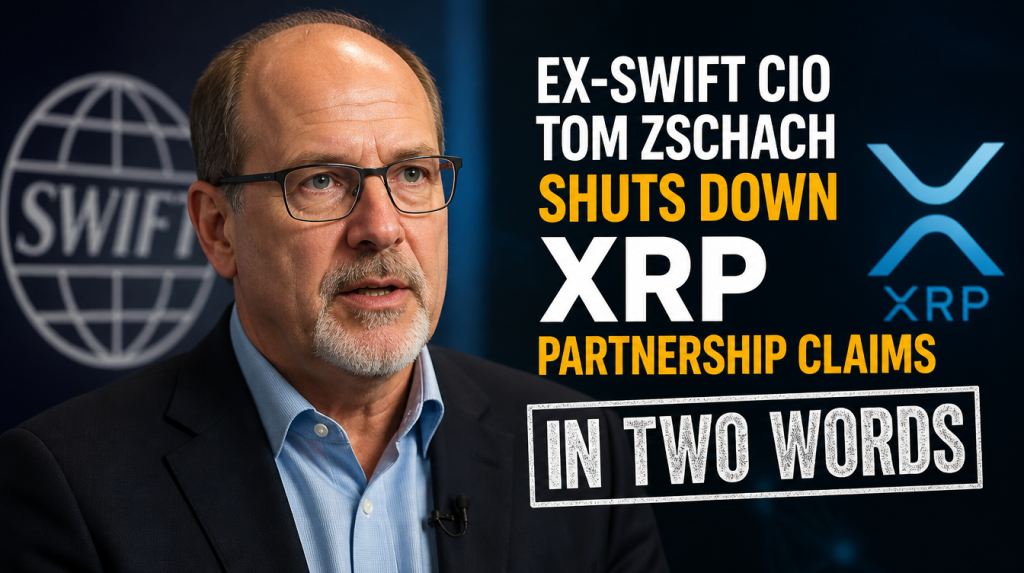
Tom Zschach, who served as SWIFT’s Chief Innovation Officer for six years before recently stepping down, dismissed renewed Ripple speculation with a blunt two-word reply on X: “Not happening.” The response carried weight given his direct role in shaping SWIFT’s digital asset strategy and his insider understanding of its direction.
His comment came after several XRP-focused influencer accounts claimed SWIFT was planning to support public cryptocurrencies like XRP rather than build its own infrastructure. These claims spread quickly online but lacked any official confirmation or supporting evidence.
One widely circulated post even suggested SWIFT had no intention of competing with XRP and would instead collaborate with it. However, no official SWIFT communication—whether a press release, statement, or document—supports that claim, indicating it likely spread without verification.
Zschach’s brief response effectively shut down the narrative before it gained further traction. While SWIFT continues exploring blockchain-based settlement and tokenization, there is no indication it plans to integrate XRP or adopt it within its core systems.
His two-word rebuttal left little room for interpretation, quickly dismantling the rumor in a way that more detailed explanations often fail to do. The situation reflects a familiar cycle: SWIFT references tokenization or interoperability, XRP communities interpret it as implicit adoption, influencers amplify the idea, and a correction eventually follows. In this case, Zschach’s direct involvement added unusual credibility to the debunking.
Zschach’s History With Ripple Claims
Zschach’s skepticism toward Ripple-related narratives is not new. He has previously likened Ripple’s technology to a “fax machine” in the modern internet era and argued that surviving a prolonged SEC case does not equate to institutional strength.
Following a career spanning Bank of America, Barclays, and Lehman Brothers, Zschach has now moved on from SWIFT to join a research initiative involving institutions such as Oxford, Harvard, and Cambridge—highlighting his focus on next-generation financial infrastructure.
What SWIFT Is Actually Building
SWIFT’s digital asset strategy is increasingly defined by interoperability, secure messaging, and tokenized assets tailored for regulated institutions. Its recent pilot programs focus on tokenized deposits within permissioned networks, rather than public blockchain ecosystems.
This distinction is key. Permissioned systems and public cryptocurrencies serve fundamentally different purposes. SWIFT is developing shared, neutral infrastructure governed collectively by financial institutions, while XRP operates as an independent public asset. Expecting the two to converge directly overlooks these structural differences.
The rumor quickly faded after Zschach publicly rejected the idea of XRP integration, and no credible evidence has emerged to support the claims. Instead, SWIFT continues to emphasize standards-based connectivity across multiple digital asset platforms, rather than backing any single token.
Market Context
Meanwhile, XRP has struggled to gain momentum, recently trading between $1.08 and $1.10 while underperforming against Bitcoin. The lack of new institutional catalysts has weighed on sentiment, and expectations tied to unverified partnerships have yet to materialize.
While XRP’s long-term outlook remains open, relying on unsupported partnership claims risks inflating expectations. For now, SWIFT and XRP appear to be developing along separate paths, despite ongoing speculation that they may eventually align.
If you want, I can shorten this into a quick 120-word news brief or a punchier version for social media.
About The Author





More Stories
Bond Volatility Surges as Bitcoin and Wall Street Remain Calm
Altcoins Surge as Bitcoin Holds Near $84,000
Bitcoin ETF Flows Turn Positive in 2026 After Erasing $5.8B Deficit