

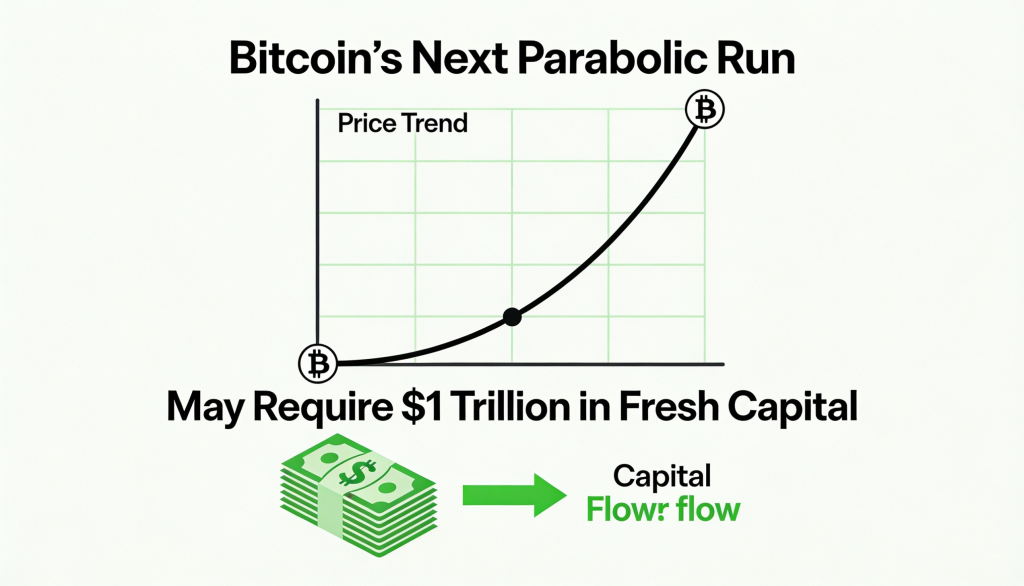
In the current cycle, roughly $697 billion in new capital has produced gains of about 689%, a stark contrast to earlier cycles where significantly smaller inflows generated returns of up to 50,000%.
Bitcoin now delivers considerably lower returns for each dollar of new capital compared to its early years, highlighting a steady decline in capital efficiency as the asset has matured and expanded in size.
Data from analytics firm CryptoQuant shows how each bitcoin bull cycle has required increasing amounts of fresh capital relative to the gains achieved. During the 2011 cycle, approximately $2.8 billion in inflows fueled a surge of around 55,000%.
By 2015, the market required about $69 billion to generate nearly 10,000% returns. The 2018 cycle saw roughly $365 billion produce gains of about 2,000%. In the current cycle, which began in 2022, inflows have reached around $697 billion, resulting in a 689% increase. These figures are based on realized capitalization, which values each bitcoin at the price it last moved, offering a more accurate estimate of actual capital invested.
This pattern is consistent across all scales. In 2011, just $5 million in new capital could double bitcoin’s price. Today, achieving the same effect requires close to $101 billion. Each successive cycle has demanded exponentially larger capital inflows for diminishing percentage returns, reflecting bitcoin’s growth into an asset with a market capitalization near $1.2 trillion, compared to just a few billion a decade ago.
CryptoQuant founder Ki Young Ju described this trend as a reason for patience rather than a signal of a market peak. He argued that bitcoin must evolve into a core macro asset rather than remain driven primarily by retail ETF flows. According to his view, another parabolic rally would likely require more than $1 trillion in new capital, implying a level of institutional adoption far beyond current levels.
This perspective comes at a challenging time. U.S. spot bitcoin exchange-traded funds have recorded significant outflows over the past month, and bitcoin has posted a negative performance for the first half of the year. Instead of strengthening, retail-driven inflows appear to be reversing, while institutional participation has yet to scale meaningfully.
A more cautious interpretation is straightforward: declining returns per dollar are a natural consequence of growth. As an asset’s size increases, percentage gains tend to compress regardless of the type of investor involved. Moreover, there is no certainty that institutional capital will enter the market at the scale required to support another major rally.
About The Author





More Stories
Bond Volatility Surges as Bitcoin and Wall Street Remain Calm
Altcoins Surge as Bitcoin Holds Near $84,000
Bitcoin ETF Flows Turn Positive in 2026 After Erasing $5.8B Deficit