

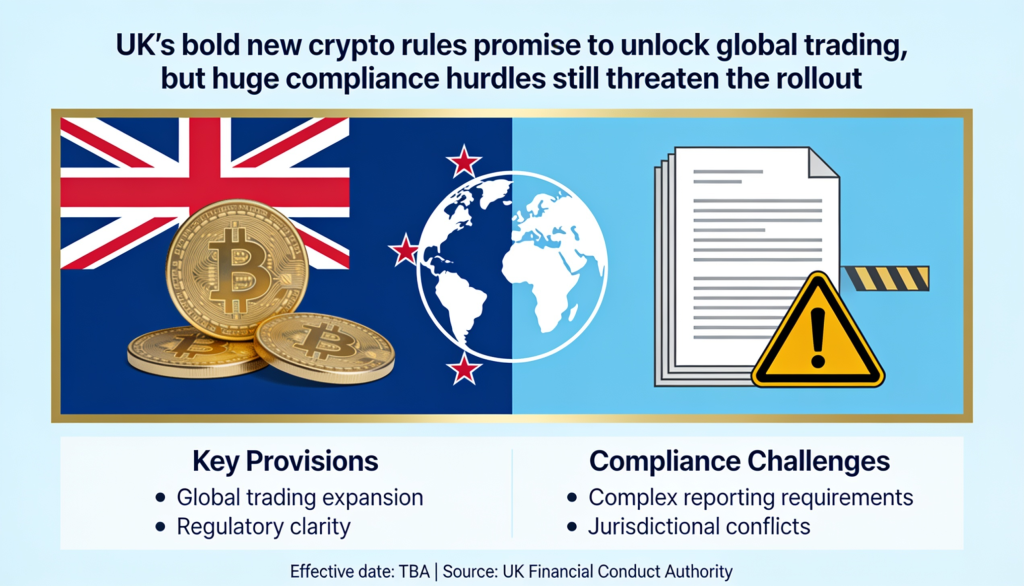
The U.K. Financial Conduct Authority’s (FCA) crypto framework has been widely commended for emphasizing global liquidity and institutional participation, though its authorization process is expected to be highly challenging.
The FCA introduced its cryptocurrency regulatory framework this week, earning early approval for its internationally integrated approach. However, industry stakeholders noted that key uncertainties still need to be addressed before the U.K. can position itself as a leading global crypto hub.
According to market participants, the FCA’s rules establish a structure that maintains access to global liquidity via offshore trading platforms and permits the circulation of stablecoins issued outside the U.K.
Katie Harries, Coinbase’s head of policy for Europe, described the release of the final rules as a significant step forward, stating that it marks a major milestone for regulatory clarity and strengthens the U.K.’s competitive position in digital asset innovation.
The FCA’s stance on global liquidity and foreign-issued stablecoins stands in contrast to the European Union’s Markets in Crypto-Assets (MiCA) framework, which many in the industry see as more protectionist, effectively encouraging firms to isolate European liquidity and operations.
In particular, the FCA’s proposed Qualifying Cryptoasset Trading Platform (QCATP) model is expected to enable overseas exchanges to serve U.K. clients through locally authorized branches linked to global trading systems, according to Christopher Collins, a financial markets and regulation partner at Katten Muchin Rosenman.
Collins explained that this approach would allow U.K. users to tap into established global liquidity pools instead of relying on segregated domestic liquidity, potentially leading to improved pricing and better outcomes for customers.
Despite these advantages, Collins cautioned that a key issue remains unresolved. While the FCA has stated that overseas branches will only be approved if their home jurisdictions offer “comparable regulatory protection,” it has not clarified which jurisdictions meet this requirement.
He emphasized that this lack of clarity makes it difficult for firms to develop viable business models, noting that greater certainty is essential before companies commit to investing in the U.K. market.
Harries also pointed to decentralized finance (DeFi) as an area lacking clarity, warning that earlier proposals could effectively block centralized platforms from providing access to DeFi services.
She stressed that the U.K.’s future stance on DeFi will be crucial, suggesting that restrictive policies could put it out of alignment with regions like the United States, where regulators are actively exploring DeFi within broader tokenization initiatives.
Beyond policy concerns, firms are also facing a rigorous authorization process. Thomas Cattee, a partner at Gherson Solicitors, warned that companies applying under the new Financial Services and Markets Act framework face a very high likelihood of failure.
He noted that even the existing anti-money laundering (AML) registration process—far more limited in scope—has proven extremely demanding, with over 85% of applications either rejected or withdrawn. The new regime introduces significantly broader requirements, including Consumer Duty obligations, prudential rules, operational resilience standards, and senior management accountability.
Cattee also advised firms not to delay their applications, referencing the rollout of MiCA in Europe, where last-minute submissions led to licensing bottlenecks and left some firms without authorization.
For institutional investors, the framework represents more than just another set of crypto regulations. Sandy Jones, director of digital assets at Baillie Gifford, noted that while regulation does not inherently make crypto safer, it provides the legal certainty and governance standards necessary for traditional financial institutions to adopt blockchain infrastructure.
He added that although the underlying technology is powerful, it cannot independently bridge the gap to mainstream financial markets without legal clarity, operational robustness, proper governance, and recognized regulatory standards.
Jones also welcomed the FCA’s updates to its stablecoin framework, stating that they support the development of strong settlement infrastructure without adding unnecessary operational burdens.
Overall, industry feedback suggests the FCA has intentionally positioned the U.K. as a commercially pragmatic alternative to the EU’s MiCA regime. However, whether this strategy will attract firms to the U.K. will depend less on the framework’s ambition and more on the consistency and predictability of its implementation in the months ahead.
The key challenge will be ensuring that regulatory uncertainties and a demanding authorization process do not undermine the U.K.’s potential competitive advantages before they can fully materialize.
About The Author





More Stories
Bitcoin Holds Near $64K as Higher Yields and Oil Pressure Stocks
Bitcoin Outpaces S&P 500 as BTC Gains 2.6% While Stocks Slide
Bitcoin’s $62K Zone Could Trigger a Leveraged Long Flush