

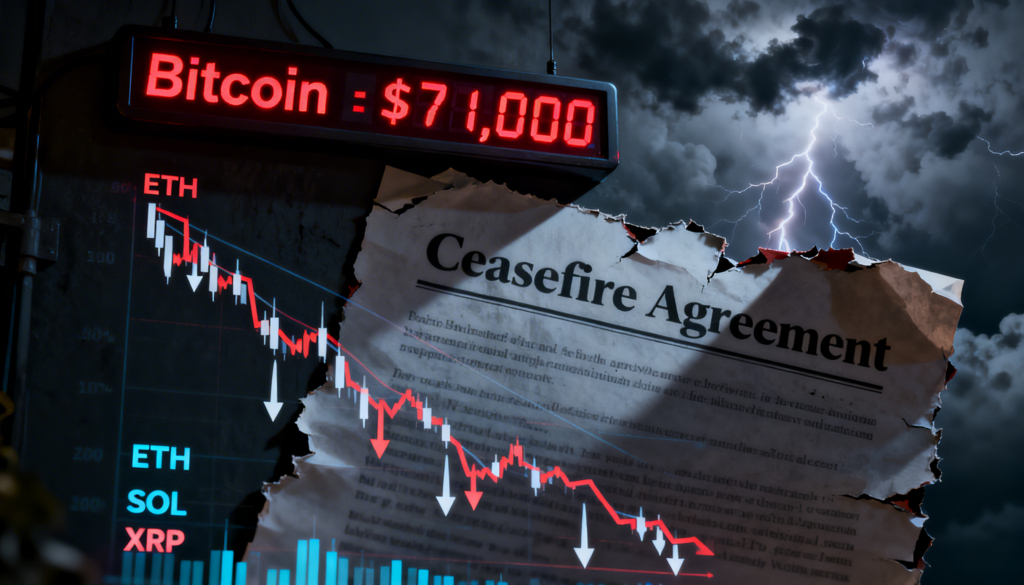
Signs of strain are already emerging in the U.S.-Iran ceasefire, just 48 hours after it was announced, adding fresh uncertainty across global markets.
Tehran has flagged alleged violations of the agreement, with Iranian Parliament Speaker Mohammad Bagher Ghalibaf stating that three clauses of the deal had been breached, though without providing specifics. At the same time, Israeli strikes in Lebanon have continued, while the Strait of Hormuz—the key shipping route expected to reopen under the agreement—remains largely shut, with only limited tanker activity despite Iran’s pledge to allow coordinated transit.
The shift in sentiment has been swift. Brent crude rebounded 2% to around $97 after plunging more than 10% the previous session, its steepest single-day drop in six years. The reversal underscores how quickly markets have moved from pricing in de-escalation to factoring in renewed geopolitical risk.
Bitcoin (BTC) traded at $70,981, down 0.5% over the past 24 hours but still up 6.1% on the week. The cryptocurrency had rallied earlier on ceasefire optimism, climbing from roughly $67,000 to above $72,000, and has so far managed to hold above the $70,000 level despite the latest volatility.
Altcoins, however, showed more weakness. Ether fell 2.6% to $2,180 after leading the earlier rally, while Solana (SOL) dropped 3.1% to $81.96. XRP declined 3% to $1.33, and Dogecoin slid 3.4% to $0.091. BNB was relatively resilient, slipping 2.2% to trade near $600.
Traditional markets also turned lower. The MSCI Asia Pacific Index declined 0.9%, with losers outnumbering gainers two-to-one, following a sharp rally the previous day. Futures for the S&P 500 and European equities pointed to a modest 0.2% pullback, suggesting a pause in the recent global equity rebound. U.S. Treasuries were steady after earlier gains faded amid concerns that rising oil prices could add to inflation pressures.
Macro conditions remain complex. The Federal Reserve continues to emphasize upside inflation risks even as labor market conditions soften, reinforcing expectations that interest rates will stay elevated for longer. In Japan, wage growth has reached multi-decade highs, increasing the likelihood of further rate hikes.
Together, these dynamics point to a backdrop of tightening financial conditions across major economies, compounded by geopolitical uncertainty that complicates the outlook for interest rates.
For bitcoin, the recent price action remains relatively constructive. The move from $67,000 to $72,700 on ceasefire news—and the subsequent hold above $70,000—marks its strongest performance since the conflict began six weeks ago.
The broader trading range between $65,000 and $73,000, which has capped price action since late February, remains intact. However, bitcoin is now testing the upper end of that range rather than hovering near its lower boundary—a shift that could prove significant if support continues to hold.
About The Author


More Stories
Bitcoin Starts New Quarter Stuck in Familiar $82K-$85K Range
Citigroup Lifts 12-Month Bitcoin Target to $113K as ETF Inflows Return
Bitcoin’s Inflation-Fueled Jump to $85.5K Fades as Yields Stay High