

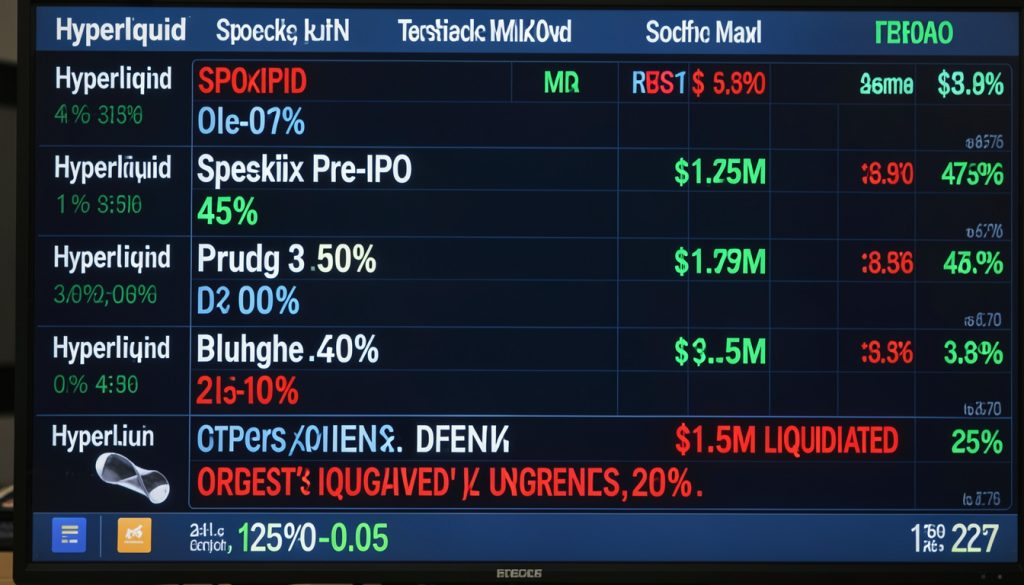
A sharp selloff in a SpaceX-linked crypto contract triggered a wave of retail liquidations, highlighting how thin liquidity can amplify price dislocations in synthetic markets.
Hyperliquid’s SPACEX-USDH perpetual contract saw a violent flash crash on Thursday, falling from an opening level of $2,277 to a low of $1,254 in around 30 minutes — a near 45% drop — before partially rebounding to roughly $2,169. Hyperliquid data shows the move liquidated 405 users across 1,393 positions, wiping out about $1.51 million in notional value.
The scale of the move was intensified by extremely shallow market depth. In the 24 hours prior, the contract had generated only $4.87 million in total trading volume against open interest of less than $2.9 million, leaving limited liquidity to absorb aggressive selling pressure. When the unwind began, the order book was quickly overwhelmed, accelerating the cascade.
Positioning data suggests a retail-dominated user base. The median liquidated account held just $31 in margin, indicating small-sized accounts using leverage that offered little protection against rapid downside moves.
The SPACEX-USDH contract is a synthetic perpetual designed to track market expectations for SpaceX’s private valuation. Since SpaceX is not publicly listed, traders use the instrument to speculate on implied valuation ahead of any future IPO.
Unlike perpetual futures tied to liquid assets such as bitcoin or ether, the contract has no deep public spot market anchor. While SpaceX shares do trade in restricted secondary markets, access is limited to accredited investors, leaving the crypto derivative without a broad external pricing reference.
At settlement, the contract’s mark price of $2,132 remained more than $220 above the oracle reference level of $1,908, suggesting that even after the liquidation event, the market continued to price the contract at a premium relative to its external valuation benchmark.
About The Author





More Stories
Bond Volatility Surges as Bitcoin and Wall Street Remain Calm
Altcoins Surge as Bitcoin Holds Near $84,000
Bitcoin ETF Flows Turn Positive in 2026 After Erasing $5.8B Deficit