

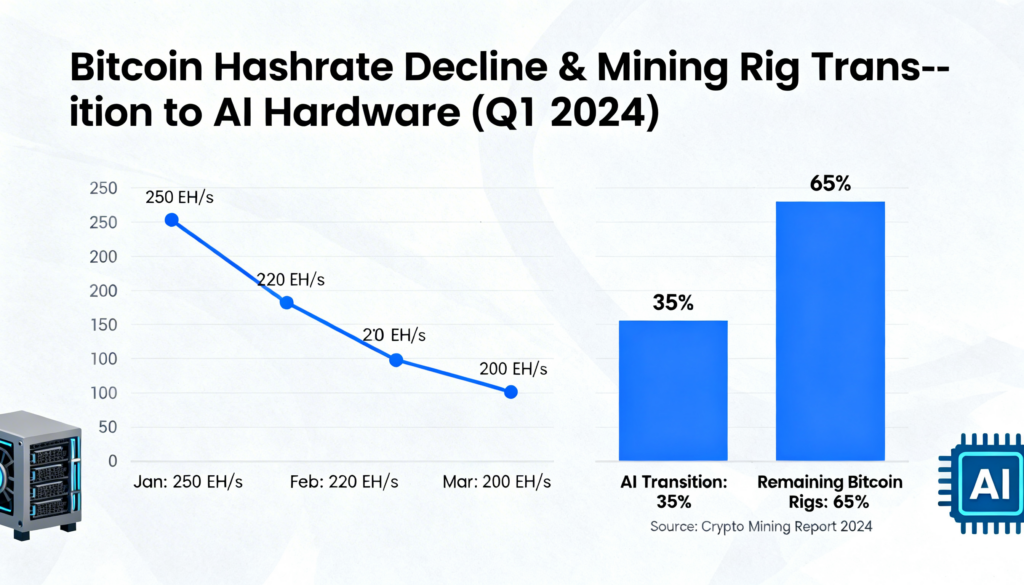
Bitcoin’s hashrate has recorded its first first-quarter decline in six years, breaking a long-standing growth pattern — though the trend shift could ultimately enhance network decentralization.
Currently hovering around 1 zettahash per second (ZH/s), the network’s total computational power is down roughly 4% year-to-date, according to Glassnode. Over the past five years, hashrate surged tenfold from roughly 100 exahashes per second (EH/s), with first-quarter gains historically fueling full-year growth above 10%. In 2022, the network’s power nearly doubled.
The slowdown in 2026 reflects shifting economics in the bitcoin mining sector. Production costs are near $90,000 per BTC, while spot prices linger around $67,000, creating negative margins. Many publicly listed U.S. miners are responding by pivoting toward artificial intelligence and high-performance computing operations, where returns are higher and more predictable.
This transition is being funded through debt and bitcoin sales, leaving less capital for reinvestment in mining operations. Consequently, hashrate growth has become more price-sensitive, and further BTC weakness could push smaller miners out of the market.
While a declining hashrate may raise network security concerns, decentralization could be the more critical factor. Publicly listed U.S. miners currently account for over 40% of global hash power, and a reduction in their dominance may lead to a more geographically distributed network, supporting long-term resilience.
Despite the first-quarter dip, CoinShares projects bitcoin’s hashrate could reach around 1.8 ZH/s by the end of 2026, assuming BTC climbs toward $100,000.
About The Author





More Stories
Bitcoin Starts New Quarter Stuck in Familiar $82K-$85K Range
Citigroup Lifts 12-Month Bitcoin Target to $113K as ETF Inflows Return
Bitcoin’s Inflation-Fueled Jump to $85.5K Fades as Yields Stay High