

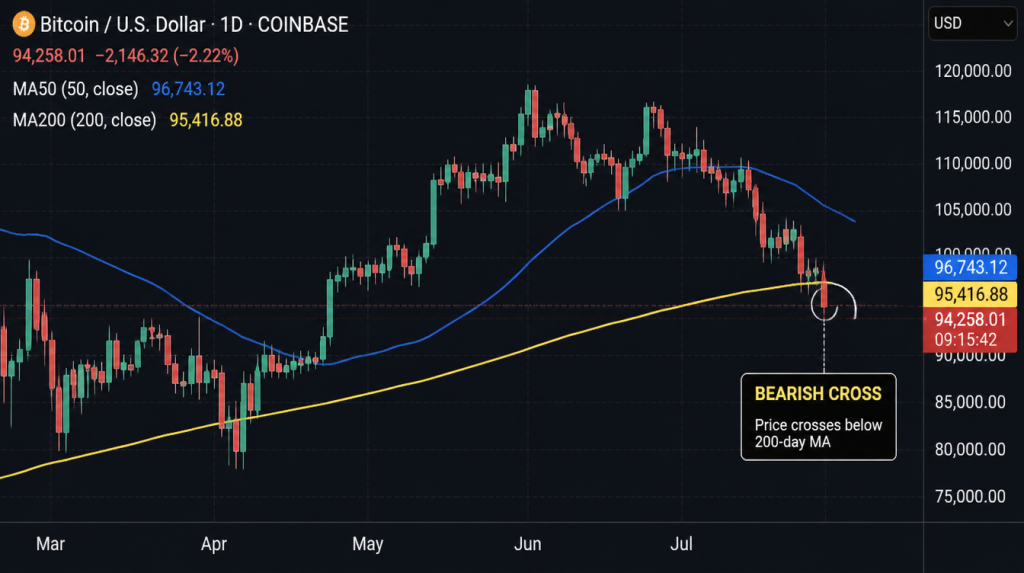
Bitcoin has turned lower after failing to sustain momentum above its 200-day moving average, a key long-term trend indicator closely watched by traders. Market analysis from CryptoQuant points to fading support behind the recent rally as the main reason for the reversal.
Bitcoin’s rebound from its February lows had started to resemble the early stages of a broader bullish phase, but that narrative weakened when price action hit resistance at the 200-day simple moving average (SMA) near $82,000. After being rejected at that level, Bitcoin slipped back toward $77,500. The pattern is similar to 2022, when a strong relief rally of roughly 43% also stalled at the same technical level before the broader downtrend resumed.
According to CryptoQuant, the rally that developed through April and early May was driven by three main forces: leveraged futures positioning, strong spot demand, and consistent inflows into U.S. spot Bitcoin ETFs. However, the firm notes that each of these supports has recently begun to weaken, leaving the market more vulnerable to downside pressure.
Sentiment has also deteriorated, reflected in CryptoQuant’s Bull Score Index, which has dropped sharply from 40 to 20. The firm classifies this level as “extremely bearish,” a zone previously seen during the February–March consolidation period when Bitcoin traded between $60,000 and $66,000.
A key signal of weakening demand is the Coinbase Bitcoin premium, which has remained negative throughout both the rally and the recent pullback. This metric compares Bitcoin prices on Coinbase with offshore exchanges, and a sustained negative reading suggests U.S. buyers are no longer paying a premium, signaling softer domestic demand.
Institutional flows are echoing this shift. Data from SoSoValue shows that U.S. spot Bitcoin ETFs recorded around $979.7 million in net outflows for the week ending May 19, following roughly $1 billion in withdrawals the week prior. This marks a clear reversal from six consecutive weeks of inflows that had previously fueled the uptrend.
Weakness is also visible across Asian markets. Korea’s “kimchi premium,” a gauge of local Bitcoin demand, has turned negative, indicating reduced buying pressure on domestic exchanges. Meanwhile, Hong Kong’s spot Bitcoin ETFs—managed by ChinaAMC, Bosera HashKey, and Harvest—have seen relatively low activity, with only modest daily trading volumes throughout May.
Looking ahead, CryptoQuant identifies $70,000, based on traders’ realized price, as the next major on-chain support level. Historically, this zone has acted as a key inflection point, capping moves in prior cycles and now potentially serving as a crucial area to watch if the correction deepens.
About The Author





More Stories
Bitcoin Starts New Quarter Stuck in Familiar $82K-$85K Range
Citigroup Lifts 12-Month Bitcoin Target to $113K as ETF Inflows Return
Bitcoin’s Inflation-Fueled Jump to $85.5K Fades as Yields Stay High