

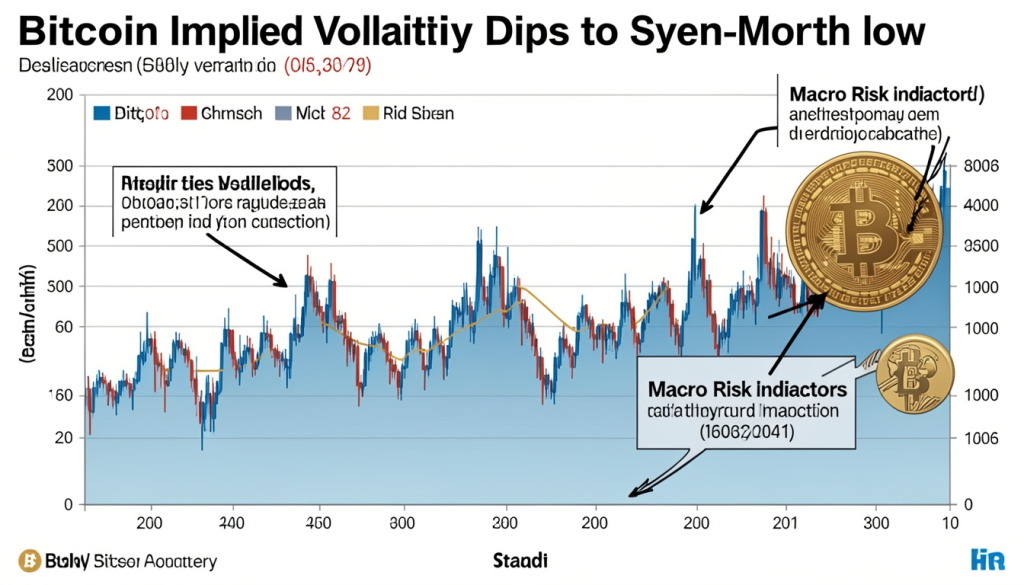
Bitcoin’s implied volatility is pointing to unusually calm conditions, even as broader financial markets continue to flag macroeconomic and geopolitical risks.
Despite persistent concerns over inflation, interest rates, and global tensions, Bitcoin’s BTC $75,432.14 volatility profile suggests traders are positioning for relatively subdued price action in the near term.
The 30-day annualized implied volatility index (BVIV) has continued its downward trend, falling to 38%—the lowest level since October 2025—according to Volmex data. In options markets, a declining implied volatility reading typically reflects expectations of smaller price swings ahead.
“Bitcoin volatility has collapsed, and you can see it clearly in BVIV levels, which we track closely to monitor market complacency,” said Shiliang Tang, Managing Partner at Monarq Asset Management.
Tang pointed to a combination of fading geopolitical anxiety and structural market dynamics behind the move. He noted that risks tied to the Iran conflict appear to be easing, while sustained Bitcoin accumulation by Strategy (MSTR) and its STRC-linked structure is helping reinforce a perceived price floor.
Another key factor, he said, is the influence of systematic “call overwriters.” This strategy involves selling out-of-the-money call options to generate yield on top of spot holdings. With Bitcoin trading near $77,300, these participants typically sell calls above current levels, limiting upside volatility while collecting premium income.
Institutional allocators using these yield-enhancement strategies have become a steady source of options supply, which in turn compresses implied volatility and reduces expectations for large directional moves.
“Because Bitcoin has underperformed other risk assets on the upside, systematic overwriters are aggressively selling options for yield, keeping a heavy lid on the entire volatility complex,” Tang added.
Bitcoin is currently trading near $77,000, while crude oil—often used as a proxy for geopolitical stress—remains relatively contained, with WTI below the $100-per-barrel level.
On the demand side, Strategy has accumulated 171,238 BTC in 2026, well above the roughly 63,450 BTC mined during the same period. That imbalance continues to signal strong institutional demand and tightening effective supply.
More broadly, Bitcoin’s declining volatility reflects its ongoing evolution into a more institutionalized asset class. As ETF participation, corporate holdings, and asset manager exposure expand, deeper liquidity and broader ownership are helping to dampen the extreme price swings seen in earlier market cycles.
About The Author





More Stories
Bitcoin Starts New Quarter Stuck in Familiar $82K-$85K Range
Citigroup Lifts 12-Month Bitcoin Target to $113K as ETF Inflows Return
Bitcoin’s Inflation-Fueled Jump to $85.5K Fades as Yields Stay High