

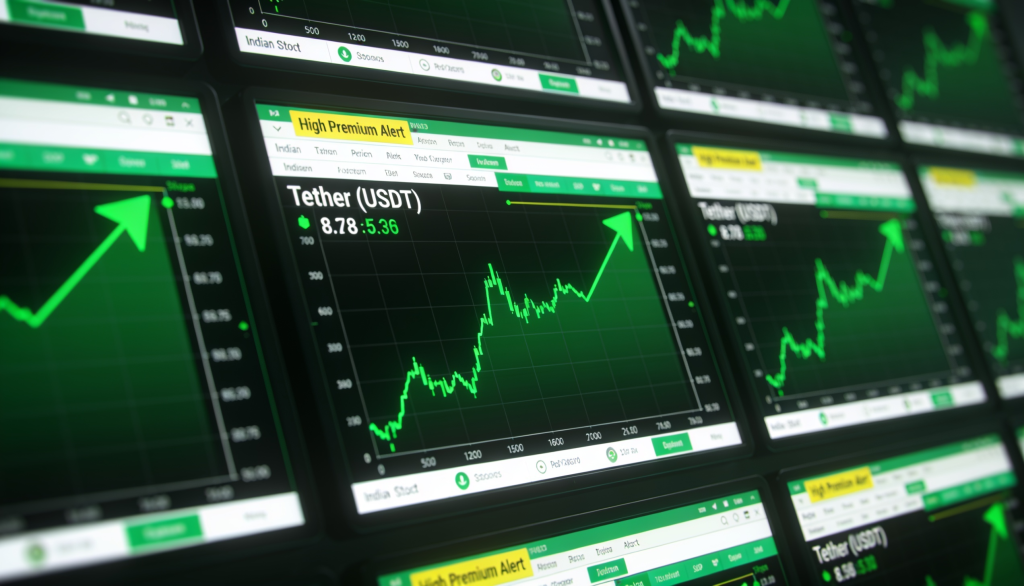
Executives at leading Indian exchanges CoinDCX and CoinSwitch say the elevated USDT premium is primarily driven by an imbalance between demand and supply, compounded by limited local liquidity.
Tether (USDT), the largest dollar-backed stablecoin globally, is currently trading significantly above its peg on Indian platforms. While some local reports linked the surge to recent enforcement activity, exchanges argue the pricing reflects basic market dynamics.
Over the weekend, USDT traded at a premium of roughly 7% to 10% above its dollar value in India. At one stage, it was priced near ₹102.88, compared to an official exchange rate of about ₹94.65 per dollar. Typically, this premium ranges between 3% and 4%, representing the extra cost buyers are willing to pay for dollar exposure via crypto rather than traditional banking channels.
The recent spike followed action by Enforcement Directorate related to USDT-linked transactions, according to reports. However, exchanges maintain that the premium is largely a function of supply constraints.
Minal Thukral of CoinDCX explained that USDT pricing in India is determined by local order-book depth in relation to global dollar benchmarks. With India historically being a net buyer of crypto, demand in rupee terms often exceeds available sell-side liquidity. When liquidity near global price levels is thin, prices naturally adjust higher.
In simple terms, there are more buyers seeking USDT than sellers willing to provide it at international rates. As this gap widens, prices rise until a new equilibrium is reached.
Ashish Singhal, co-founder and CEO of CoinSwitch, emphasized that the premium is not unique to any single platform and is not set by exchanges themselves. Instead, it reflects broader market conditions, including liquidity constraints and the availability of dollar-backed digital assets.
He noted that similar premiums have appeared in other markets during periods of strong demand or restricted liquidity. On CoinSwitch, USDT has traded at around a 9% premium in recent days, consistent with trends across Indian exchanges.
Singhal also clarified that pricing on exchanges is entirely market-driven, with users seeing real-time buy and sell rates before executing trades. The premium, he said, is a reflection of prevailing conditions rather than any hidden fees or platform-imposed markup.
Both CoinDCX and CoinSwitch attribute the elevated premium to organic market forces—strong demand, limited supply, and reduced liquidity near global price levels—rather than exchange-driven pricing.
While neither executive directly commented on the impact of the Enforcement Directorate’s actions, the resulting supply constraints may have played a role. Market makers could have scaled back sourcing USDT from overseas following the regulatory move, effectively tightening supply.
Additionally, India’s regulatory environment—featuring a flat 30% tax on crypto gains, no loss offsets, and a 1% tax deducted at source—has historically made operations more challenging for liquidity providers, contributing to persistent market inefficiencies.
About The Author




More Stories
Bitcoin Starts New Quarter Stuck in Familiar $82K-$85K Range
Citigroup Lifts 12-Month Bitcoin Target to $113K as ETF Inflows Return
Bitcoin’s Inflation-Fueled Jump to $85.5K Fades as Yields Stay High