

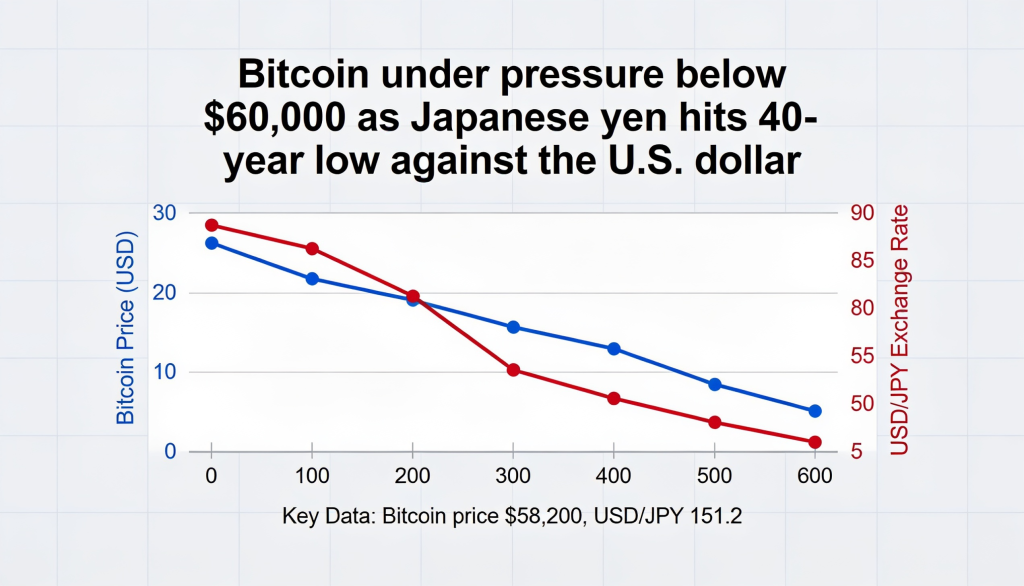
Bitcoin News: Bitcoin declined during Asian trading hours as the Japanese yen dropped to its weakest level in four decades, boosting the U.S. dollar and adding pressure across global markets.
The world’s largest cryptocurrency fell more than 1% on Tuesday, with BTC slipping below the $60,000 mark as the yen weakened sharply against the dollar, fueling volatility in foreign exchange markets.
Bitcoin remained under its key 200-week simple moving average, a level widely watched by traders as a long-term support indicator.
Meanwhile, Strategy, the largest publicly traded holder of Bitcoin, announced on Monday that it had approved plans to repurchase up to $1 billion of both its preferred shares and Class A common stock. At the same time, the company introduced a $1.25 billion “Bitcoin Monetization Program,” signaling potential BTC sales to raise capital. The move suggests the firm could offload more than $1 billion worth of Bitcoin into an already fragile market—marking a stark departure from founder Michael Saylor’s long-held stance of never selling BTC.
However, some analysts argue that this shift may not resolve underlying challenges. Strategy’s preferred stock, STRC—previously a key yield-generating instrument—has dropped sharply in recent weeks, undermining a crucial funding avenue for further Bitcoin accumulation.
Jeff Dorman, Chief Investment Officer at Arca, commented that the situation merely delays deeper structural issues. He noted that capital structure challenges are likely to resurface unless Bitcoin experiences a significant rally, adding that past decisions, such as reducing debt, may have contributed to substantial enterprise value erosion.
Yen Weakness Intensifies
The Japanese yen fell to 162.40 per U.S. dollar, its lowest level since October 1986. The sharp decline has strengthened the dollar broadly, with the Dollar Index climbing to 101.32 after hovering near 101 in the previous session.
While the yen’s decline has been ongoing, the pace has accelerated in recent years. Since 2021, the currency has lost roughly 57% against the dollar, largely due to diverging monetary policies. The U.S. Federal Reserve previously raised interest rates above 5%, while Japan maintained near-zero rates. Although the Bank of Japan has recently increased rates to around 1%, they remain significantly below U.S. levels, currently near 3.5%.
Analysts view the yen’s weakness as a reflection of Japan’s broader fiscal challenges. With a debt-to-GDP ratio exceeding 220%, aggressive rate hikes could trigger financial instability, while maintaining low rates continues to weigh on the currency.
For now, Japanese authorities have relied primarily on verbal interventions to slow the decline, while the Bank of Japan’s tightening stance has yet to fully materialize. Some market participants warn that any decisive policy shift could lead to a rapid unwinding of yen-funded carry trades, potentially putting pressure on global risk assets, including equities, bonds, and cryptocurrencies.
About The Author





More Stories
Bitcoin Starts New Quarter Stuck in Familiar $82K-$85K Range
Citigroup Lifts 12-Month Bitcoin Target to $113K as ETF Inflows Return
Bitcoin’s Inflation-Fueled Jump to $85.5K Fades as Yields Stay High