

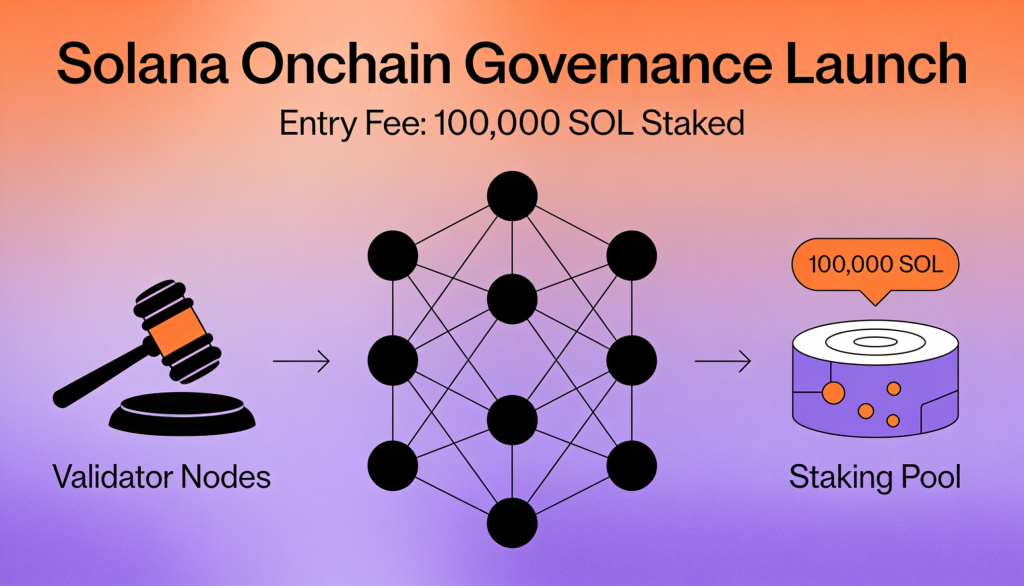
Solana validators and their delegators can now formally signal the network’s direction through a new framework called Solana Governance Proposals (SGPs). Validators backed by at least 100,000 SOL can submit proposals, while stakers have the ability to override how their validator votes.
The programmable blockchain has rolled out its first structured onchain governance system, according to its GitHub repository, giving both validators and token holders a direct and transparent say in shaping the network’s future.
Under the new SGP model, validators with a minimum of 100,000 SOL (around $7.7 million) staked can put forward proposals that outline major strategic decisions. The system effectively introduces shareholder-style voting, where influence is determined by the amount of SOL staked.
Each proposal is framed as a straightforward, high-level question about the network’s direction. Voting power is weighted by stake, with results recorded onchain and verified using a Merkle proof, ensuring accuracy without requiring a full recount.
The framework separates governance into two distinct layers. SGPs focus on the broader question — “Should this be done?” — while a separate mechanism, Solana Improvement Documents (SIMDs), handles the technical implementation details, answering “How should it be done?”
If an SGP is approved, it serves as a clear mandate to move forward, with developers then drafting one or more SIMDs to execute the decision.
Proposals do not go directly to a vote. They must first meet a support threshold of 15% of active stake to advance to a formal ballot, a filter designed to ensure only meaningful issues are put to a network-wide vote while allowing routine updates to proceed without governance friction.
Once this threshold is reached, voting unfolds over Solana’s epoch-based schedule, with each epoch lasting roughly two days.
To pass, a proposal must secure a two-thirds supermajority of participating stake, with abstentions excluded from the calculation. There is no minimum turnout requirement.
A notable feature of the system is the increased authority granted to delegators — users who stake their SOL with validators rather than operating nodes themselves. These participants can override their validator’s vote or cast a vote if the validator abstains, with their influence proportional to their own stake.
The Solana Foundation describes this model as “staker sovereignty,” ensuring that voting power ultimately remains with token holders rather than being fully controlled by validators.
The governance rollout comes amid renewed momentum for Solana, with SOL rising about 16% over the past week to around $78, making it one of the few major tokens to post gains while the broader market declined.
About The Author





More Stories
Bitcoin Starts New Quarter Stuck in Familiar $82K-$85K Range
Citigroup Lifts 12-Month Bitcoin Target to $113K as ETF Inflows Return
Bitcoin’s Inflation-Fueled Jump to $85.5K Fades as Yields Stay High