

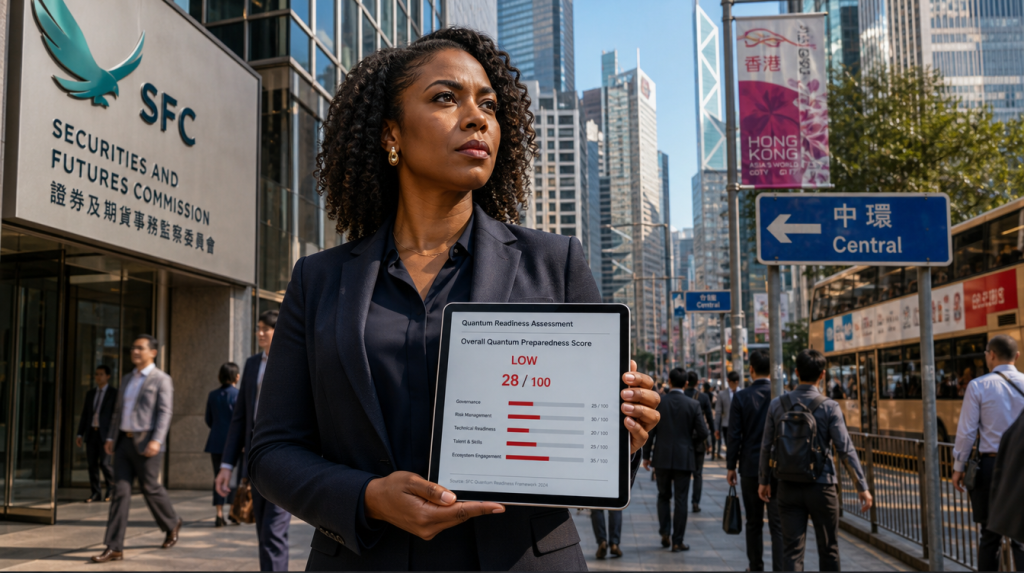
The Hong Kong Monetary Authority (HKMA) has released a whitepaper examining the banking sector’s preparedness for quantum computing, along with the introduction of its first Quantum Preparedness Index.
Hong Kong’s central bank has issued a warning about the financial industry’s limited readiness for the coming quantum computing era.
On Monday, the HKMA published its assessment of how prepared local banks are for quantum-related challenges, including the first-ever score from its Quantum Preparedness Index.
The result was far from encouraging, with the banking sector receiving a score of just 2.3 out of 10.
At this stage, Hong Kong’s banks are only beginning to understand the potential risks posed by quantum technology, even as cybersecurity experts warn that the transition to the quantum era may arrive sooner than many institutions expect.
The report, introduced during the eighth FiNETech conference and based on a survey conducted earlier this year, found that awareness of quantum risks is increasing, but meaningful preparation remains limited.
Around 68% of surveyed banks had either developed some level of awareness or entered planning and pilot phases. However, the remaining institutions had not yet begun their preparation efforts. Nearly half of the banks have yet to create a formal strategy for transitioning to post-quantum cryptography. While about half had discussed quantum risks at the board level, only one-third had started experimenting with or testing quantum-related solutions.
Overall, Hong Kong’s banking industry remains focused on early-stage planning rather than developing operational quantum capabilities. The index tracks four stages of readiness: awareness, planning, pilot initiatives, and practical implementation.
Quantum preparedness is becoming increasingly important because quantum computers could eventually threaten the encryption systems that protect modern financial infrastructure. Banks are particularly exposed to “harvest now, decrypt later” attacks, a risk highlighted by the Bank for International Settlements’ Project Leap as a potential threat to global financial security.
Under this type of attack, malicious actors collect encrypted financial information today and store it until future quantum computers become powerful enough to decrypt the data. Blockchain networks such as Bitcoin and Ethereum face similar concerns, creating potential long-term security challenges for digital assets and traditional finance.
Although quantum machines capable of breaking current banking systems or blockchain encryption do not currently exist, some estimates suggest such capabilities could become possible as early as 2029.
The HKMA has set a goal of achieving a perfect 10 score on its Quantum Preparedness Index by 2030. To support that target, the regulator is developing practical resources, including a post-quantum cryptography toolkit in partnership with the Hong Kong University of Science and Technology’s business school. It also plans to organize workshops aimed at helping banks strengthen expertise, improve cryptographic flexibility, and explore quantum technologies safely.
Hong Kong is not the only jurisdiction preparing for this challenge. U.S. President Donald Trump recently signed two executive orders related to quantum technology. One focuses on accelerating American quantum computing development, with the goal of creating advanced systems for scientific research by 2028. The other directs federal agencies to transition toward post-quantum cryptography between 2030 and 2031.
About The Author





More Stories
CFTC Warns Prediction Platforms of Manipulation Risks in ‘Mention Markets’
Lummis Says Trump Opposition Helped Derail Crypto Clarity Act
XRP Ledger Retries Upgrade Designed to Split Payments and Compliance Roles