

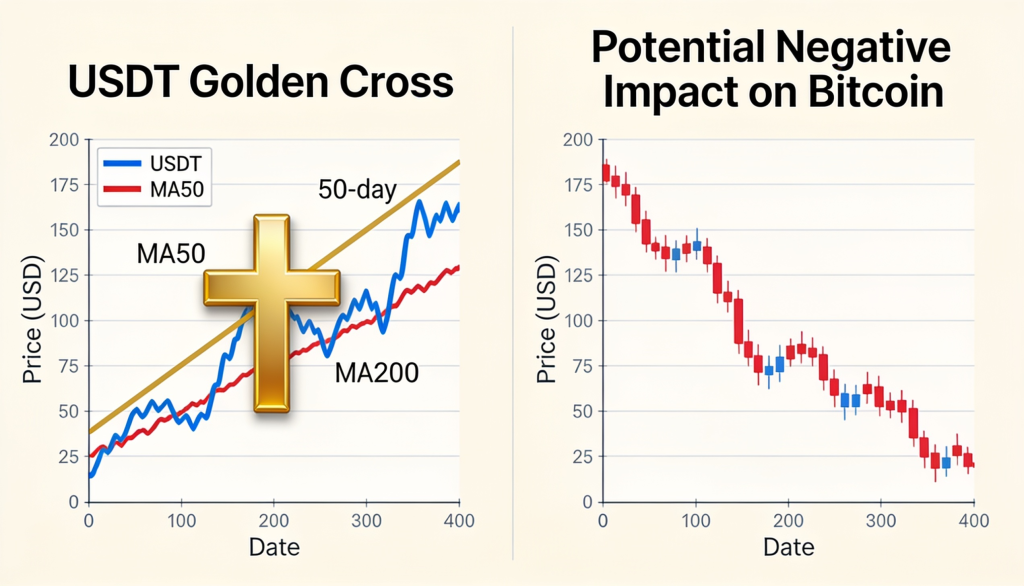
USDT dominance has flashed a golden cross, a signal that may point to caution across the wider crypto market.
A closely watched momentum indicator has appeared on Tether’s USDT dominance chart, suggesting a shift in capital flows may be underway.
This could be a negative development for Bitcoin, the largest cryptocurrency by market capitalization.
USDT dominance—its share of the total crypto market cap—has formed a golden cross, a technical pattern often interpreted as a sign that allocation toward stablecoins could increase in the coming weeks.
Such a setup is typically viewed as bearish for Bitcoin, as it implies investors are rotating funds into dollar-pegged assets rather than taking exposure to riskier crypto positions.
To understand the impact, it helps to consider USDT’s role in the broader crypto ecosystem.
With a market capitalization of roughly $186.84 billion, Tether’s USDT is among the largest digital assets, second only to Bitcoin and Ether. It is designed to maintain a 1:1 peg with the U.S. dollar, effectively serving as tokenized cash.
Central role in trading activity
USDT is the primary settlement and funding currency across crypto markets, widely used for trading, DeFi lending, and borrowing strategies.
Its dominance tends to rise during Bitcoin selloffs, as capital moves away from volatile assets into stable value storage—similar to a risk-off rotation in traditional finance.
That pattern was recently evident when USDT dominance jumped 13.5% to 9% in a single day, its strongest rise since March 2025, while Bitcoin fell nearly 14% and briefly dropped below $60,000.
The golden cross—where the 50-week moving average rises above the 200-week average—suggests this rotation may continue, indicating strengthening momentum in USDT’s market share.
This reflects increasing risk aversion in crypto markets, which could lead to further inflows into stablecoins.
However, capital parked in stablecoins does not always return to crypto markets; in some cases, it is converted back into fiat and exits the ecosystem entirely.
Recent data supports this view, as USDT’s market cap has declined for three consecutive weeks even as its dominance has risen, suggesting that some capital may be leaving crypto altogether.
The signal also comes amid Bitcoin’s weakest weekly performance in months, continued outflows from U.S. spot ETFs, and growing competition from AI-related equities for institutional capital.
Taken together, these factors point to a broader cooling in risk appetite rather than a temporary pause.
Unless USDT dominance begins to reverse—signaling renewed inflows into risk assets—Bitcoin and the wider crypto market may remain under downward pressure.
About The Author





More Stories
Bitcoin Starts New Quarter Stuck in Familiar $82K-$85K Range
Citigroup Lifts 12-Month Bitcoin Target to $113K as ETF Inflows Return
Bitcoin’s Inflation-Fueled Jump to $85.5K Fades as Yields Stay High