

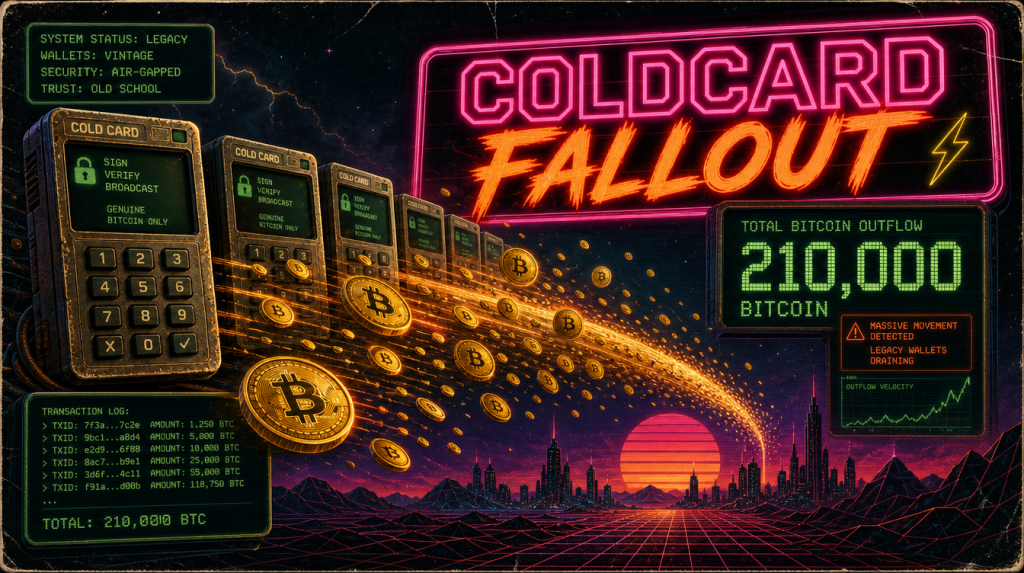
Around 200,000 BTC have exited long-term holder wallets over the past week, pointing more toward a potential shift in custody arrangements than traditional market selling.
The impact of the Coldcard security breach is beginning to appear in blockchain data.
Glassnode data shows that approximately 210,000 BTC have moved out of long-term holder (LTH) wallets in the last seven days, marking the largest decline in this category since December 2024, when Bitcoin was nearing its first move toward the $100,000 level.
Glassnode defines long-term holders as entities that have held their Bitcoin for at least 155 days, or roughly five months. This group is often viewed as “smart money” because these investors typically maintain their positions through short-term market fluctuations.
Long-term holder supply currently sits near 14.7 million BTC. Before the Coldcard incident, the figure was close to 15 million BTC, approaching its highest level ever recorded.
Historically, significant selling activity from long-term holders has often appeared during periods of strong market rallies or near cycle peaks. Previous distribution waves occurred around Bitcoin market highs in March 2021, March 2024, and December 2024, as experienced investors took profits during periods of rising demand.
This latest movement, however, is happening while Bitcoin remains near lower price levels. The cryptocurrency is trading around $64,000, approximately 50% below its October record high.
The current outflow from long-term holder wallets does not necessarily represent profit-taking. Instead, it may reflect investors changing how they store their Bitcoin following the Coldcard security issue. Notably, Bitcoin did not fall to new lows after the breach.
The exploit was linked to weak randomness in certain Coldcard firmware versions, allowing attackers to potentially recover wallet seed phrases and steal funds. Thousands of addresses were impacted, with estimated losses reaching up to $114 million. Coldcard advised affected users to create new wallets and transfer their holdings, explaining that firmware updates alone cannot protect keys that may already have been exposed.
As a result, part of the decline in long-term holder supply may be due to users moving their BTC into newly created wallets with improved security measures. Some investors may also be transferring assets to regulated custodians or spot Bitcoin ETFs as they reassess the risks associated with self-custody.
ETF activity provides additional evidence of continued demand. U.S. spot Bitcoin ETFs recorded roughly $754 million in inflows over the past week, with BlackRock’s iShares Bitcoin Trust (IBIT) receiving the majority of the capital.
The key takeaway is that on-chain transfers do not automatically indicate selling pressure. In this case, the drop in long-term holder supply may represent a broader transition in Bitcoin custody practices rather than a loss of investor confidence.
About The Author





More Stories
CFTC Warns Prediction Platforms of Manipulation Risks in ‘Mention Markets’
Lummis Says Trump Opposition Helped Derail Crypto Clarity Act
XRP Ledger Retries Upgrade Designed to Split Payments and Compliance Roles