

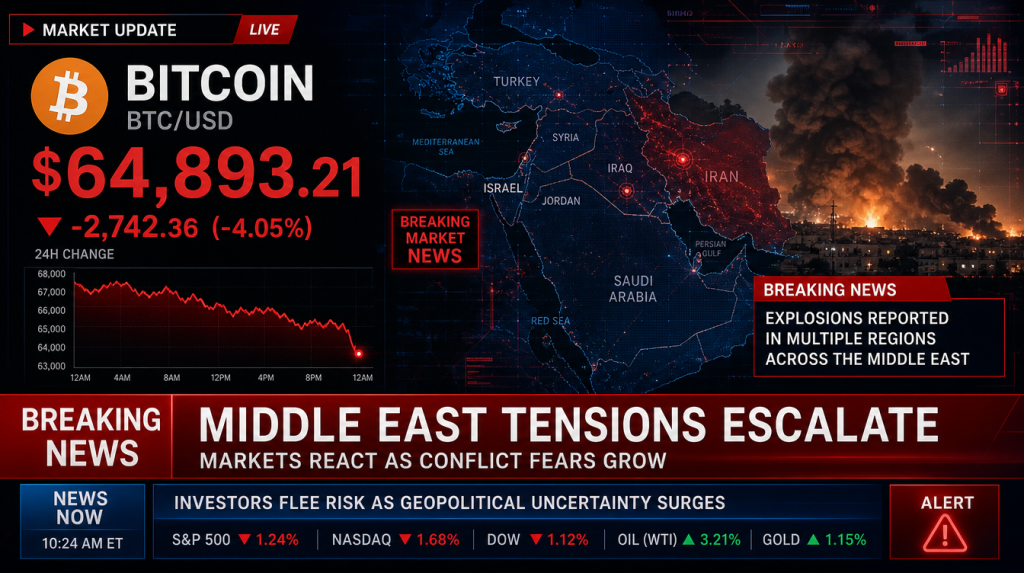
Bitcoin remained largely stable below the $65,000 mark on Friday as investors monitored rising geopolitical risks and shifting market dynamics.
Bitcoin was trading near $64,700, showing little movement over the previous 24 hours, while the broader CoinDesk 20 (CD20) index slipped 0.2% during the same period.
Meanwhile, Brent crude prices climbed above $83 per barrel after Iran-backed Houthi forces from Yemen launched an attack on Saudi Arabia, adding to growing instability in the Middle East.
U.S. Treasury yields pulled back slightly but remained elevated, with the 10-year note holding around 4.67%. Fidelity’s Director of Global Macro Jurrien Timmer previously warned that historical trends suggest markets often struggle when yields remain above 4.5%.
If oil prices continue rising, inflation concerns could intensify, while high Treasury yields may further tighten financial conditions. Together, these factors could reduce expectations for near-term Federal Reserve rate cuts and create pressure on Bitcoin and other risk-sensitive assets.
Gold continued its rebound as investors sought protection amid uncertainty, rising 1.5% to approximately $4,300 per ounce.
Derivatives Market Activity
Long-short taker ratio:
Crypto futures traders have shifted back toward a neutral position after showing a more bullish bias on Thursday, indicating increased caution ahead of the U.S. employment report.
CC token sees open interest increase:
Canton Network’s CC token declined 13% over 24 hours, while futures open interest rose more than 5%. The combination suggests the ongoing downtrend may be strengthening, as negative 24-hour open-interest-adjusted cumulative volume delta (CVD) data shows sellers are actively opening short positions through market orders.
Open interest changes:
DOGE, XRP, and SUI recorded increases in open interest, while SHIB experienced a decline.
CVD signals:
The cumulative volume delta indicator continues to show bearish market conditions, with most major cryptocurrencies showing negative readings except ADA, HBAR, and ETH.
Volatility indicators:
Bitcoin’s BVIV index, which tracks 30-day implied annualized volatility, remains near its long-established floor of 36%. The lack of a significant volatility spike suggests traders are not pricing in major stress despite delays surrounding the Clarity Act and the upcoming U.S. jobs report. Ether’s volatility index (EVIV) is showing a similar trend.
Options market activity:
On Deribit, BTC options traders showed strong demand for bearish protection, with $60,000 and $62,000 put options leading 24-hour trading volume. For Ethereum, the $2,000 call option was the most actively traded.
Token Developments
Sui introduces quantum-resistant account security
Sui has added quantum-resistant security features to its accounts by integrating two post-quantum signature algorithms approved by the U.S. National Institute of Standards and Technology (NIST), according to The Block.
The upgrade allows users to adopt quantum-safe keys derived from existing recovery phrases, meaning they can strengthen account security without creating new seeds or transferring assets to new addresses.
The protection targets a specific blockchain security risk. Unlike many traditional systems where attackers must first access a private key, blockchain users publicly expose their wallet addresses and related key information once they make transactions. This creates the possibility of “harvest-now, forge-later” attacks, where malicious actors collect exposed keys today and attempt to compromise them in the future once quantum computers become powerful enough to run Shor’s algorithm.
Sui is implementing two different cryptographic approaches based on risk levels. ML-DSA-65 is designed for standard accounts at the protocol level, while hash-based SLH-DSA-SHA2-128s is used within Move smart contracts for higher-value applications. Using separate cryptographic methods provides additional protection if one system is later found to have weaknesses.
The decision to use stronger security measures follows a July incident where an AI model reduced the effective strength of another post-quantum cryptography candidate, highlighting the importance of maintaining additional security margins.
The upgrade does not require a complete network redesign. Sui said its focus on “cryptographic agility” allows new signature technologies to be integrated without modifying consensus rules or existing balances.
The approach differs from Bitcoin and Ethereum, where implementing quantum-resistant protections would require more extensive changes. The move also comes as major Bitcoin stakeholders, including Strategy and BlackRock, explore preparations for potential quantum-related risks.
SUI was trading around [X], according to CoinDesk data.
About The Author





More Stories
CFTC Warns Prediction Platforms of Manipulation Risks in ‘Mention Markets’
Lummis Says Trump Opposition Helped Derail Crypto Clarity Act
XRP Ledger Retries Upgrade Designed to Split Payments and Compliance Roles