

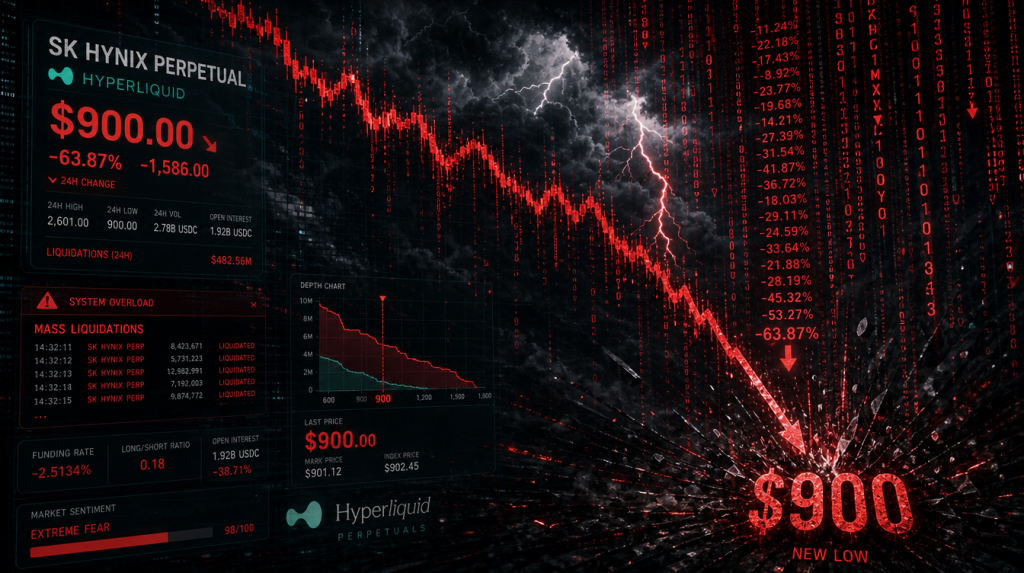
Perpetual futures linked to the American depositary receipts (ADRs) of South Korean chipmaker SK Hynix experienced a sharp flash crash on Hyperliquid, briefly falling 20% in one minute before quickly recovering above the $1,000 mark.
The sudden move occurred shortly before SK Hynix’s underlying shares came under pressure in South Korea. The company’s ADRs, which began trading on Nasdaq earlier this month, became the basis for the perpetual futures contract available on Hyperliquid.
According to Hyperliquid data, the perpetual contract tracking SK Hynix’s Seoul-listed shares dropped from 23:00 UTC to 23:01 UTC, plunging to $900 before rebounding above $1,000 within the following minute. The contract was recently trading around $1,092 and is settled in the dollar-pegged stablecoin USDC.
About an hour later, South Korea’s stock market opened lower, led by declines in semiconductor companies. By the close, SK Hynix shares had fallen 15% to 1,550,000 won ($1,762). Other major decliners included Samsung Electronics and Hyundai Motor, while South Korea’s benchmark Kospi index dropped 11%.
SK Hynix ADRs, with each ADR representing one-tenth of a company share, declined 4.5% in pre-market trading to $136.51.
Hyperliquid, a decentralized exchange specializing in perpetual futures, has become increasingly popular among traders seeking exposure to traditional financial assets, particularly since the Iran conflict began in late February. The platform had not provided a response regarding the incident at the time of publication.
Flash crashes are relatively common on crypto trading platforms, especially during periods between the U.S. market close and the opening of Asian markets such as China and South Korea. During these hours, trading liquidity is often lower, making prices more vulnerable to sharp movements from large orders.
SK Hynix, one of the world’s leading producers of high-bandwidth memory (HBM) chips used in Nvidia’s artificial intelligence processors, has faced significant selling pressure this month. The stock has fallen nearly 48% from its June 26 peak of 1,947 won.
The broader AI sector has also experienced weakening sentiment on Wall Street. Nvidia shares dropped 5% on Monday following a report from The Wall Street Journal that the AI chip giant could provide a financial guarantee of roughly $250 billion for an OpenAI-supported data center project.
About The Author





More Stories
CFTC Warns Prediction Platforms of Manipulation Risks in ‘Mention Markets’
Lummis Says Trump Opposition Helped Derail Crypto Clarity Act
XRP Ledger Retries Upgrade Designed to Split Payments and Compliance Roles