

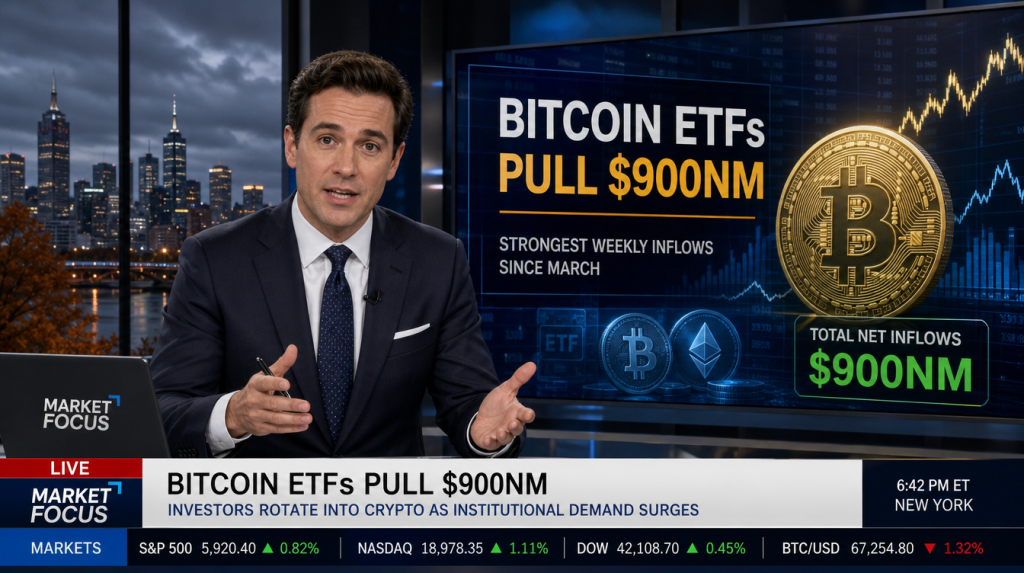
Spot Bitcoin ETFs attracted $226.8 million on July 20, concluding a five-day inflow streak totaling $723 million, driven primarily by BlackRock’s IBIT, Fidelity’s FBTC, and ARK’s ARKB.
On July 21, U.S.-listed spot Bitcoin ETFs saw an additional $206 million in net inflows, according to CoinGlass data, extending the run to six straight days and pushing the total above $900 million—the longest uninterrupted inflow streak since May.
This surge in inflows coincided with Bitcoin briefly reclaiming the $66,000 level (before retreating) and a shift in market sentiment back to neutral territory for the first time in nearly a month.
Rather than a simple rebound, the trend reflects a deeper structural return of institutional capital after one of the most severe periods of ETF outflows since their launch in January 2024.
The key question has shifted from whether June’s selling pressure has run its course to whether the current pace of inflows can sustainably alter the medium-term supply-demand dynamics.
The sequence began after a 10-day outflow stretch in late June that drained more than $2.7 billion from spot Bitcoin ETFs. That trend reversed sharply on July 2, when inflows of $221.7 million were recorded in a single session.
Fidelity’s FBTC and ARK’s ARKB led that session, while BlackRock’s IBIT posted an unusual net outflow of roughly $40 million before subsequently reversing direction.
Momentum built quickly thereafter. On July 6, inflows reached $265.7 million, with IBIT alone contributing about $209 million—marking a shift in leadership that persisted in later sessions.
Although the streak paused briefly, inflows resumed between July 14 and 17 with daily totals of $181 million and $108 million, culminating in the $226.8 million recorded on July 20. Over the two-week period, total inflows reached approximately $273 million, marking the second straight week of net gains.
Across most sessions, IBIT, FBTC, and ARKB consistently led inflows, with leadership rotating among issuers—an indication that demand is broadly distributed across institutional players rather than concentrated in a single fund.
Regulatory developments have also supported the improving sentiment. In the United States, the White House resolved an ethics-related impasse that had stalled the CLARITY Act, a bipartisan bill aimed at defining regulatory boundaries between the SEC and CFTC.
With that hurdle cleared, the likelihood of Senate progress before the August recess has increased, reducing a key source of regulatory uncertainty for institutional investors.
Meanwhile, Russia’s State Duma approved a sweeping crypto law on July 21 that formally recognizes digital assets as property, establishes trading and custody rules under the Bank of Russia, and permits cross-border settlements while prohibiting domestic crypto payments.
The legislation will take effect on September 1, 2026, with some provisions phased in over time. Retail investors who are not classified as qualified will face an annual purchase cap of 300,000 rubles (around $3,800), while qualified investors will remain unrestricted but subject to mandatory risk assessments.
On-chain data from CryptoQuant adds further context, showing that wallets holding between 1,000 and 10,000 BTC significantly increased accumulation after Bitcoin dipped below $55,000 earlier in July. Total whale accumulation for the month surpassed 66,700 BTC, valued at roughly $4.4 billion.
CryptoQuant noted that this surge in buying activity intensified specifically after the sub-$55,000 price level, aligning with historical patterns of large-holder accumulation during market downturns.
Additionally, Strategy raised $500 million in cash through a new convertible notes offering while maintaining its Bitcoin holdings unchanged—suggesting balance sheet strengthening without introducing immediate selling pressure into the market.
About The Author




More Stories
CFTC Warns Prediction Platforms of Manipulation Risks in ‘Mention Markets’
Lummis Says Trump Opposition Helped Derail Crypto Clarity Act
XRP Ledger Retries Upgrade Designed to Split Payments and Compliance Roles