

Here’s a clear and polished paraphrased version of your text:
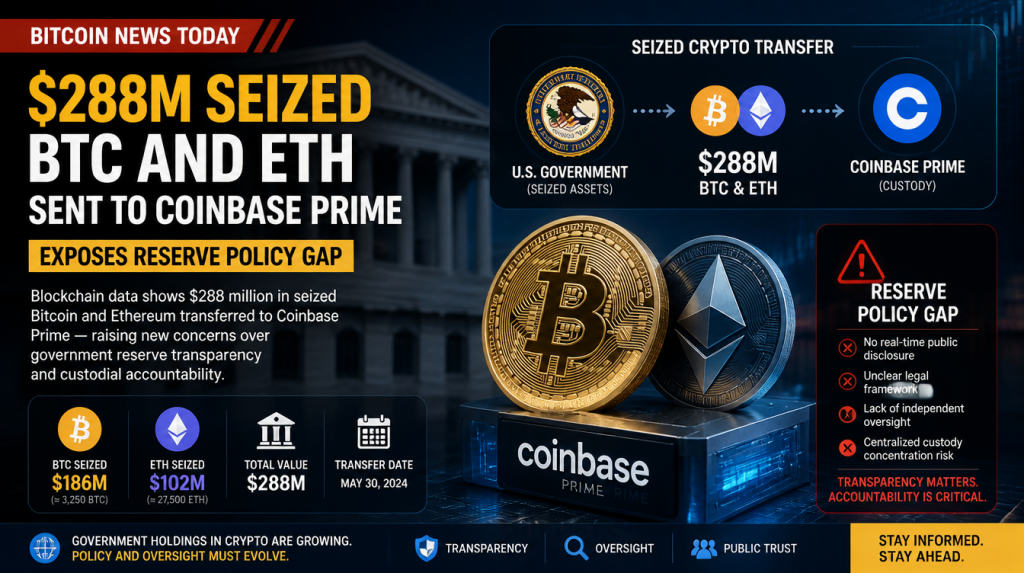
U.S. government-linked wallets transferred $288 million worth of seized Bitcoin and Ethereum to Coinbase Prime, prompting fresh concerns over how strictly Donald Trump’s Strategic Bitcoin Reserve executive order is being enforced.
Bitcoin News Today: On Monday, July 14, 2026, federal wallets moved roughly $288 million in confiscated BTC and ETH within a span of hours, according to blockchain data tracked by Arkham Intelligence. The transfers included 2,875 BTC tied to the Ryan Farace (“xanaxman”) drug trafficking case, along with assets seized from the now-defunct BTC-e exchange.
In addition, 30,007 ETH connected to Brian Krewson’s Oracle-related laundering operation were also routed to Coinbase Prime. This movement has drawn scrutiny because Trump’s Strategic Bitcoin Reserve directive explicitly states that seized Bitcoin should be held—not sold.
This activity goes beyond a routine custody adjustment. Instead, it serves as a real-time test of whether the March 2025 executive order—mandating that seized Bitcoin be retained within a national reserve—has been effectively implemented across government agencies, or if it remains more of a policy intention without firm operational enforcement.
On-Chain Breakdown: Farace, BTC-e, and Krewson Transfers
The transaction flow reveals a structured pattern. A wallet associated with the Farace case first sent 2,875 BTC (around $178 million) to a newly created intermediary address, which quickly forwarded the entire amount to a Coinbase Prime deposit wallet, leaving no remaining balance.
A similar two-step process was observed in the BTC-e-related transfer, where 925.512 BTC (approximately $57 million) moved through a fresh intermediary wallet before reaching Coinbase Prime.
The Ethereum transaction followed a different route. A wallet tied to Brian Krewson directly transferred 30,007 ETH (about $53.09 million) to Coinbase Prime without using an intermediary layer.
Separately, 140.214 BTC were shifted between existing government-controlled Coinbase Prime wallets and a Coinbase cold storage address, indicating internal fund management rather than a new external deposit, based on Arkham’s findings.
These movements sparked speculation about a potential collaboration between government agencies and private crypto firms aimed at strengthening anti-fraud efforts.
The use of newly generated intermediary wallets for Bitcoin transfers is particularly noteworthy. Historically, this routing pattern has been linked to preparations for asset sales. However, Coinbase Prime also offers institutional custody and asset staging services, meaning such transfers do not automatically imply liquidation.
Strategic Bitcoin Reserve: Policy vs. Execution
Trump’s executive order, issued in March 2025, designated seized Bitcoin for inclusion in the Strategic Bitcoin Reserve and explicitly discouraged selling these holdings. Treasury Secretary Scott Bessent reinforced this stance, stating that government BTC should be treated as a long-term reserve asset rather than liquidated.
However, the lack of clearly defined custody frameworks and onboarding procedures creates uncertainty. Without explicit operational guidelines, transfers of seized BTC to exchanges like Coinbase Prime exist in a gray area—neither clearly violating nor fully complying with the directive.
It is likely that these transfers highlight an operational gap rather than an intentional policy breach. Coinbase Prime already serves as a trusted institutional custodian for government digital assets, making it a plausible staging point before formal reserve allocation. Still, without official clarification, the intent behind these transactions remains uncertain.
About The Author





More Stories
Bond Volatility Surges as Bitcoin and Wall Street Remain Calm
Altcoins Surge as Bitcoin Holds Near $84,000
Bitcoin ETF Flows Turn Positive in 2026 After Erasing $5.8B Deficit