

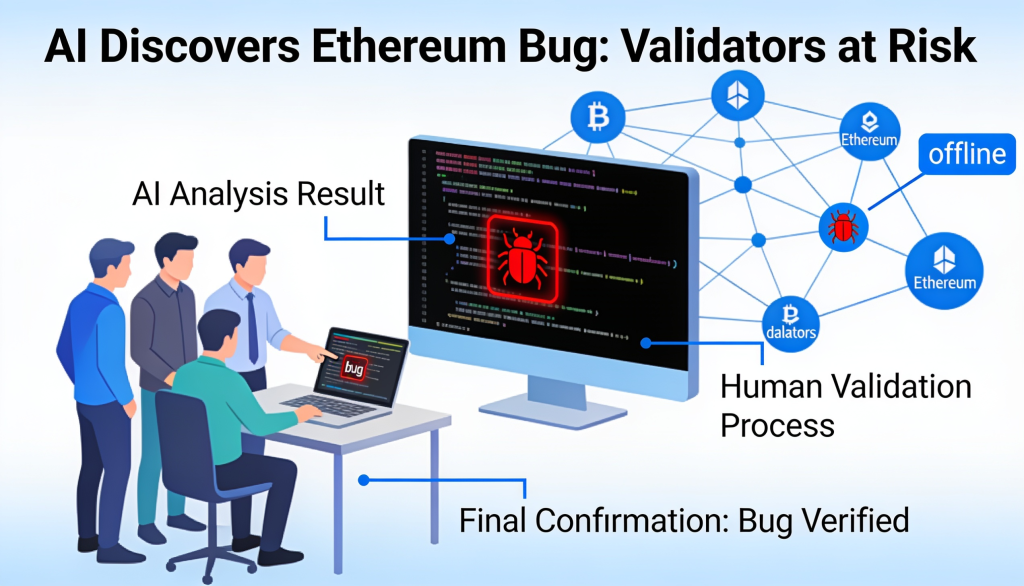
The Ethereum Foundation used coordinated AI agents to analyze validator software and uncovered a remotely exploitable crash vulnerability. However, human researchers were still needed to separate genuine security issues from convincing but incorrect findings.
Engineers at the Ethereum Foundation recently deployed AI agents to examine the software infrastructure that powers Ethereum, aiming to uncover vulnerabilities and improve the security of the world’s largest blockchain network by total value locked.
Although the AI-driven review successfully identified real bugs, developers found that careful human analysis remained essential for distinguishing actual threats from false positives. The Foundation’s Protocol Security team shared its findings and outlined lessons for other developers using AI-based security tools.
Ethereum operates through thousands of nodes, which are computers running the network’s software. These nodes maintain copies of the blockchain and communicate with one another to keep the network synchronized.
Validators, which stake ether and participate in approving new blocks, depend on this communication layer. If messages fail to reach them properly, validator operations can be disrupted.
The vulnerability discovered by the engineers was located in the gossipsub messaging system. The flaw allowed a remote attacker to trigger a software crash by forcing the node to perform an invalid calculation, causing the program to shut down. As a result, affected validators could be taken offline until manually restarted.
The issue was quickly patched and publicly disclosed under the identifier CVE-2026-34219, with credit given to the researchers who discovered it. However, the larger challenge was determining which AI-generated reports represented legitimate vulnerabilities and which only appeared credible.
“The surprising part was not how difficult it was to find bugs, but how much effort was required to distinguish real vulnerabilities from false alarms,” wrote Nikos Baxevanis, the author of the Foundation’s report.
Traditional security tools such as fuzzers typically generate clear results by sending malformed inputs into software until something fails. These tools usually provide a crash report and the location of the failure, allowing engineers to verify the issue quickly.
AI agents operate differently. Instead of simply identifying a failure, they generate detailed explanations, describe possible attack paths, assign severity levels, and produce sample exploit code. Their reports can appear highly convincing regardless of whether the underlying vulnerability actually exists.
The Ethereum Foundation identified three recurring categories of false positives during the AI testing process.
The first involved crashes that only appeared in development or testing environments. These builds included additional safety checks that were not present in production software, meaning real users were never exposed to the issue.
The second involved theoretical attacks that required an attacker to manually insert a harmful value into the system. In practice, all external methods of delivering that value were blocked before reaching the vulnerable area.
The third category involved formal verification issues, where AI agents incorrectly interpreted mathematical proofs. In some cases, the proof only demonstrated something obvious or irrelevant rather than confirming meaningful software behavior.
In each case, the AI produced detailed and confident explanations for issues that did not represent real-world security risks.
Researchers also found that AI systems are generally better at analyzing isolated events than identifying vulnerabilities that depend on a sequence of individually valid actions. Many major crypto exploits occur through this type of chain reaction, where normal operations are combined in a malicious order.
Recent attacks across the crypto industry have followed this pattern. In the Edel Finance exploit, attackers manipulated a system around a legitimate Chainlink price feed rather than compromising the oracle itself. Similarly, the BONK governance attack involved normal actions — purchasing tokens, voting, and executing a proposal — that became harmful when combined strategically.
The Ethereum Foundation’s approach is to use AI agents as tools for identifying promising areas of investigation, while relying on human experts to verify findings and determine whether they represent genuine security risks.
About The Author





More Stories
XRP News: SEC AMM Shift Could Boost Tokenized Stocks on XRPL
Strong Jobs Data Pushes Back Fed Rate Cut Hopes as Bitcoin Faces Pressure
Mid-Sized Bitcoin Wallets Accumulate 113,950 BTC as Rally Nears Key Test