

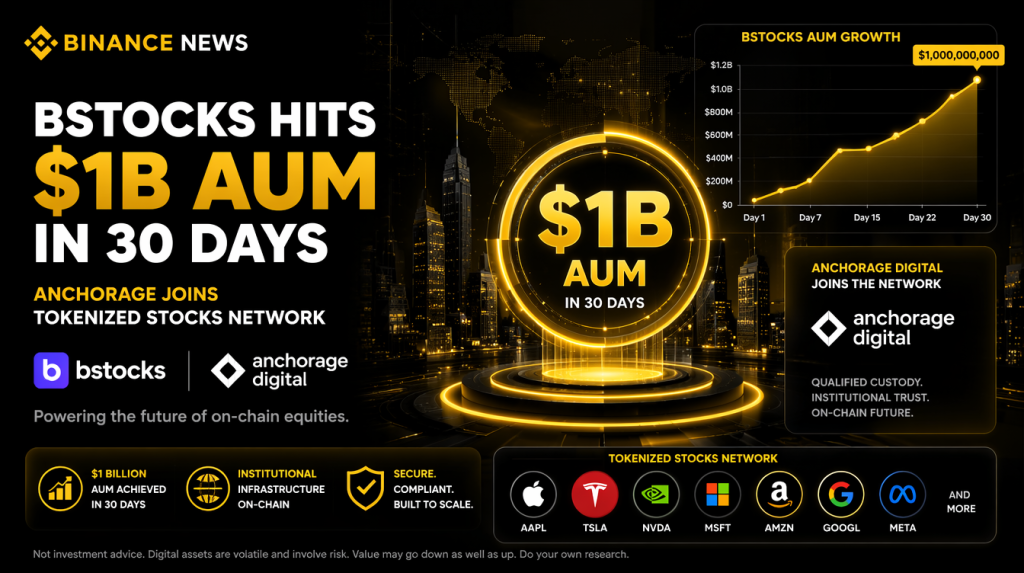
Binance’s tokenized equities platform, Bstocks, reached $1 billion in assets under management within just 30 days of launch, while Anchorage Digital simultaneously joined its Triparty Banking network to support institutional settlement.
In today’s Binance developments, the Bstocks platform—introduced on June 1, 2026—surpassed $1 billion in AUM during its first month. Over the same period, it recorded $3 billion in total trading volume and averaged $42 million in daily inflows.
At the same time, Binance revealed on June 30 that Anchorage Digital, a federally chartered crypto bank, had been integrated into its Triparty Banking network. This marks the first instance of Anchorage’s Atlas institutional settlement platform being connected to a crypto exchange.
This milestone goes beyond a typical product launch. It signals that tokenized equities are evolving from a niche concept into a meaningful asset class. Notably, Bstocks’ 30-day trading activity already exceeds the weekly volumes of established platforms like Backed Finance and Ondo Finance, which collectively averaged $35–40 million per week during the same timeframe.
Bstocks: Product Design, User Trends, and RWA Market Implications
Bstocks enables eligible users outside the United States to trade more than 7,000 U.S.-listed stocks and ETFs. Investors can purchase fractional shares starting from $5 using stablecoins. The platform operates through an ADGM-licensed broker, Nest Trading, along with U.S.-based clearing broker Alpaca Securities.
The system utilizes BEP-20 tokens on the BNB Chain, issued via BTech Holdings under a Financial Services Regulatory Authority-approved prospectus. These tokens provide economic exposure to underlying assets but do not grant voting rights or dividend entitlements.
User data shows that 73% of new participants come from emerging markets. Additionally, 40% of trades are valued under $100, while 35% of total trading activity is driven by fractional share transactions.
With only 11% of the global adult population holding brokerage accounts, the platform addresses a substantial gap in equity market access. Binance’s Head of Spot and Derivatives, Shunyet Jan, highlighted strong demand from underserved segments, particularly younger users and smaller investors.
Technology equities dominate the platform, accounting for 71% of holdings and generating 23 times more trading volume than other sectors. Semiconductor stocks alone represent 48% of activity. Binance projects that Bstocks could reach $10 billion in AUM by the end of 2026.
The broader tokenized real-world asset (RWA) market is also expanding rapidly, reflecting a growing shift toward on-chain financial instruments. This trend is reinforced by initiatives such as Chainlink’s APAC equities data, which includes major firms like Samsung and Toyota.
Anchorage Integration: Institutional Infrastructure and Triparty Model
The addition of Anchorage Digital to Binance’s Triparty Banking network represents a shift in how institutional participants handle custody and collateral. Eligible institutions can now hold assets with Anchorage Digital Bank and use them as collateral for trading on Binance.
As the first federally chartered crypto bank in the United States, Anchorage enables institutions to post a range of collateral types, including cryptocurrencies, U.S. dollar deposits, and tokenized RWAs.
Binance CEO Richard Teng noted that institutional crypto markets are increasingly aligning with traditional financial structures, where custody and execution are handled separately. Anchorage CEO Nathan McCauley emphasized that the integration allows institutions to access exchange liquidity while maintaining secure custody of assets.
To encourage adoption, Binance is offering zero-fee Triparty services for institutions through December 31, 2026. A tiered pricing model is expected to be introduced starting in 2027. The exchange also reiterated that it does not provide services to U.S. persons.
Competitive Landscape and the Rise of Off-Exchange Settlement
The Binance-Anchorage partnership is one of several major off-exchange settlement integrations announced in the first half of 2026. Other developments include BitMEX’s collaboration with Zodia Custody and Bitget’s integration with Fireblocks. KuCoin Institutional has also enhanced its custody framework by incorporating Ceffu’s MirrorX platform to enable faster off-chain settlement.
These developments suggest that institutional adoption of crypto markets is increasingly driven by structural alignment with traditional prime brokerage models, rather than just liquidity or asset availability.
Anchorage Digital, valued at $4.2 billion and backed by investors such as Andreessen Horowitz and Goldman Sachs, brings strong regulatory credibility. Its Singapore arm holds a license from the Monetary Authority of Singapore, while its New York operations are authorized under a BitLicense.
As regulatory frameworks like the CLARITY Act continue to evolve, the credibility of custody providers is becoming increasingly important. Exchanges that demonstrate clear separation of custody through regulated partners may gain an advantage in regulatory engagement, extending beyond simple product innovation.
About The Author





More Stories
Bitcoin Starts New Quarter Stuck in Familiar $82K-$85K Range
Citigroup Lifts 12-Month Bitcoin Target to $113K as ETF Inflows Return
Bitcoin’s Inflation-Fueled Jump to $85.5K Fades as Yields Stay High