

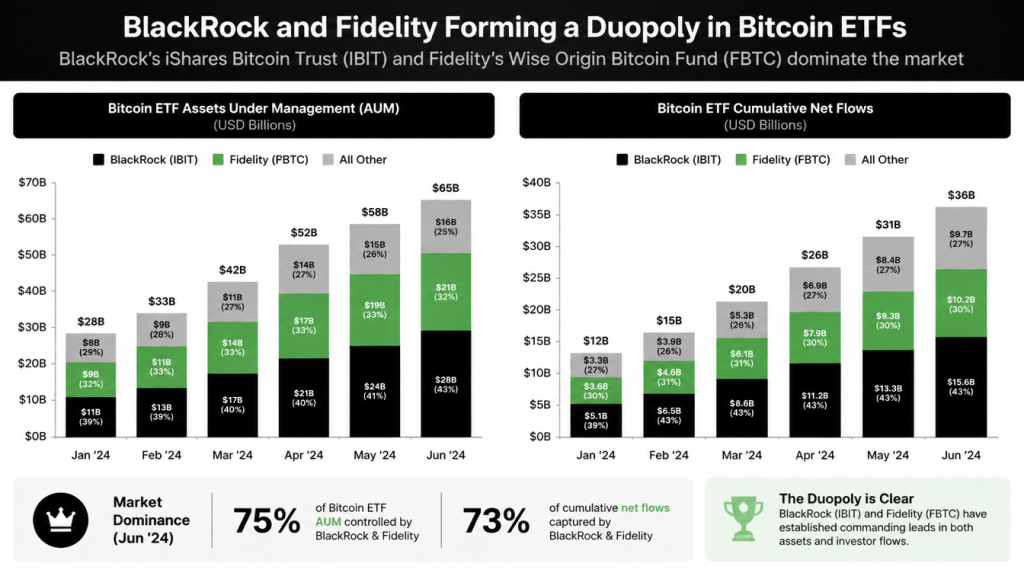
BlackRock’s IBIT and Fidelity’s FBTC are attracting the vast majority of new capital flowing into bitcoin ETFs, while smaller funds are being increasingly left behind as institutional investors cluster around the largest and most liquid vehicles.
When U.S. spot bitcoin ETFs launched in January 2024, investors had more than a dozen options from issuers such as BlackRock, Fidelity, Ark Invest, Bitwise, VanEck, and Franklin Templeton, creating what was expected to be a highly competitive market.
Eighteen months later, the landscape has largely consolidated into a two-player structure.
Flow data shows IBIT and FBTC now dominate most major inflow days, with smaller ETFs playing a diminishing role in driving overall market direction.
This pattern has held steady throughout 2026.
On January 14, total inflows reached $840.6 million, with IBIT contributing $648.4 million and FBTC adding $125.4 million—together accounting for more than 90% of flows. A similar dynamic occurred on April 17, when the two funds made up about two-thirds of $663.9 million in inflows.
Even in weaker market sessions, concentration remains clear. On May 1, IBIT and FBTC together accounted for nearly $500 million of $629.8 million in total inflows.
While year-to-date data shows some exceptions—such as relatively strong inflows into Grayscale’s Bitcoin Mini Trust compared with IBIT—the broader pattern still shows BlackRock and Fidelity consistently capturing the bulk of new allocations into spot bitcoin ETFs.
This consolidation has formed during a difficult year for crypto markets, with bitcoin down roughly 29% year-to-date and ETF flows oscillating between inflows and significant redemptions. Periods of selling pressure in mid-May and early June highlight how sentiment has shifted away from the earlier “buy-the-dip” behavior.
Even so, investor behavior is increasingly driven by scale, liquidity, and brand trust.
BlackRock has been the biggest beneficiary of this trend.
IBIT has effectively become the flagship bitcoin ETF, frequently leading inflows and showing relative stability during market stress. On several days of broad ETF outflows, it either stayed positive or saw smaller redemptions than competitors.
This dominance reflects who is buying: financial advisers, RIAs, hedge funds, family offices, and pension consultants, all of whom prioritize execution quality, liquidity, and issuer reputation alongside exposure.
With more than $10 trillion in assets under management and extensive global distribution, BlackRock has a structural advantage, while Fidelity benefits from its deep roots in retail brokerage and institutional investing.
As a result, IBIT and FBTC are increasingly treated as default entry points for bitcoin exposure.
Meanwhile, smaller issuers are struggling to maintain relevance.
Funds from firms like Franklin Templeton, VanEck, Valkyrie, and WisdomTree often see relatively small daily flows that have little impact on overall market direction.
Even once-strong competitors such as Bitwise and Ark now play a secondary role, highlighting how quickly the competitive landscape has consolidated.
During volatile periods, the pattern becomes even more pronounced: the net direction of ETF flows is largely determined by IBIT and FBTC, effectively deciding whether the entire sector records inflows or outflows on a given day.
Overall, the data suggests the bitcoin ETF market is evolving from a crowded field into a winner-take-most structure, where scale, liquidity, and distribution increasingly determine long-term success.
About The Author





More Stories
Bitcoin Starts New Quarter Stuck in Familiar $82K-$85K Range
Citigroup Lifts 12-Month Bitcoin Target to $113K as ETF Inflows Return
Bitcoin’s Inflation-Fueled Jump to $85.5K Fades as Yields Stay High