

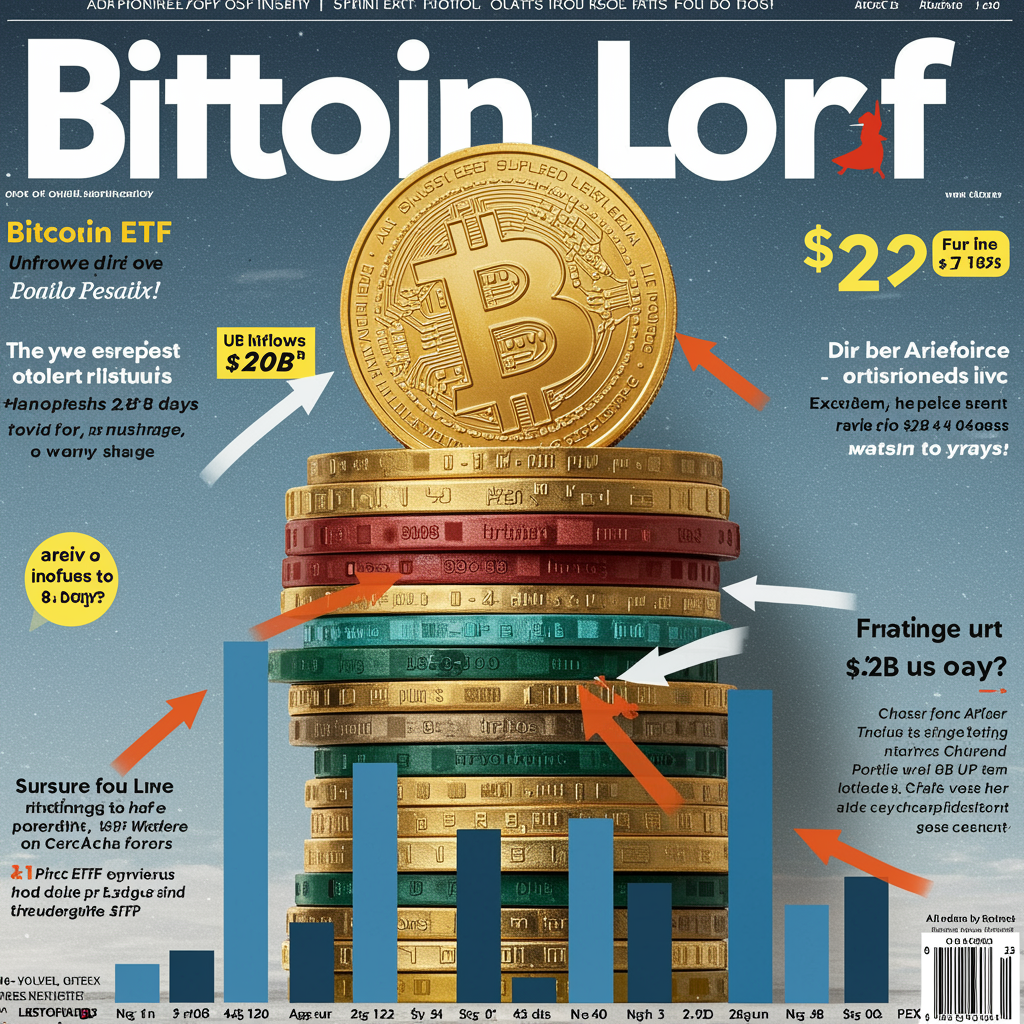
Spot bitcoin ETFs are on their longest inflow streak in months, but on-chain signals suggest selling pressure is already building at levels that have historically marked local tops.
U.S. spot ETFs tracking Bitcoin BTC have now recorded eight straight days of inflows through April 23, totaling about $2.1 billion, according to SoSoValue. This is the strongest run since October 2025, when a nine-day streak helped drive bitcoin to its $126,000 peak.
April 23 alone brought in roughly $223 million. BlackRock’s IBIT dominated flows with around $167 million, while Fidelity Investments’s FBTC was the only major fund to see net outflows, losing about $17 million.
Over the same period, bitcoin has rallied from $68,000 to near $77,000, a gain of roughly 12%, closely mirroring the return of ETF demand. Since launch, cumulative inflows into spot ETFs have climbed to around $58 billion, with total assets reaching $102 billion—equivalent to about 6.5% of bitcoin’s market value.
Still, ETF data doesn’t capture the full picture.
On-chain metrics from Glassnode show bitcoin has reclaimed its “True Market Mean” at approximately $78,100, a key level representing the average cost basis of actively traded supply. This is the first reclaim since mid-January and has historically signaled a shift toward more constructive market conditions.
The next level to watch sits just above. The short-term holder cost basis—currently near $80,100—represents the average entry price for investors who bought within the last 155 days. A move above that threshold would push more than half of these holders into profit.
In past instances this cycle, that level has coincided with local tops, as short-term holders used rallies to exit positions. A similar setup is now emerging again after failing to hold previously.
Profit-taking data reinforces that risk. Short-term holders are currently realizing profits at a pace of roughly $4.4 million per hour, according to Glassnode. For context, levels around $1.5 million per hour have preceded each local top so far this year—placing current readings at nearly three times that benchmark.
Derivatives positioning adds another layer to the setup. Funding rates in perpetual futures remain negative, meaning short sellers are paying long positions—evidence that bearish sentiment is still dominant. A recent short squeeze briefly pushed bitcoin toward $78,000 before geopolitical developments tied to the Strait of Hormuz reversed the move.
Another squeeze, combined with ongoing ETF inflows and improving spot demand on offshore exchanges, could provide a pathway toward $80,000. The key question is whether that level can hold, or if it once again triggers selling from short-term holders.
A similar pattern played out in March, when a seven-day inflow streak coincided with a local top. This time, inflows have been heavily concentrated in IBIT, while other issuers have seen mixed activity. The structure isn’t identical, but the parallels are hard to ignore.
ETF demand is clearly strong—but it may also be acting as an exit ramp for short-term holders. The market’s reaction around $80,000 is likely to determine which force ultimately dominates.
About The Author


More Stories
Morgan Stanley is positioning to play a central role in managing reserves for stablecoin issuers.
Bitcoin’s upward move is stalling amid rising Japanese inflation and escalating Iran war–driven uncertainty in markets.
The $145 billion debate: Why quantum computing poses a manageable risk to Bitcoin, not an existential one