

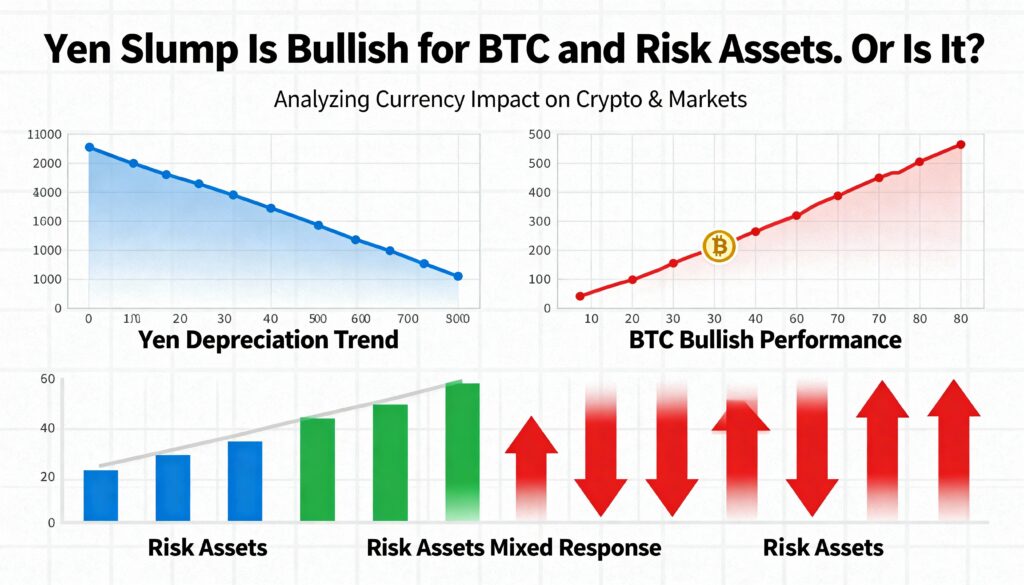
The Japanese yen has slid to 157.20 per U.S. dollar, a sharp move for a major currency that has market participants watching closely for possible intervention from the Bank of Japan.
While this may seem like a purely foreign-exchange story, the yen’s weakness has long been intertwined with global risk sentiment. Historically, low Japanese interest rates encouraged traders to borrow yen and convert it into higher-yielding currencies—fueling “carry trades” that pressure the yen lower and channel liquidity into risk assets. A softer yen typically reinforces this cycle, as fewer dollars are required to repay yen-denominated debts, boosting overall returns.
A stronger yen, by contrast, has often signaled risk aversion. During the August 2024 sell-off, bitcoin plunged from about $65,000 to $50,000 in a week after the BOJ raised rates for the first time in a decade, jolting the currency higher and reducing the appeal of carry trades.
Given that backdrop, it’s easy to assume the yen’s latest decline should be bullish for bitcoin and broader risk assets. Japan’s benchmark rate remains just 0.5%, versus 4.75% in the U.S., offering a still-attractive carry spread. Reports even suggest Japanese retail investors are exploring high-yield currencies like the Turkish lira.
However, Japan’s macro environment has changed dramatically. The country’s heavy debt burden—roughly 240% of GDP—combined with post-pandemic inflation and the new prime minister’s commitment to expansionary fiscal policy has heightened concerns about financial stability. On Friday, the government approved a $135 billion stimulus package, reinforcing expectations of more borrowing and upward pressure on bond yields.
These fiscal strains are showing up clearly in Japan’s fixed-income markets. The 10-year government bond yield has climbed to 1.84%, its highest level since 2008, after spending nearly six years near or below zero. Twenty- and 30-year yields are also at multi-decade highs, even as the yen weakens—an unusual divergence that suggests fiscal concerns are overwhelming traditional yield-currency correlations.
About The Author



More Stories
Bitcoin holds near $68,300 while gold tumbles for a ninth session and Asian stocks fall
Resolv stablecoin drops 70% as exploiter siphons $25 million worth of ETH
Equities catch up to bitcoin’s drop toward $60,000 amid a surge in bond yields.