

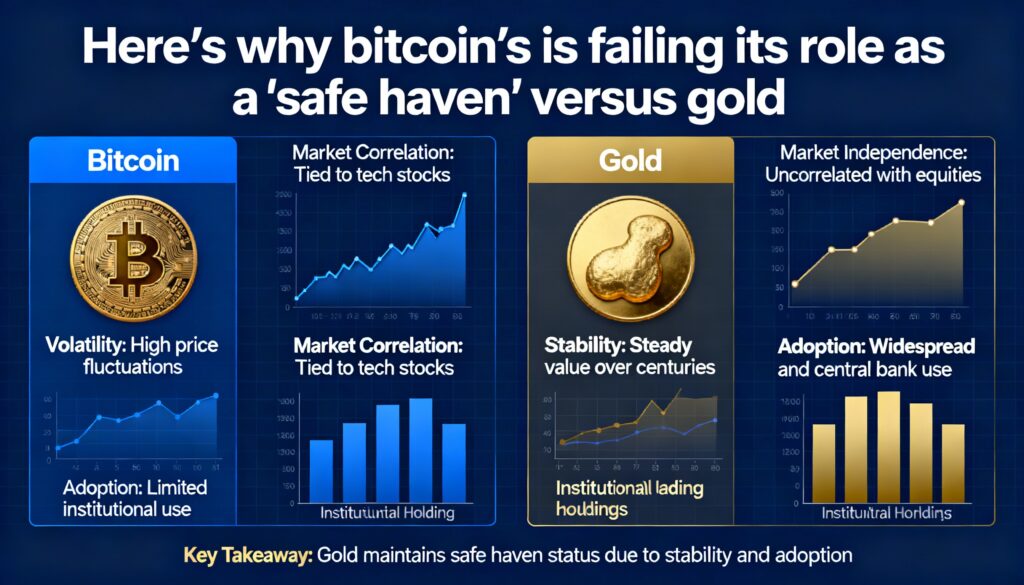
Bitcoin Acts More Like an “ATM” During Market Stress, Gold Holds Its Ground
While Bitcoin is often touted as “digital gold” and a censorship-resistant form of sound money, in practice it behaves more like an “ATM” during periods of market stress, with investors quickly selling to raise cash.
Geopolitical tensions over the past week—including Trump’s threats of tariffs on NATO allies over Greenland and speculation about potential military action in the Arctic—spurred market volatility. Since January 18, when Trump first raised the Greenland tariff threat, Bitcoin has fallen 6.6%, while gold has surged 8.6% to near $5,000 per ounce.
The difference lies in how each asset functions in portfolios under stress. Bitcoin’s deep liquidity, constant trading, and instant settlement make it easy to sell quickly, whereas gold—less liquid but widely held—tends to be retained. “Liquidity preference dominates in times of stress, and this hurts Bitcoin more than gold,” said Greg Cipolaro, NYDIG’s Global Head of Research. “Despite its liquidity, Bitcoin is more volatile and often sold reflexively as leverage is unwound, while gold continues to act as a true liquidity sink.”
Large holders reinforce the divergence. Central banks are accumulating gold at record levels, while long-term Bitcoin holders continue selling. On-chain data shows vintage Bitcoin coins moving to exchanges, creating a “seller overhang” that depresses prices.
Another factor is how markets price risk. Gold excels as a hedge against immediate shocks like war, policy threats, or short-term market turmoil. Bitcoin, by contrast, is better suited for long-term risks such as fiat debasement, sovereign debt crises, or gradual trust erosion. “As long as current risks are seen as temporary rather than systemic, gold remains the preferred hedge,” Cipolaro said.
In short, while Bitcoin may shine as a long-term store of value, gold continues to dominate in moments of acute uncertainty.
About The Author


More Stories
Bitcoin holds near $68,300 while gold tumbles for a ninth session and Asian stocks fall
XRP slides 3% on break under $1.44 with BTC softness capping recovery
BTC mining turns unprofitable with $19,000 loss per coin despite 7.8% difficulty drop