

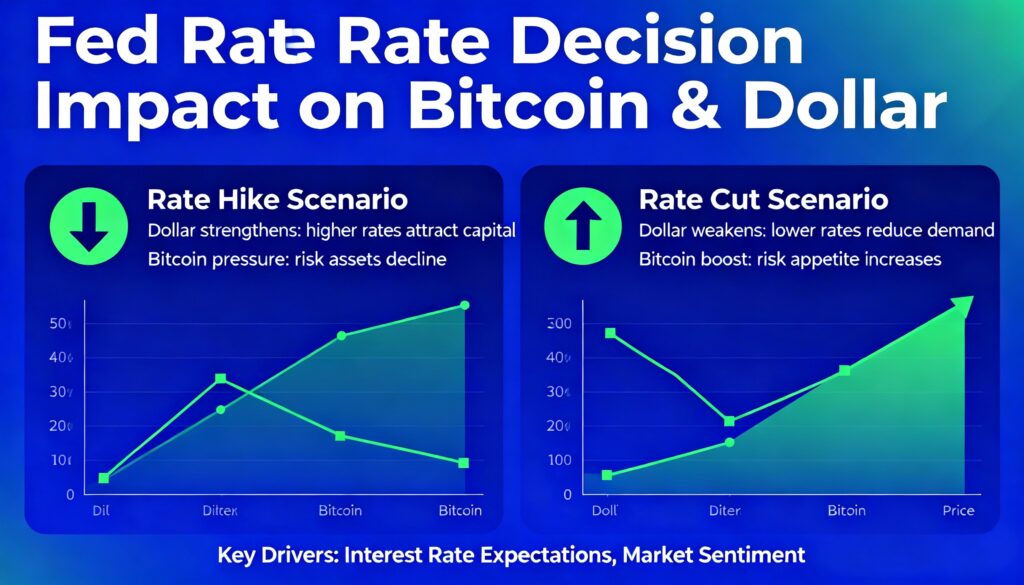
While the Fed is expected to hold rates steady, Chair Jerome Powell’s guidance could shape the outlook for bitcoin, the dollar, and broader risk assets.
The Federal Reserve is set to announce its latest policy decision this week, and markets are nearly unanimous in expecting no change to interest rates. The real focus, however, will be on Chair Jerome Powell’s post-meeting press conference, where his commentary could prove more market-moving than the decision itself.
Powell’s views on the path of rates, along with his remarks on politically sensitive topics such as President Donald Trump’s affordability agenda and renewed questions around the Fed’s independence, could ripple through both traditional markets and crypto.
Here’s what investors are watching.
Rates on hold
After delivering three consecutive quarter-point rate cuts, the Fed is widely expected to pause. As of Friday, CME FedWatch data showed a 96% probability that policymakers will keep rates unchanged at 3.5%–3.75%.
That expectation aligns with Powell’s December message that the Federal Open Market Committee (FOMC) intends to hold off on further cuts into 2026. Minneapolis Fed President Neel Kashkari, a voting member this year, reinforced that stance recently, telling The New York Times it is “way too soon” to resume easing.
Absent a surprise cut—which would likely weaken the dollar while boosting bitcoin and equities—the rate decision itself is expected to be largely uneventful.
Hawkish or dovish pause?
The key question for markets is whether the pause signals restraint or simply a temporary break before further easing.
A hawkish pause would see Powell emphasize lingering inflation risks, potentially pushing rate-cut expectations further out and weighing on risk assets. A dovish pause, by contrast, would suggest cuts could resume in the coming months, a scenario that would likely support bitcoin and equities.
Morgan Stanley expects the Fed to lean dovish by retaining language that it is “considering the range and timing for further adjustments” to rates—keeping the door open to future easing even as it acknowledges economic resilience.
Traders will also be watching for dissent among policymakers. Trump-appointed Fed governor Stephen Miran is expected to dissent in favor of a larger 50-basis-point cut. An increase in dissenters could strengthen the case for future easing, lifting stocks and crypto.
Most Wall Street firms currently expect one or two rate cuts later this year. JPMorgan is a notable outlier, forecasting no cuts in 2025 followed by a rate hike next year.
Dollar implications and affordability politics
Powell is also likely to face questions about why rates are being held steady and how Trump’s affordability initiatives could affect inflation and financial conditions.
Analysts at ING say Powell may struggle to argue that financial conditions are restrictive, given the strength of U.S. asset markets and economic activity. That messaging could support the dollar and weigh on dollar-denominated assets such as bitcoin.
“Pouring cold water on the notion of a second Fed rate cut would lift the dollar against low-yielding currencies like the yen and the euro,” ING said, adding that a sustained dollar decline is more likely to come from weak economic data than dovish Fed rhetoric.
Powell’s response to Trump’s housing affordability measures could also inject volatility. Trump has said he directed representatives to purchase $200 billion in mortgage-backed securities to lower borrowing costs and signed an executive order limiting large institutional investors’ ability to buy single-family homes.
Some economists warn these steps could front-load demand and push housing inflation higher. Allianz Investment Management noted that large-scale MBS purchases could inflate prices, while restrictions on institutional buyers may have limited impact given their relatively small share of housing stock.
Trump’s tariff policies are largely viewed as already priced in, though their inflationary effects are expected to emerge gradually as higher import costs reach consumers.
Other risks in focus
Powell may also face questions about a Justice Department investigation targeting him personally—an inquiry he has described as politically motivated—as well as recent bond market volatility tied to Japan’s fiscal challenges. He is expected to avoid detailed comment on the investigation and downplay concerns around global bond markets.
In the absence of a rate move, markets will be parsing Powell’s every word for clues on how long the pause lasts—and whether the next move in rates ultimately favors the dollar or assets like bitcoin that tend to benefit from easier financial conditions.
About The Author


More Stories
Bitcoin holds near $68,300 while gold tumbles for a ninth session and Asian stocks fall
XRP slides 3% on break under $1.44 with BTC softness capping recovery
BTC mining turns unprofitable with $19,000 loss per coin despite 7.8% difficulty drop