

Here’s a more refined and tighter rewrite with a stronger editorial flow:
Strategy has resumed aggressive Bitcoin accumulation after a turbulent week in crypto markets. Between June 1 and June 7, Michael Saylor purchased 1,550 BTC for approximately $101 million at an average price of $65,332, increasing total holdings to 845,256 BTC and lifting cash reserves to $1 billion. The purchases followed a small 32 BTC sale, signaling continued conviction amid volatility.
That sale, executed at $77,135 per BTC to cover preferred dividend obligations, marked Strategy’s first Bitcoin reduction since 2022. Although the amount was negligible at just 0.0038% of holdings, it coincided with a volatile period that saw Bitcoin drop from $77,000 to below $60,000 amid liquidation pressure.
The timing sparked debate over whether Strategy had softened its long-held “never sell” stance. Saylor remained silent during the drawdown, but the sequence ultimately proved favorable: a small amount was sold near local highs and later repurchased at significantly lower levels, effectively increasing net Bitcoin exposure while adding liquidity.
Despite renewed accumulation, Strategy remains highly sensitive to price swings. Its average cost basis is estimated at $75,680 per BTC, leaving it with sizable unrealized losses at current levels near $65,000. Earlier in 2026, when Bitcoin traded above $80,000, those holdings were firmly in profit before the correction reversed gains.
Tom Lee and Ethereum’s Parallel Positioning
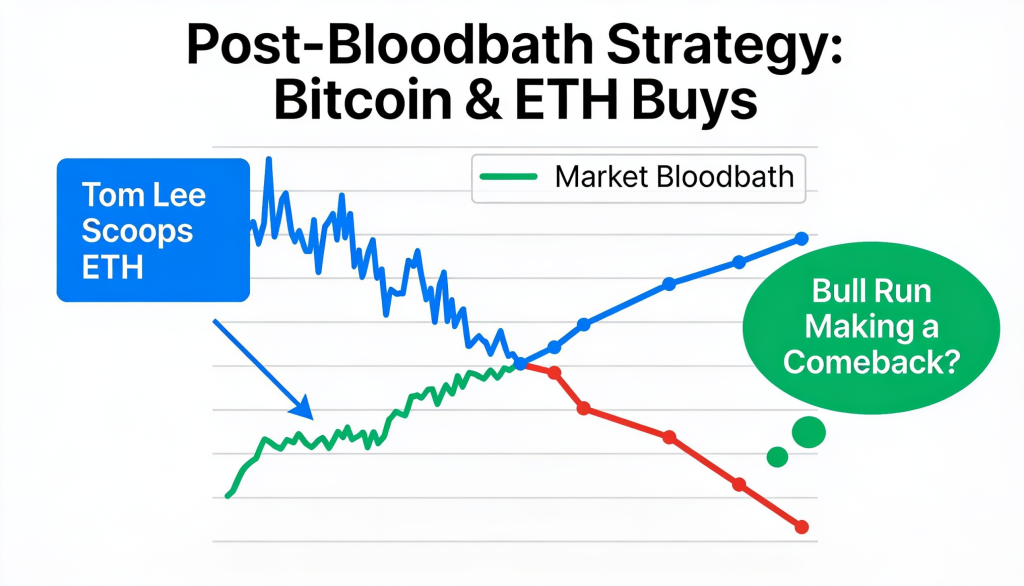
On the Ethereum side, BitMine Immersion Technologies, led by Tom Lee, also increased exposure during the downturn. The firm acquired 126,971 ETH for roughly $213 million at prices near $1,670, bringing total holdings to about 5.54 million ETH—around 4.6% of total supply. Over 85% of these holdings are staked through its MAVAN platform, generating an estimated $270 million in annual yield.
Ahead of the decline, Lee described the market as entering a “crypto spring” and later pointed to Strategy’s small BTC sale as a potential bottom signal, while continuing to accumulate aggressively. However, BitMine’s average ETH cost of around $3,460 leaves it deeply underwater at current prices near $1,681, with unrealized losses approaching $10 billion. Unlike Strategy, staking income provides an ongoing yield buffer against price weakness.
Two Diverging Treasury Models
The firms represent two distinct approaches to crypto treasury management. Strategy relies on equity issuance, convertible debt, and balance sheet capacity to accumulate Bitcoin, focusing entirely on long-term price appreciation and “Bitcoin per share” growth. BitMine, in contrast, combines accumulation with large-scale staking, creating a yield-generating Ethereum strategy.
Risk, Conviction, and Market Dynamics
If downside volatility continues, Strategy’s structure may prove more exposed due to its reliance on capital markets and debt servicing. The recent small BTC sale already highlighted how quickly stress can surface during drawdowns. BitMine’s staking income, by comparison, provides a partial cushion in prolonged downturns.
The latest market action underscored this divergence: a minor transaction from Strategy carried outsized psychological weight, while Ethereum-focused buyers continued accumulating through weakness. Despite sharp drawdowns, both firms continue to signal strong institutional conviction.
The recent wave of buying during the selloff suggests large players view volatility as accumulation opportunity. Liquidations cleared excess leverage, while fresh capital from equity issuance flowed into digital assets. While volatility is likely to persist, the broader tone is gradually improving.
Strategy and BitMine are increasingly shaping corporate balance sheets through crypto-native treasury strategies, helping establish a structural floor during periods of stress.
With both Saylor and Lee continuing to add exposure, market sentiment is slowly shifting toward an early-stage “crypto spring” that could evolve into a broader uptrend.
About The Author





More Stories
Bond Volatility Surges as Bitcoin and Wall Street Remain Calm
Altcoins Surge as Bitcoin Holds Near $84,000
Bitcoin ETF Flows Turn Positive in 2026 After Erasing $5.8B Deficit