

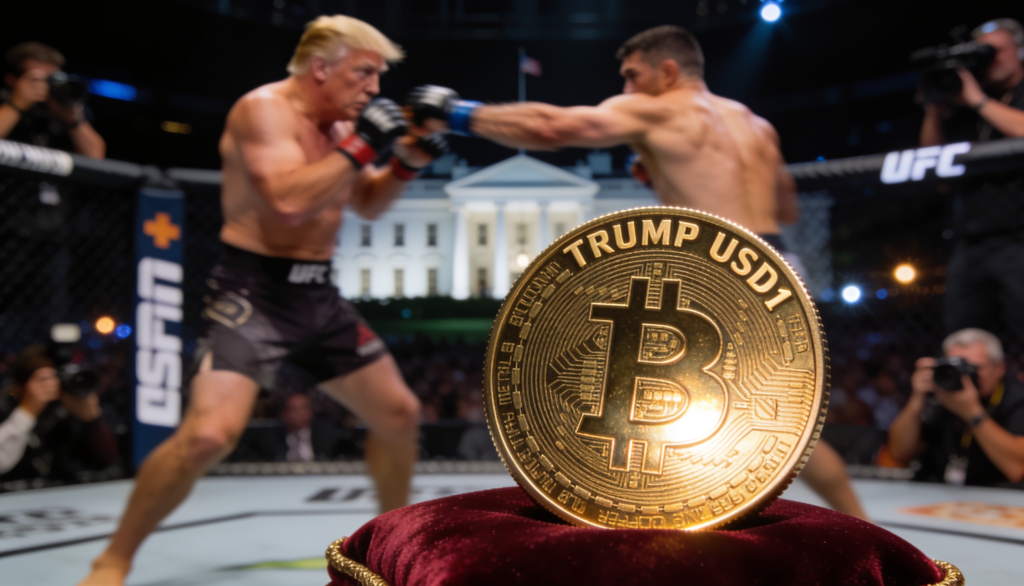
World Liberty Financial’s USD1 stablecoin was used to distribute $250,000 in fighter performance bonuses during UFC Freedom 250, a mixed martial arts event held on the White House South Lawn on June 14, coinciding with President Trump’s 80th birthday.
As the presenting sponsor of the bonus pool, WLFI allocated USD1 rewards across seven fights, marking the most visible real-world use of the Trump-linked stablecoin so far.
This activation was part of a broader crypto push. WLFI tokens rose 3% following the sponsorship announcement, while Binance launched a rewards campaign distributing 178 million WLFI governance tokens to USD1 holders. At the same time, Crypto.com contributed a separate $1 million bonus pool denominated in CRO as a co-presenter. Altogether, crypto-based fighter payouts for the event totaled करीब $1.65 million.
Trump Crypto Strategy: Inside the USD1 Bonus Structure
WLFI funded a $250,000 bonus pool in USD1, awarded to fighters across seven bouts based on standard UFC performance metrics.
The payouts were issued in USD1, a stablecoin pegged to the US dollar and backed by cash reserves and short-term US Treasuries held with BitGo. In practice, fighters received compensation equivalent to USD, but in a digital format tied to a Trump-affiliated DeFi project.
Todd Phillips of Klaros Group explained the strategy: compensating fighters in USD1 is economically similar to paying cash, but branding it as such serves as a global marketing signal—linking the stablecoin to both the UFC and the White House.
The White House as a Promotional Platform
Trump’s political identity has long overlapped with his business ventures, including crypto. Hosting a UFC event at the White House while distributing bonuses via a family-linked stablecoin highlights that integration.
The administration maintains that Trump’s financial interests are held in a trust managed by his children. However, reports suggest the Trump family receives roughly 75% of net proceeds from WLFI token sales, along with a share of earnings generated from USD1 reserves.
The situation raises questions, as the event took place on government property, while stablecoin regulations are being shaped under an administration with financial ties to a stablecoin issuer.
The SEC has also issued an investor bulletin identifying USD1 as a privately issued stablecoin connected to the sitting president’s family.
Market Impact and Risk Considerations
From a marketing standpoint, the strategy is highly effective. Trump has leveraged large-scale attention, using a White House-hosted UFC event to spotlight USD1.
However, market participants should be aware of underlying risks. USD1 has reportedly pushed pool utilization levels as high as 93% to support internal borrowing needs, and it is currently involved in a legal dispute with Justin Sun over frozen funds. At the same time, the project is pursuing a federal banking charter.
For DeFi users, this underscores that USD1 is not just a stablecoin—but part of a broader, actively evolving financial and political ecosystem.
About The Author




More Stories
Bitcoin Starts New Quarter Stuck in Familiar $82K-$85K Range
Citigroup Lifts 12-Month Bitcoin Target to $113K as ETF Inflows Return
Bitcoin’s Inflation-Fueled Jump to $85.5K Fades as Yields Stay High