

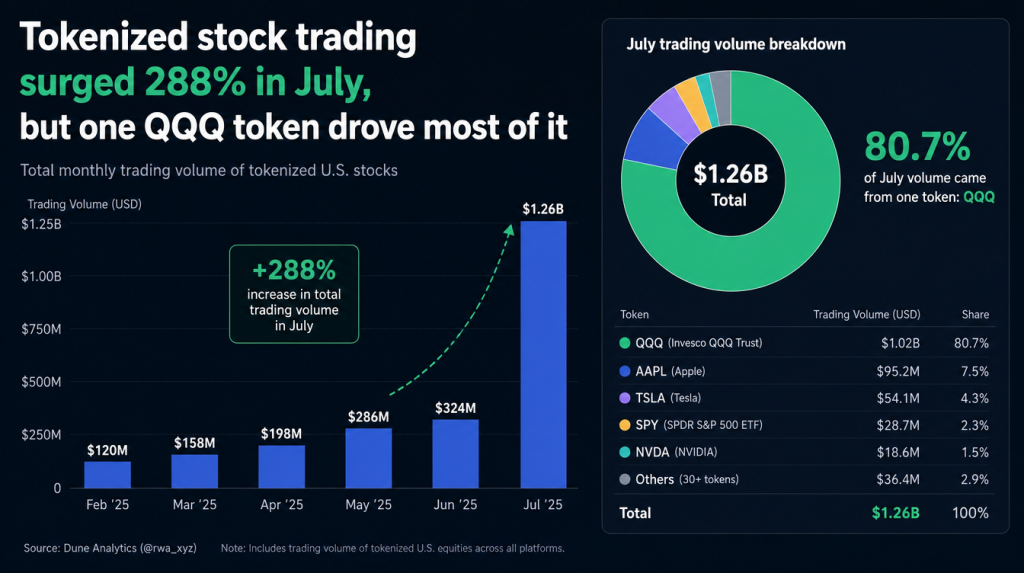
Stripping out the QQQ-linked token QQQB, total tokenized equity trading in July would come in at about $2.03 billion—roughly 30% lower than June’s estimated $2.91 billion.
Overall, trading in tokenized stocks and ETFs jumped 288% to a record $11.3 billion in July, but the bulk of that growth was driven by a single Binance-related product.
Binance’s bStocks alone accounted for $9.41 billion, or 83.3% of total volume, according to CoinDesk Data’s latest Stablecoins & Tokenized Assets report. Within that, QQQB—tracking the Invesco QQQ ETF—generated $9.27 billion, making up around 82% of all tokenized equity trading.
Excluding QQQB, activity across the rest of the market was far more muted. xStocks volume dropped sharply to $335 million from $1.55 billion, while Ondo recorded $792 million and Backpack $479 million, the report noted.
QQQB launched on Binance on June 30 with zero maker fees through Aug. 31. On July 23, Binance also began counting stock and bStocks trades at three times their actual value for certain users aiming for higher VIP tiers, though this adjustment does not affect real trading volume.
Meanwhile, the underlying Invesco QQQ Trust declined 6.6% in July, compared with a 3.2% drop in the Nasdaq Composite and a marginal 0.1% dip in the S&P 500. The ETF fell as much as 10.2% from its June 30 close before recovering in the final days of the month.
Much of the volatility was driven by AI and semiconductor stocks. The iShares Semiconductor ETF plunged 22.1%, marking its worst month since December 2002, while Micron shares dropped 28.7%, according to MarketWatch. Increased volatility tied to AI-related trading, the FOMC meeting, and big tech earnings helped fuel higher trading activity in the QQQ ETF.
One of the key attractions of tokenized equities is their round-the-clock availability. By mirroring traditional stocks on blockchain networks, these assets allow continuous trading, offering non-U.S. investors exposure outside regular market hours and in regions where direct access to U.S. equities may be limited.
About The Author




More Stories
CFTC Warns Prediction Platforms of Manipulation Risks in ‘Mention Markets’
Lummis Says Trump Opposition Helped Derail Crypto Clarity Act
XRP Ledger Retries Upgrade Designed to Split Payments and Compliance Roles