

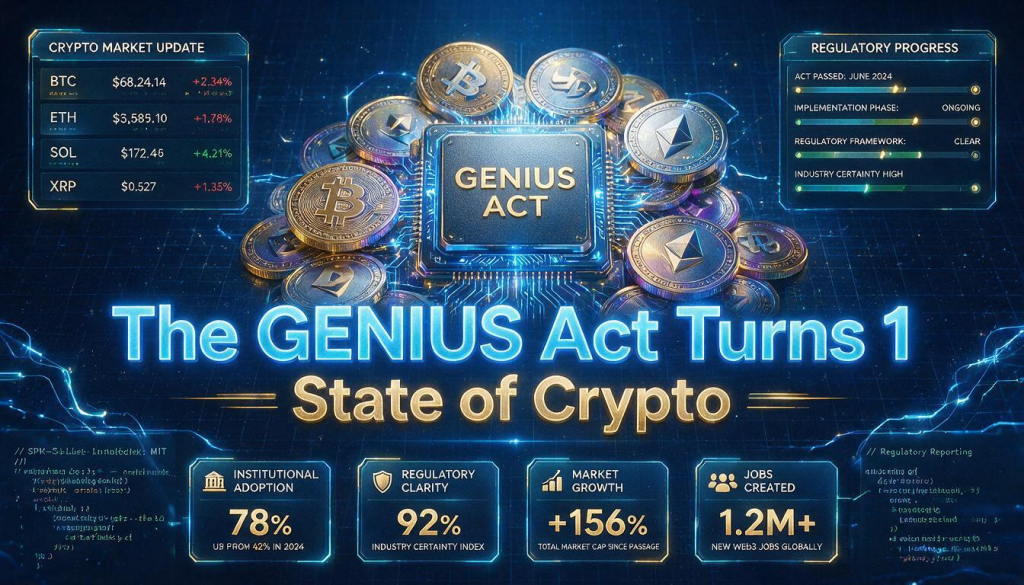
The GENIUS Act, a landmark piece of legislation focused on regulating stablecoins, became law one year ago.
President Donald Trump signed the Guiding and Establishing National Innovation for U.S. Stablecoins (GENIUS) Act into law a year ago, marking the beginning of the U.S. effort to create the country’s first federal framework for stablecoins. However, twelve months later, regulators are still working on developing the detailed rules that stablecoin issuers will ultimately need to follow.
Stablecoin Regulation: The Current Landscape
The GENIUS Act officially took effect a year ago, instructing federal regulators to establish guidelines for overseeing stablecoins and determining how these digital assets should be managed.
The law created a broad regulatory framework covering areas such as reserve requirements, governance structures and operational standards for stablecoin issuers. However, much of the implementation was left to agencies including the Office of the Comptroller of the Currency (OCC) and the Federal Deposit Insurance Corporation (FDIC).
Although the GENIUS Act only addresses one segment of the broader cryptocurrency industry, it represents the first major federal crypto legislation in the United States. While the final rules have not yet been completed, regulators have provided clearer indications of how they plan to approach stablecoin oversight.
Ji Hun Kim, CEO of the Crypto Council for Innovation, described the legislation as a “landmark moment,” saying that regulators, financial institutions and innovators now have a stronger foundation as stablecoins move closer toward wider adoption.
Regulatory agencies have already introduced proposals seeking public feedback on various elements of stablecoin supervision. Some proposals would require stablecoin companies to implement know-your-customer procedures similar to those used by traditional financial institutions.
The FDIC has released a series of questions exploring how it should oversee stablecoin issuers, including issues related to custody, capital requirements and liquidity standards. Meanwhile, the OCC issued its own proposal in February outlining its interpretation of the GENIUS Act and how banks and other institutions should approach stablecoin activities.
Final regulations are expected to take additional time before they are completed. Meanwhile, the crypto industry is also awaiting progress on another major legislative effort: the Digital Asset Market Clarity Act.
Clarity Act Update
The finalized text of the combined Clarity Act proposals has not yet been released. Although industry observers expected the legislation to be unveiled recently, the timeline has repeatedly shifted.
A planned briefing between Senators Cynthia Lummis and Bernie Moreno and President Trump did not produce a public update, leaving several unresolved issues surrounding the bill.
One of the biggest obstacles remains disagreement over ethics provisions that would prevent senior government officials from benefiting from personal crypto-related ventures.
Sources familiar with the negotiations said lawmakers had not reached bipartisan agreement on the ethics language as of last week.
Senator Elizabeth Warren has also raised concerns, requesting that Trump provide updated financial disclosures covering the first half of 2026. She argued that previous disclosures, which reported more than $1.4 billion in earnings from crypto-related ventures, may not fully reflect his current financial position.
Warren said an updated voluntary disclosure would help Congress better evaluate potential conflicts of interest and address concerns surrounding government ethics.
Meanwhile, lawmakers continue to promote the broader goals of the Clarity Act. A House Financial Services Committee subcommittee recently held a hearing focused on how the legislation could shape the future of the crypto industry.
Representative Bryan Steil, chairman of the digital assets subcommittee, argued that clear regulatory rules are necessary to replace enforcement-based oversight and encourage innovation.
He said the objective is to establish a predictable regulatory environment for digital assets, allowing the U.S. to maintain its leadership in financial innovation while providing clearer rules for the evolving blockchain industry.
The final outcome will depend on whether lawmakers can resolve remaining disagreements over ethics provisions and other unresolved issues before Congress leaves for recess.
Upcoming Schedule
On Tuesday, a House Agriculture Committee subcommittee is scheduled to hold a hearing focused on prediction markets.
The crypto industry continues to monitor developments around stablecoin regulation and broader digital asset legislation as lawmakers work toward creating a more defined regulatory framework.
About The Author





More Stories
Bond Volatility Surges as Bitcoin and Wall Street Remain Calm
Altcoins Surge as Bitcoin Holds Near $84,000
Bitcoin ETF Flows Turn Positive in 2026 After Erasing $5.8B Deficit