

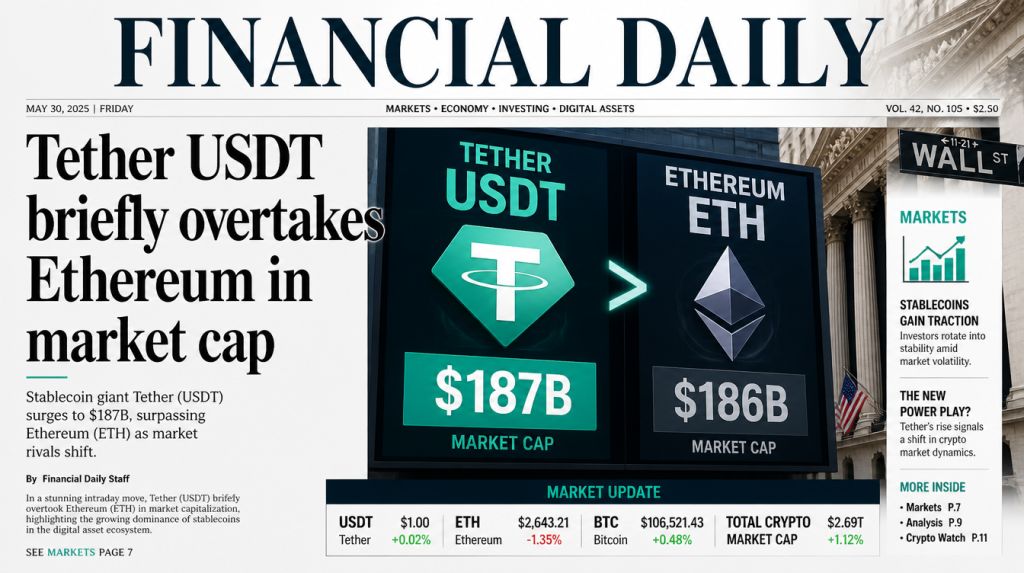
For a brief period earlier this week, Tether’s USDT stablecoin surpassed Ethereum in market capitalization—marking the first such occurrence in eight years. Data from multiple tracking platforms showed both assets fluctuating within the $183 billion to $188 billion range during the crossover, with one snapshot placing USDT at $187 billion and ETH at $186 billion—a gap of less than $1 billion.
The reversal was short-lived, with Ethereum reclaiming the number two spot once prices stabilized. However, the underlying forces that enabled the flip—continued USDT supply growth alongside persistent ETH price weakness—remained intact even after rankings normalized.
Crypto Market Structure: Understanding the USDT Flip
This shift was not driven by any sudden change in Ethereum’s supply. Instead, ETH’s market cap compression came from price declines, while USDT’s growth was fueled by ongoing issuance. Tether’s Q4 2025 attestation reported a record $187.3 billion supply, reflecting a $12.4 billion increase in a single quarter despite broader market turbulence.
Over a 12-month period into early 2026, USDT expanded from $144.2 billion to $184 billion—a 28% increase—while Ethereum’s valuation moved in the opposite direction.
In the three weeks leading up to the crossover, more than $7 billion exited the stablecoin sector, while total crypto market capitalization declined by roughly $400 billion. Ethereum’s DeFi total value locked (TVL) fell to around $36 billion. Rather than exiting stablecoins entirely, traders appeared to be rotating into them as a defensive move, parking capital while reducing exposure to volatile assets.
USDT currently commands approximately 59% of the stablecoin market, with USDT and USDC together accounting for about 82%, reinforcing Tether’s dominant position in this segment.
Mike McGlone’s Long-Term View
Bloomberg Intelligence senior commodity strategist Mike McGlone has tracked this trend for years. In October 2020, when USDT stood at $16 billion compared to Ethereum’s $43 billion, he suggested that USDT was on course to match Ethereum’s market cap within a year, framing it as part of a broader and persistent shift toward stablecoins gaining mainstream adoption.
His updated outlook extends even further. McGlone believes the “flippening” trend could continue, projecting that USDT may surpass Ethereum again in 2026—and potentially even Bitcoin over time. In a more extreme scenario, he suggests that if Bitcoin were to fall toward $10,000, USDT—requiring roughly 7x growth from current levels—could eventually challenge it for the top position.
While such a scenario may appear unlikely, dismissing it outright echoes the skepticism that previously surrounded the idea of USDT overtaking Ethereum.
ETH vs USDT: Current Positioning and What Lies Ahead
At present, Ethereum has reclaimed its position as the second-largest crypto asset by market cap, but the margin remains narrow. For that lead to become more secure, ETH would need sustained price appreciation, or USDT issuance would need to slow meaningfully.
Neither outcome is guaranteed. Ethereum’s long-term fundamentals—including advancements in scaling technologies such as zero-knowledge proofs—offer a bullish narrative, but these developments operate on a longer horizon than the short-term price pressures that enabled the recent crossover.
Meanwhile, USDT’s growth trajectory shows little sign of slowing. Tether added $12.4 billion in supply during a declining market. In more favorable conditions, issuance could accelerate further. Because USDT maintains a $1 peg, its market cap directly reflects circulating supply, meaning each newly minted token translates immediately into higher market capitalization—without the price volatility that affects assets like Ethereum.
As a result, the dynamics that briefly pushed USDT ahead of ETH remain firmly in play, even if the rankings have temporarily reset.
About The Author





More Stories
Bitcoin Starts New Quarter Stuck in Familiar $82K-$85K Range
Citigroup Lifts 12-Month Bitcoin Target to $113K as ETF Inflows Return
Bitcoin’s Inflation-Fueled Jump to $85.5K Fades as Yields Stay High