

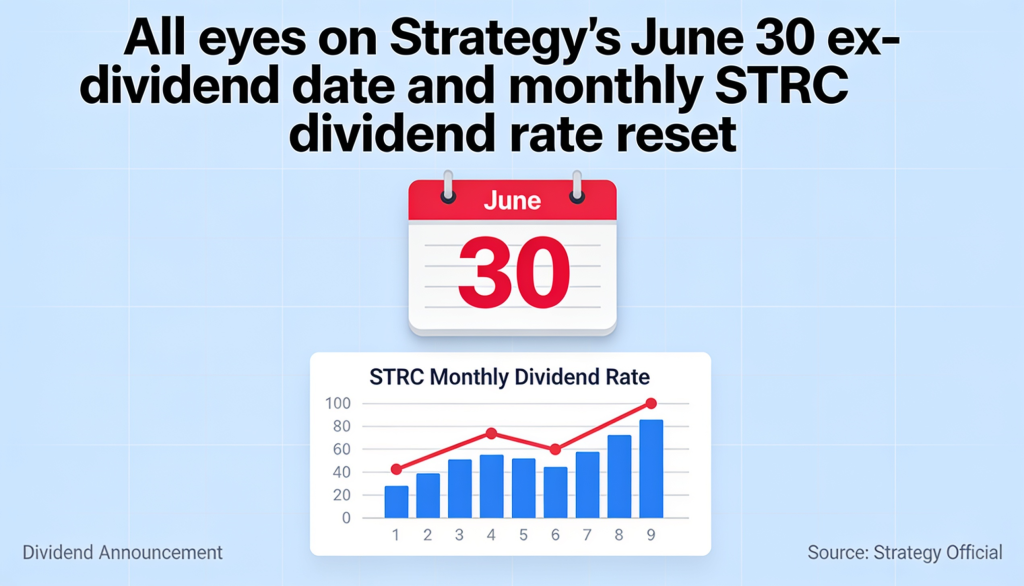
Investors are closely tracking both the upcoming ex-dividend date and the monthly dividend rate reset for Strategy’s preferred stock.
Strategy (MSTR) perpetual preferred shares, STRC, fell about 3% in Friday pre-market trading, slipping below $73—roughly 27% under their $100 par value—as attention turns to June 30, which marks two key events.
The first is the ex-dividend date. Shareholders who hold STRC before this date will qualify for the next payout, while those who purchase on or after June 30 will not. It also serves as the record date for eligibility, with investors set to receive STRC’s first semi-monthly dividend of $0.48 per share on July 15.
Typically, a stock adjusts downward by about the value of its dividend when it goes ex-dividend. In STRC’s case, a $0.48 payout on a $73 share price equates to less than a 0.7% move—small compared with the token’s recent 2–3% daily swings. As a result, the ex-dividend event is unlikely to be a major driver of additional downside.
The more significant focus is the monthly dividend rate reset. STRC is a perpetual preferred security with no maturity date, and its dividend rate can be adjusted periodically.
Strategy has kept the rate steady at 11.50% for four straight months despite STRC trading well below par. With a one-month volume-weighted average price (VWAP) of $91.46 and the stock now near $73, its implied yield has risen to around 15% based on market price—signaling that investors are effectively demanding higher compensation than the current payout provides.
This raises expectations for a possible upward adjustment to around 12%–12.50%. However, longer-term recovery in STRC is likely to depend more on Bitcoin’s performance than on modest changes to the dividend rate.
Meanwhile, MSTR common shares are trading near $85, more than 84% below their November 2024 peak, adding further pressure to Strategy’s bitcoin-linked capital structure.
About The Author





More Stories
Bitcoin Starts New Quarter Stuck in Familiar $82K-$85K Range
Citigroup Lifts 12-Month Bitcoin Target to $113K as ETF Inflows Return
Bitcoin’s Inflation-Fueled Jump to $85.5K Fades as Yields Stay High