

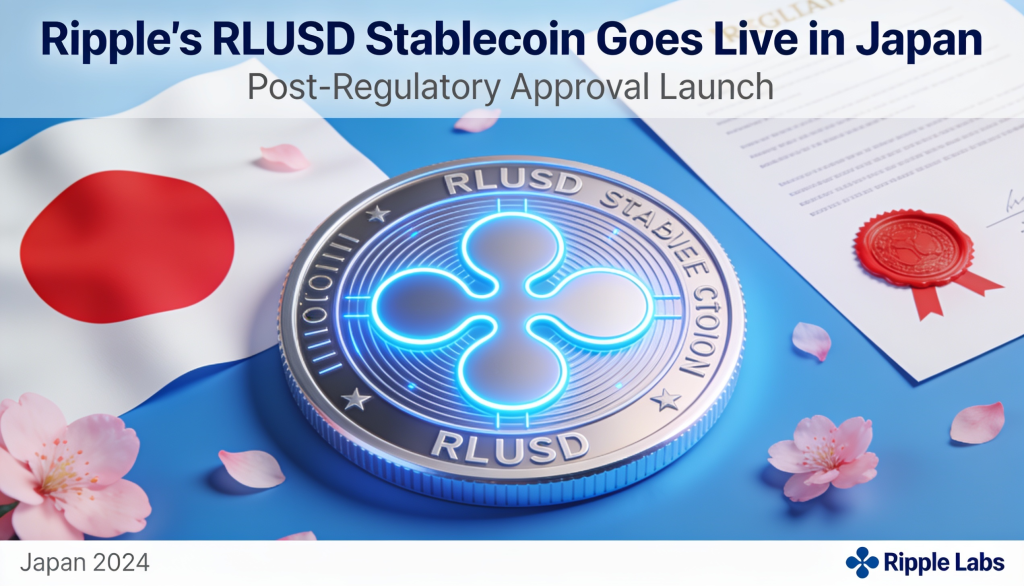
Japan’s financial regulator has approved Ripple’s U.S. dollar–backed RLUSD stablecoin as a new category of payment instrument, enabling SBI VC Trade to offer it to both institutional and retail users. Despite the expansion, RLUSD remains relatively small at around $1.7 billion in market value.
Ripple’s RLUSD has officially been cleared for use in Japan after receiving regulatory approval, marking its entry into one of Asia’s most tightly controlled crypto markets.
The Japan Financial Services Agency classified RLUSD as a new form of electronic payment instrument under the Payment Services Act, a framework designed for foreign-issued stablecoins that meet strict domestic requirements.
Stablecoins are crypto assets designed to maintain a stable value, typically pegged to fiat currencies like the U.S. dollar. In Japan, RLUSD will be distributed via SBI VC Trade, the crypto arm of financial conglomerate SBI, and will be accessible to both institutional and retail clients.
Japan maintains one of the strictest regulatory frameworks for stablecoins globally, making approval for a foreign-issued dollar-pegged token a significant milestone.
However, RLUSD’s scale remains limited. Ripple reports its market capitalization at roughly $1.7 billion since its launch in late 2024, far below dominant rivals such as Tether’s USDT at around $186 billion and Circle’s USDC at about $74 billion.
The rollout follows a memorandum of understanding signed by Ripple and SBI in August 2025 and builds on a partnership that began in 2016 focused on cross-border payments and blockchain infrastructure in Asia.
According to Ripple SVP Jack McDonald, RLUSD is intended to function as a bridge for payments, tokenization, and collateral management, linking Japanese businesses with global dollar liquidity.
RLUSD is positioned as Ripple’s regulated stablecoin offering and is distinct from XRP, the company’s native token. It is aimed primarily at enterprise use cases such as settlements and real-world asset tokenization.
The Japan launch extends Ripple’s broader push into regulated stablecoin markets at a time when jurisdictions including the U.S. and Europe are tightening oversight and formalizing rules for digital dollars.
Still, RLUSD faces a steep challenge in competing with established leaders. While regulatory approvals strengthen its institutional credibility, it must still build the scale, liquidity, and adoption needed to rival dominant stablecoins like USDT and USDC.
About The Author




More Stories
Bitcoin Starts New Quarter Stuck in Familiar $82K-$85K Range
Citigroup Lifts 12-Month Bitcoin Target to $113K as ETF Inflows Return
Bitcoin’s Inflation-Fueled Jump to $85.5K Fades as Yields Stay High