

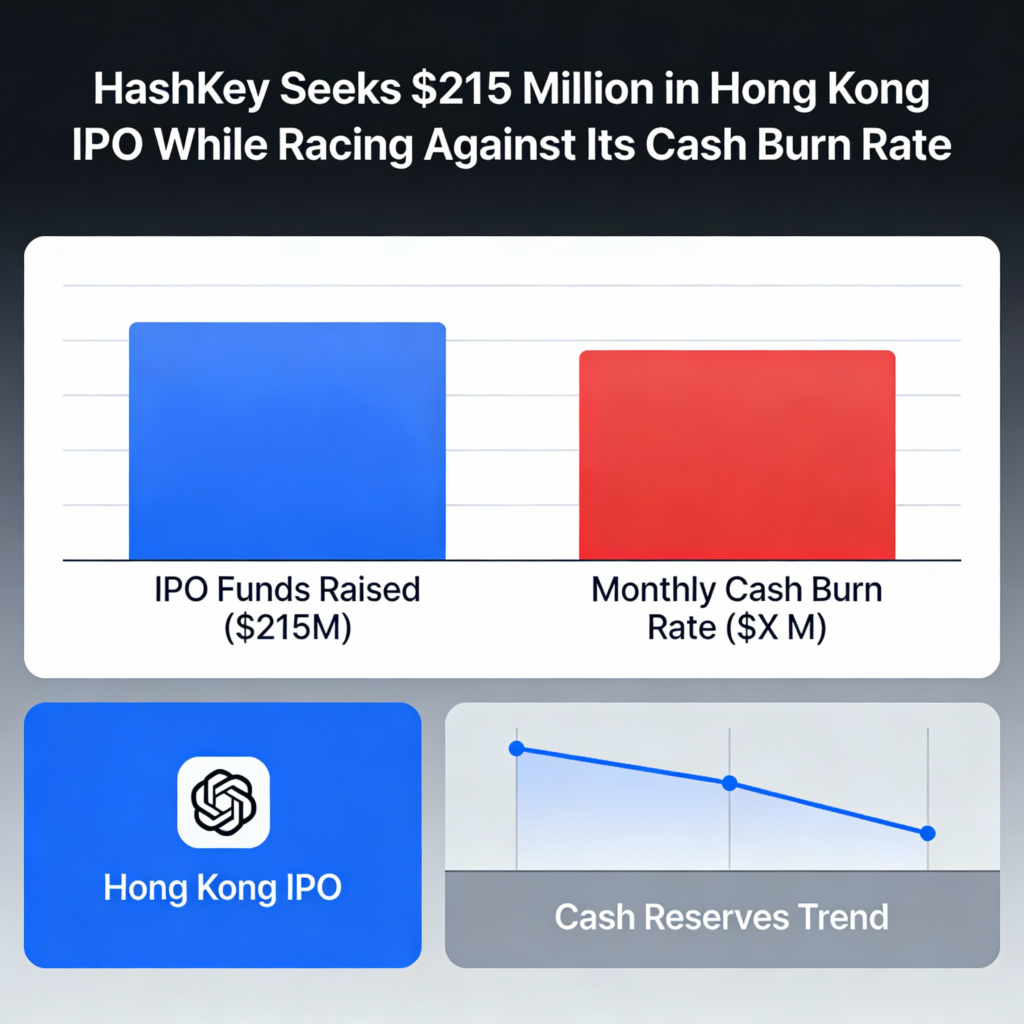
HashKey Eyes Hong Kong IPO Amid Institutional Growth and High Cash Burn
HashKey, one of Asia’s largest regulated crypto exchanges, plans to raise up to HK$1.67 billion ($215 million) in a Hong Kong IPO, according to its recently filed prospectus. The filing highlights strong institutional activity, growing staking and tokenization pipelines, and a user base surpassing 1.44 million accounts.
The prospectus also reveals significant losses. HashKey posted cumulative losses exceeding HK$3.0 billion ($386 million) from 2022 through mid-2025, reflecting major investments in custody, compliance, and on-chain infrastructure essential for a licensed exchange. In the first half of 2025, it lost HK$506.7 million, while averaging HK$40.9 million in monthly cash burn during the third quarter.
The company points to the leverage offered by its regulated structure. Major costs—including licensing, custody, and risk infrastructure—do not scale linearly, while revenue from trading, staking, and management fees can grow faster than expenses as adoption increases, creating potential for improved margins. Registered users surged from fewer than 200 in 2022 to 1.44 million today.
The filing notes a shift in user composition. Retail trading fell in early 2025 amid declines in Ether and other major assets, while institutional flows remained strong. HashKey Global, its Bermuda-registered retail-focused platform, was scaled back due to limited fiat on- and off-ramps. The exchange is focusing on its onshore platform, which offers licensed fiat channels and has become closely linked to ETF flows and traditional financial institutions.
With cash, digital assets, and expected IPO proceeds, HashKey estimates over 70 months of liquidity under conservative assumptions.
HashKey competes directly with Bullish, CoinDesk’s parent company.
About The Author




More Stories
Bitcoin holds near $68,300 while gold tumbles for a ninth session and Asian stocks fall
Resolv stablecoin drops 70% as exploiter siphons $25 million worth of ETH
Equities catch up to bitcoin’s drop toward $60,000 amid a surge in bond yields.