

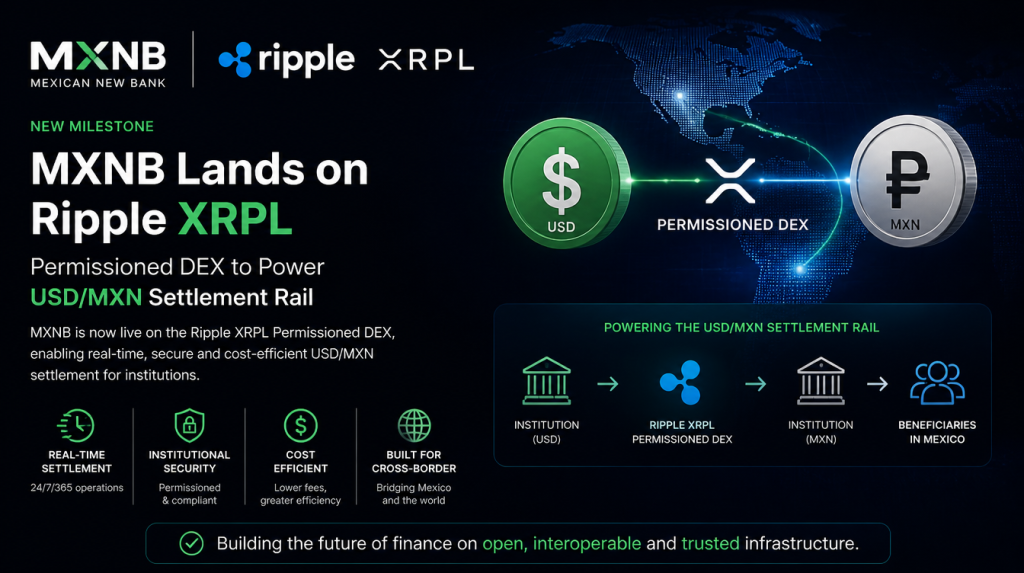
Ripple and Bitso have expanded their partnership to deploy the peso-backed stablecoin MXNB on XRPL’s Permissioned DEX, alongside RLUSD, aiming to build a regulated on-chain USD/MXN settlement rail for the U.S.–Mexico remittance corridor, which handles an estimated $60 billion in annual flows.
The announcement, made on June 13, 2026, marks the integration of MXNB—issued by Juno, a Bitso subsidiary—natively into the XRP Ledger. It is paired with Ripple’s RLUSD stablecoin on XRPL’s Permissioned DEX to enable direct USD/MXN settlement within a compliant, institutional-grade on-chain environment serving cross-border payments between the U.S. and Mexico.
Rather than a routine network expansion, the initiative is positioned as an effort to transform XRPL into regulated liquidity infrastructure tailored for one of the world’s largest remittance corridors.
Industry estimates, including figures cited by Bitget, place annual U.S.–Mexico remittance flows at over $60 billion, highlighting the scale of the opportunity, even though this number is not explicitly stated in Ripple’s own announcement.
MXNB on XRPL and how the settlement system works
MXNB, which already operates across blockchains such as Ethereum, Arbitrum, and Avalanche, has now been integrated into XRPL’s Permissioned DEX. This environment is designed for compliance-first participation, restricting access to KYC/AML-verified institutions and separating it from XRPL’s public decentralized exchange.
When combined with RLUSD, Ripple’s enterprise dollar stablecoin, the setup effectively creates a unified FX and settlement layer on a single ledger, reducing reliance on traditional correspondent banking infrastructure for cross-border transfers.
According to Bitso’s reserve disclosures, MXNB is fully backed 1:1 by Mexican pesos held in regulated financial institutions in Mexico. Its issuer, Juno, operates under Mexico’s Fintech Law as a licensed electronic payment institution, providing the regulatory framework that underpins its institutional positioning.
Ripple and Bitso’s long-standing LATAM partnership
Ripple first partnered with Bitso in 2019 as part of its On-Demand Liquidity network, using XRP to facilitate hundreds of millions of dollars in remittance flows into Mexico.
That early relationship helped establish Bitso as a key liquidity bridge across Latin America, setting the stage for today’s shift from XRP-based liquidity routing toward stablecoin-based settlement infrastructure.
Ripple’s LATAM Managing Director Silvio Pegado described the integration as “the next evolution of how value moves between dollars and pesos,” adding that the RLUSD–MXNB pairing on XRPL’s Permissioned DEX delivers “regulated, onchain liquidity infrastructure purpose-built for enterprise cross-border payments.”
Bitso Business head of stablecoins Ben Reid said MXNB was designed specifically for institutional settlement, offering “peso-denominated liquidity on-chain” with compliance assurance and efficiency suited for enterprise use cases.
Industry implications and infrastructure outlook
The key question is no longer whether XRPL can support stablecoin activity—it already has demonstrated that capability through RLUSD adoption. The focus now shifts to whether the Permissioned DEX can attract enough institutional participants such as banks, payment processors, and fintech firms to generate the liquidity depth needed to compete with traditional FX and settlement systems.
Ripple frames the MXNB–RLUSD pairing as a blueprint for expanding similar locally denominated stablecoin settlement corridors across Latin America, with the U.S.–Mexico route serving as the initial proof of concept.
In the near term, the most important signal is likely not XRP price action, but the pace of institutional onboarding to the Permissioned DEX, which will determine whether this model scales into a broader regional settlement network or remains a more limited bilateral corridor solution.
About The Author





More Stories
Bitcoin Starts New Quarter Stuck in Familiar $82K-$85K Range
Citigroup Lifts 12-Month Bitcoin Target to $113K as ETF Inflows Return
Bitcoin’s Inflation-Fueled Jump to $85.5K Fades as Yields Stay High