

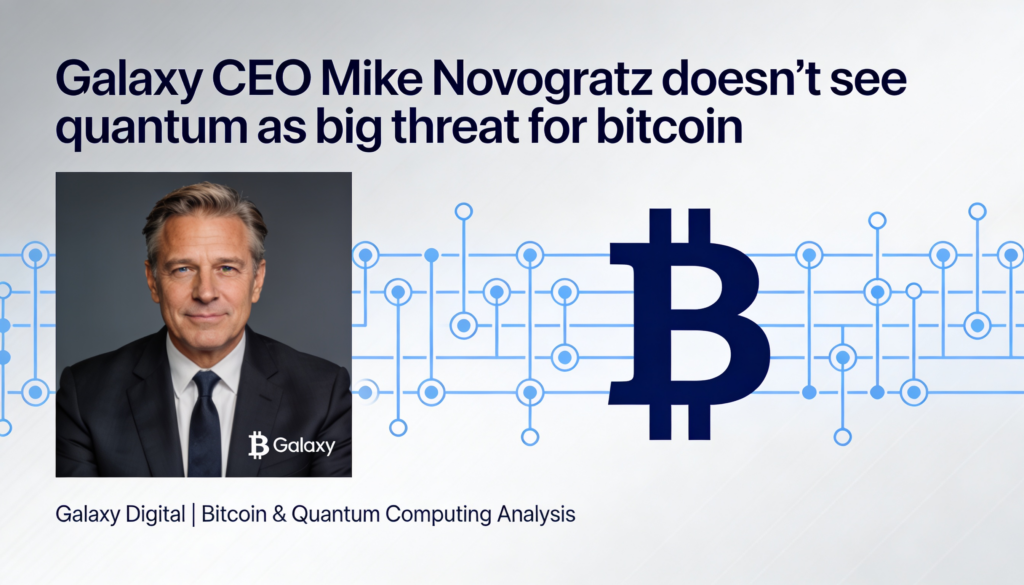
Galaxy Digital CEO Mike Novogratz says early Bitcoin investors are increasingly taking profits, a shift that suggests weakening adherence to the long-standing “HODL” philosophy that once defined the crypto community.
During Galaxy’s earnings call on Tuesday, Novogratz downplayed fears that quantum computing poses a near-term threat to Bitcoin, arguing that the concern is often used as a rationale for selling rather than a reflection of imminent risk.
“Quantum has been the big excuse for people,” Novogratz said, adding that while the technology could have broad implications globally, it is unlikely to destabilize Bitcoin. “In the long run, quantum will not be a huge issue for crypto. It’ll be a big issue for the world, but crypto—Bitcoin especially—will be able to handle it.”
Concerns around quantum computing and its potential impact on Bitcoin’s cryptography have gained traction in recent months. Last month, Jefferies’ global head of equity strategy Christopher Wood removed a 10% Bitcoin allocation from his model portfolio, citing quantum-related risks. Coinbase has also acknowledged that quantum computing could represent a long-term threat to the crypto market, while the Ethereum Foundation this month elevated post-quantum security to a strategic priority by forming a dedicated team.
Novogratz said quantum computing remains in its early stages and stressed that the Bitcoin network will be able to adapt as the technology matures. “As we get closer to quantum, we’re going to get closer to quantum-resistant,” he said. “The Bitcoin code will be changed in time.”
Some Bitcoin developers have pushed back on the quantum narrative, noting that computers capable of breaking Bitcoin’s cryptography do not exist today and are unlikely to emerge for decades. Still, for some investors, even a distant or theoretical risk is enough to challenge Bitcoin’s “store of value” credentials.
Early holders sell
Novogratz also addressed growing scrutiny over whether long-term Bitcoin holders, often referred to as “OGs,” are selling their holdings.
The discussion intensified last year after Galaxy revealed it had facilitated the sale of more than 80,000 bitcoin—worth roughly $9 billion at the time—for a Satoshi-era investor. The firm said the transaction, one of the largest in Bitcoin’s history, was conducted as part of the seller’s estate planning.
The sale reignited debate over whether early Bitcoin adopters, who have long championed holding through market volatility, are beginning to lose conviction. According to Novogratz, profit-taking among these investors is real and tends to build momentum once it begins.
“Once you start selling, it becomes a cycle,” he said. “You sell a little more, you sell a little more, and it becomes very hard to HODL.”
“There used to be a tremendous number of almost religious believers in never selling Bitcoin,” Novogratz added. “Somehow that fever broke, and you started seeing more selling.”
About The Author


More Stories
Bitcoin holds near $68,300 while gold tumbles for a ninth session and Asian stocks fall
XRP slides 3% on break under $1.44 with BTC softness capping recovery
BTC mining turns unprofitable with $19,000 loss per coin despite 7.8% difficulty drop