

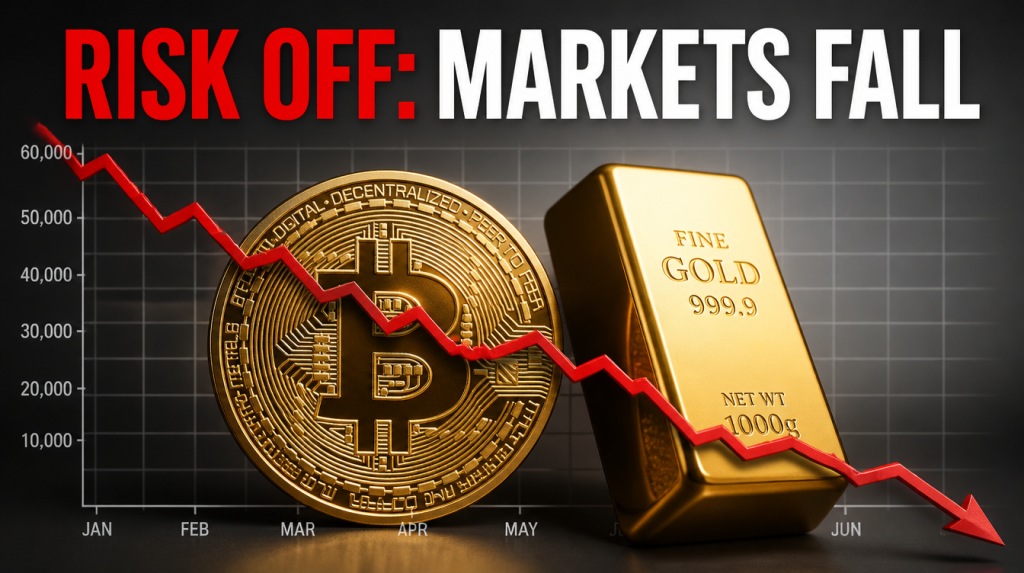
Bitcoin is trading near $61,100, down about 3% on the day and roughly 7% over the week, as a stronger-than-expected U.S. May jobs report pushed interest rate expectations higher and triggered a broad risk-off move across global markets.
Gold also moved lower, slipping around 2% to below $4,200 per ounce. The joint decline challenges the idea that the two assets consistently behave differently during periods of macro stress.
The catalyst was U.S. employment data showing 172,000 non-farm payrolls in May versus 130,000 expected, with April’s figure also revised up to 214,000. The stronger labor print reinforced expectations that the Federal Reserve will keep rates higher for longer, potentially pushing rate cuts far into 2027 and forcing a widespread repricing of global liquidity conditions.
Higher Rates Pressure Both Bitcoin and Gold
Stronger economic data reduces the urgency for monetary easing, lifting real yields and strengthening the U.S. dollar—conditions that typically weigh on non-yielding assets like Bitcoin and gold.
The 10-year Treasury yield rose to 4.54%, while Brent crude climbed near $92 per barrel, adding further inflation pressure and complicating the Federal Reserve’s policy outlook.
New Fed Chair Kevin Warsh now faces a pivotal decision at the June 17–18 FOMC meeting, where policymakers must choose between maintaining current policy guidance or signaling a more restrictive stance if inflation remains persistent.
Cleveland Fed President Beth Hammack has already suggested that further action may be required, while WSJ’s Nick Timiraos noted that the strong labor report has effectively removed expectations for near-term rate cuts.
At the same time, Bitcoin ETF flows continue to soften. According to sFOX executive Diana Pires, short-term dip buyers are present, but sustained institutional demand has yet to return in meaningful size.
Ongoing outflows from U.S. spot Bitcoin ETFs, along with Strategy’s first BTC sale since 2022, have further weakened the narrative of consistent institutional accumulation that previously supported Bitcoin above $70,000.
Global equities also reflected the risk-off tone. South Korea’s Kospi fell 6.3%, the MSCI Asia-Pacific index dropped 2.5% for a fourth consecutive decline, and Nasdaq 100 futures eased 0.8%.
More than $500 million in bearish positions were liquidated, indicating the earlier rebound was driven largely by short covering rather than fresh capital inflows. Bitcoin’s brief move toward $62,500 failed to attract sufficient spot demand to sustain gains.
Bitcoin and Gold Correlation Is Unstable
The relationship between Bitcoin and gold remains highly variable. While longer-term correlations have recently climbed toward 0.6, shorter-term readings from CryptoQuant show sharp swings into negative territory, underscoring how quickly macro conditions can reshape their behavior.
A dovish outcome from the June 17–18 FOMC meeting could spark a relief rally, but any hawkish surprise or tightening signal could extend downside pressure.
Bitcoin Technical Structure Weakens Further
Bitcoin is now trading around $61,146 and has broken below its February lows, a key structural support level that had previously supported the recovery trend. This marks its weakest point since mid-2024 and signals a clear deterioration in the short-term technical structure.
The $61,000–$62,000 zone had been essential for maintaining the bullish narrative. Losing it decisively places the market in a more fragile position.
If selling continues, the next major support lies in the $55,000–$58,000 range, aligning with a prior accumulation zone from mid-2024.
While sharp declines often produce short-term relief rallies, those rebounds are likely to face resistance unless stronger spot inflows return.
To stabilize, Bitcoin would need to reclaim the $64,000–$65,000 area, with $68,000 as the next threshold for any sustained recovery attempt.
For now, the market remains in a breakdown phase, with sellers firmly in control and buyers needing to rebuild structure before any meaningful recovery can develop.
About The Author





More Stories
Bond Volatility Surges as Bitcoin and Wall Street Remain Calm
Altcoins Surge as Bitcoin Holds Near $84,000
Bitcoin ETF Flows Turn Positive in 2026 After Erasing $5.8B Deficit