

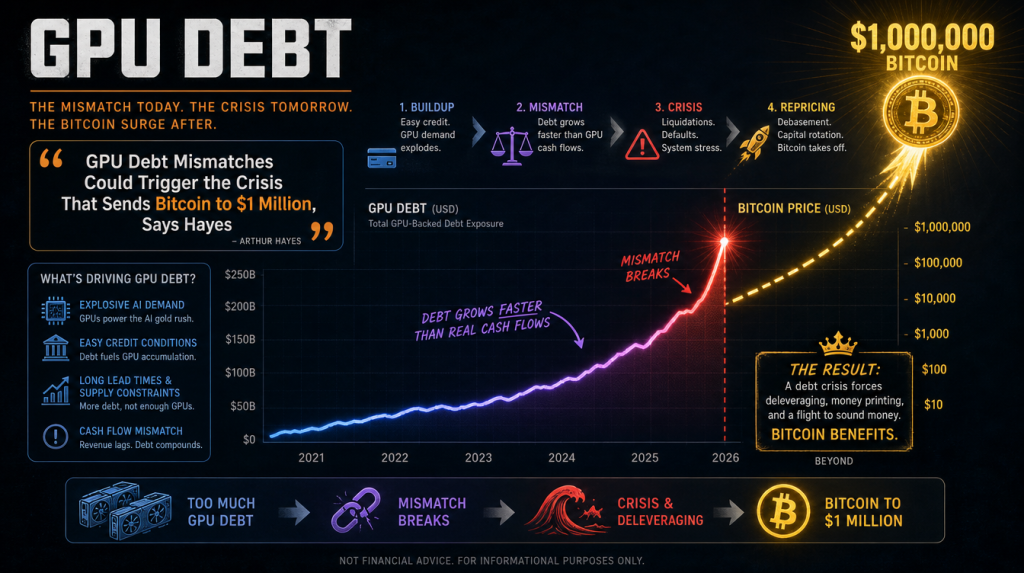
Arthur Hayes has cautioned that roughly $1.5 trillion in debt tied to artificial intelligence could spark a financial crisis larger than the one in 2008. In his view, such a shock would force aggressive money printing, ultimately driving capital into Bitcoin and potentially pushing its price toward $1 million per coin.
Speaking on the Bankless podcast on June 22, 2026, the BitMEX co-founder and CIO of Maelstrom explained that AI-related borrowing since late 2022 has absorbed nearly all of the expansion in the U.S. M2 money supply. This, he argues, has effectively drained liquidity that might otherwise have flowed into Bitcoin, setting the stage for a credit collapse that could exceed the scale of the subprime crisis. Under such conditions, Hayes envisions Bitcoin reaching a long-term peak of $1 million.
Hayes emphasized that his outlook goes beyond a simple price prediction. Instead, it reflects a broader structural argument about massive capital misallocation—on a scale he believes the global financial system has never experienced—where Bitcoin ultimately benefits as a residual asset once policy responses kick in.
He outlined how the potential AI credit crisis could unfold. Capital that might have supported Bitcoin has instead been funneled into building data centers and GPU clusters, financed largely through long-term debt. Hayes compared the current AI investment boom to the 19th-century railroad expansion, both in size relative to global GDP and in the risk of eventual overextension. A key vulnerability, he noted, lies in mismatched financing: loans are structured over five to six years, while cutting-edge AI hardware often becomes outdated within about two years.
Another risk channel involves pricing competition from Chinese AI firms. If U.S. providers are forced to lower prices to remain competitive, the projected cash flows supporting GPU-related debt could deteriorate quickly. Hayes described this repricing as a potential trigger for a major credit event—one he believes could surpass the subprime meltdown in severity.
Supporting this concern, a bulletin from the Bank for International Settlements highlighted the rapid rise of AI-linked private credit, which has grown from virtually nothing to over $200 billion, now accounting for nearly 8% of the total private credit market. The report also pointed out that major tech firms are increasingly shifting AI infrastructure debt off their balance sheets through special-purpose vehicles and leasing structures, creating less visible channels through which financial stress could spread.
According to Hayes, the likely policy response to such a crisis would be familiar: governments and central banks would inject large amounts of liquidity to stabilize the financial system. He suggested that authorities would effectively flood the system with fiat money to counteract the fallout from years of excessive investment in AI.
The key question, he argued, is where that liquidity would ultimately flow. After suffering significant losses in AI investments, investors may avoid returning to the sector, as it would no longer justify its cost of capital. Instead, Hayes believes much of this capital would shift into cryptocurrencies, with Bitcoin capturing a large share because it operates outside traditional financial institutions and asset classes affected by the downturn.
A $1 million Bitcoin price would imply a total market value of around $21 trillion, requiring an extraordinary level of liquidity injection—far greater than what was seen during the COVID-19 crisis. Hayes acknowledged that the timing of such a scenario is uncertain, noting that the AI bubble could unwind within months or take years to materialize. His thesis depends on a large-scale monetary response rather than gradual policy easing.
For this scenario to play out, Hayes said there would need to be widespread defaults or impairments in AI-related private credit, particularly among smaller GPU lenders and highly leveraged data center operators. If this triggers a major policy response and institutions begin to view Bitcoin as a hedge against currency debasement, the capital rotation he describes becomes more plausible.
However, there are also risks to this outlook. In past crises, liquidity has typically flowed first into traditional safe havens such as government bonds and gold. Bitcoin, which has historically behaved like a risk asset during acute market stress—as seen in March 2020—could initially decline alongside AI-related equities before benefiting from any later shift into scarce assets.
Hayes’ own investment stance reflects a cautious approach. As of June 2026, he described himself as consistently bullish on Bitcoin but also holding substantial cash in Treasury bills, while reducing exposure to more volatile crypto assets like NEAR and Hyperliquid. He emphasized that preserving capital has been key to maintaining wealth across market cycles. In this context, the $1 million Bitcoin target represents a potential peak in a future cycle rather than an immediate expectation, dependent on a series of macroeconomic events that have yet to fully unfold.
About The Author





More Stories
CFTC Warns Prediction Platforms of Manipulation Risks in ‘Mention Markets’
Lummis Says Trump Opposition Helped Derail Crypto Clarity Act
XRP Ledger Retries Upgrade Designed to Split Payments and Compliance Roles