

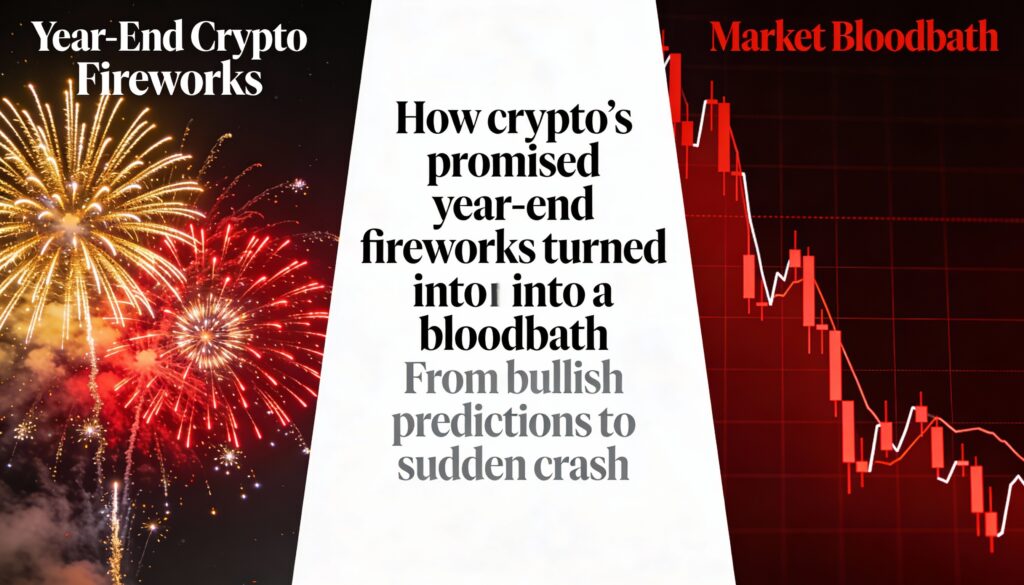
Crypto’s year-end optimism in 2025 — fueled by digital asset treasuries (DATs), altcoin ETFs, and bitcoin’s historically strong seasonal performance — turned into one of the harshest drawdowns since the 2022 crypto winter.
Heading into Q4, bitcoin rode strong ETF inflows, the launch of new DATs promising leveraged exposure, and analysts pointing to the final three months of the year as the most reliable for gains. Expectations of looser monetary policy and a favorable political backdrop in Washington further fueled projections of record highs.
Reality, however, diverged sharply. A $19 billion liquidation cascade in October drained liquidity, spot altcoin ETFs failed to offset selling pressure, and many treasury-heavy crypto firms shifted from buyers into potential forced sellers. Bitcoin has fallen 23% since early October, underperforming equities and precious metals.
DATs: From growth driver to risk
Digital asset treasuries — hastily launched publicly traded firms attempting to replicate Michael Saylor’s strategy — initially sparked investor excitement. But as crypto prices fell in October, DATs accelerated selling. Share prices dropped below net asset value, limiting their ability to issue new shares or debt. Some treasuries, instead of buying crypto, began using cash to repurchase their own shares. For example, KindlyMD (NAKA) now holds bitcoin worth more than twice its enterprise value. Analysts warn other DATs could follow, dumping assets into a fragile market and turning a promised growth flywheel into a tailspin.
Altcoin ETFs fail to move markets
Spot altcoin ETFs launched in the U.S. saw meaningful inflows — Solana ETFs brought in $900 million and XRP vehicles surpassed $1 billion in just over a month. Yet the underlying tokens fell: SOL is down 35% since the ETF debut, and XRP nearly 20%. ETFs for smaller altcoins such as Hedera (HBAR), DOGE, and LTC saw little demand as risk appetite evaporated.
Bitcoin’s seasonal rally fails to materialize
Historically, bitcoin’s fourth quarter has been its strongest, with an average gain of 77% since 2013 and positive returns in eight of the past twelve years. Exceptions — 2014, 2018, 2019, and 2022 — occurred during bear markets. 2025 now looks set to join that list, with BTC down 23% since October, its worst Q4 performance in seven years if current levels hold.
The October 10 liquidation sent BTC from $122,500 to $107,000 in hours, with altcoins seeing larger losses. Despite ETFs and increasing institutional involvement, crypto remains highly speculative. Liquidity has yet to recover, and investor confidence has weakened. Open interest has dropped from $30 billion to $28 billion, suggesting recent gains largely reflect short-covering rather than genuine buying.
Since October, crypto has lagged traditional assets: the Nasdaq is up 5.6%, gold 6.2%, while BTC has fallen 21%. This highlights the failure of 2025 catalysts and the absence of strong drivers for 2026.
DATs pose ongoing risks
Many DATs bought heavily at market peaks, with several now trading below mNAV, raising the risk of forced liquidations into illiquid markets. Strategy (MSTR) CEO Phong Le noted the company could sell BTC if mNAV falls below 1.0, though large-scale purchases continue. CoinShares has called the DAT bubble “already burst” in many respects.
A cautious silver lining
Historically, sell-offs from treasury-heavy firms can create buying opportunities. Similar conditions appeared during the 2022 bear market following the collapse of Celsius, Three Arrows Capital, and FTX — suggesting strategic investors could find attractive entry points as DATs unwind.
About The Author



More Stories
Bitcoin holds near $68,300 while gold tumbles for a ninth session and Asian stocks fall
Resolv stablecoin drops 70% as exploiter siphons $25 million worth of ETH
Equities catch up to bitcoin’s drop toward $60,000 amid a surge in bond yields.