

Bitcoin News: Crypto Wealth Is Increasingly Funding Physical Security Assets
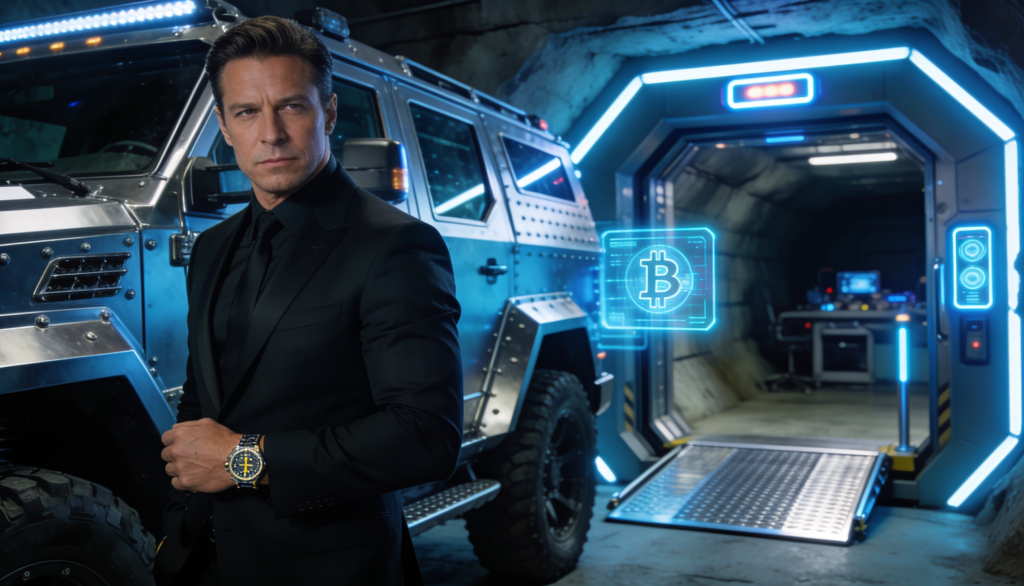
Marathon Digital Holdings (MARA) revealed in its latest DEF 14A proxy filing that it spent $869,160 on armored vehicles for its top executives. The company allocated $430,780 for CEO Fred Thiel and $438,380 for CFO Salman Khan. Combined with other security-related expenses, Thiel’s annual personal protection costs reached $4.3 million, while Khan’s totaled $3.9 million.
This is far more than a minor executive perk. The disclosure reflects a growing reality within the cryptocurrency industry: individuals with large, publicly known Bitcoin holdings are increasingly facing security risks that require extensive physical protection measures.
MARA’s filing highlights a broader trend among early Bitcoin adopters and crypto whales who have been directing a portion of their digital wealth into tangible security infrastructure. Armored vehicles are only one aspect of this movement.
Many wealthy Bitcoin investors are also purchasing underground shelters, off-grid compounds, so-called Bitcoin citadels, second citizenships, and diversified residency options. Strategies once viewed as extreme or overly cautious in 2020 are becoming increasingly mainstream in 2025.
Cypherpunk Philosophy and the Rise of Modern Preparedness
The roots of this trend can be traced back to the cypherpunk movement, which viewed financial privacy and personal sovereignty as closely connected concepts.
During the 1990s, the same communities that helped shape Bitcoin’s intellectual foundations expressed deep skepticism toward centralized institutions, government-controlled monetary systems, and the long-term stability of fiat currencies. When Satoshi Nakamoto published the Bitcoin whitepaper in October 2008 shortly after the collapse of Lehman Brothers, the timing reinforced many of these concerns.
Early discussions on Bitcointalk frequently combined Bitcoin price speculation with conversations about financial crises, jurisdictional mobility, and methods for preserving wealth outside traditional banking systems.
Those ideas never disappeared; they simply gained greater financial backing as Bitcoin matured. Former Coinbase CTO Balaji Srinivasan expanded on these concepts in his 2022 book The Network State, presenting Bitcoin as a form of borderless digital money and advocating for independent communities and startup cities as safeguards against institutional decline.
The concept effectively transforms long-standing cypherpunk principles into a practical framework supported by real-world assets and infrastructure.
Similarly, the “Bitcoin citadel” concept—once a niche meme on early Bitcoin forums describing fortified communities for Bitcoin holders in the event of fiat currency collapse—has evolved from internet folklore into a growing investment theme.
What was once speculative discussion is increasingly reflected in corporate disclosures and rising demand for luxury survival infrastructure.
From Armored Transportation to Secure Compounds
MARA’s armored vehicle expenditure stands out because it appears in a legally regulated corporate filing reviewed by shareholders and regulators.
The company justified the spending by citing the unique risks associated with Bitcoin and Ethereum. Because digital assets can be transferred instantly and, in many cases, irreversibly, an executive forced to surrender wallet credentials could lose substantial holdings within seconds.
Coinbase provides another notable example. The crypto exchange disclosed $7.6 million in personal security-related compensation for CEO Brian Armstrong during the previous year, covering executive protection, home security, family security, and secure transportation.
Together, disclosures from MARA and Coinbase show more than $16 million in executive security spending within a single reporting period, highlighting an industry-wide reassessment of physical security risks.
Beyond public filings, private investments in preparedness infrastructure appear to be following the same trajectory. Companies such as Survival Condo, Oppidum, and Vivos market fortified underground residences equipped with amenities ranging from private living quarters to cinemas, swimming pools, and dedicated staff facilities.
According to Vivos founder Robert Vicino, demand has been fueled by concerns surrounding geopolitical tensions, social unrest, electromagnetic pulse (EMP) threats, and even nuclear scenarios.
Many providers market armored vehicles and underground shelters together as comprehensive security solutions. Specialized armored SUVs, often compared to futuristic military-style vehicles, are frequently packaged alongside secure underground properties.
For early Bitcoin investors who accumulated BTC at prices below $1,000, allocating a small percentage of their holdings toward physical security infrastructure can be viewed as a rational hedge. In the best-case scenario, they own highly secure real estate. In the worst-case scenarios they have long anticipated, those investments could prove invaluable.
As one emerging perspective suggests: gold may serve as protection during times of conflict, Bitcoin may provide mobility and financial escape, and armored transportation bridges the gap between the two.
About The Author




More Stories
Bitcoin Starts New Quarter Stuck in Familiar $82K-$85K Range
Citigroup Lifts 12-Month Bitcoin Target to $113K as ETF Inflows Return
Bitcoin’s Inflation-Fueled Jump to $85.5K Fades as Yields Stay High