

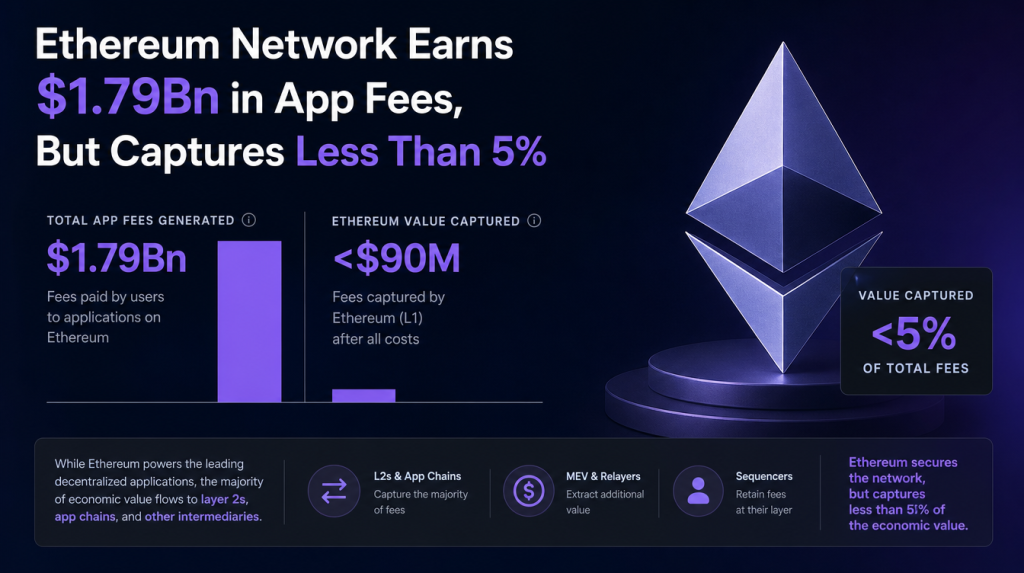
Ethereum’s application ecosystem generated $1.79 billion in fees during Q2 2026, while layer-2 networks processed around 1,270 user operations per second and real-world assets worth $17.2 billion were brought on-chain.
Despite this growth, ETH remains below the $2,000 level, nearly 60% lower than its August 2025 all-time high of around $4,950. While Ethereum’s network activity continues to expand, the value flowing back to the ETH token has failed to keep pace, creating one of the biggest debates surrounding the ecosystem.
On-chain analyst @Tanaka_L2 highlighted this disconnect in a July 31 analysis, showing that Ethereum’s base layer captured only 4.9% of the economic value produced by applications built on top of it during Q2. The network generated $88.4 million in Real Economic Value compared with $1.79 billion produced by applications.
This imbalance helps explain ETH’s weaker performance compared with both its historical trends and Bitcoin. In 2026, Bitcoin has declined about 11% year-to-date, while Ethereum has fallen closer to 32%.
The decline in Ethereum’s value capture appears to be driven by structural changes rather than a temporary market cycle. Layer-2 rollups have become the main source of user activity, with Tanaka’s data showing roughly 1,270 user operations per second on rollups compared with only 20.4 on Ethereum’s mainnet.
The Impact of the Blob Fee Model on ETH’s Burn Narrative
Ethereum’s scaling strategy has successfully reduced costs for L2 networks, but the introduction of low-cost blob fees has also reduced the fee pressure that previously supported ETH’s supply burn mechanism.
Data shows that only around 0.22 ETH was burned through blob fees over a seven-day period, a negligible amount. With ETH’s annual supply growth estimated at 0.85% and staking yields around 2.6%, the conditions behind the “ultrasound money” narrative have weakened.
The ETH/BTC ratio has fallen to multi-year lows as Bitcoin continues benefiting from steady institutional demand. At the same time, Ethereum faces challenges from ETF outflows and the lack of a clear near-term demand catalyst.
Understanding Ethereum’s current position requires looking beyond network usage and examining how institutional capital is moving across digital assets, where strong narratives often influence investment decisions alongside fundamentals.
A New ETH Investment Thesis: Settlement Asset Rather Than Fee Generator
Tanaka argues that Ethereum’s traditional value proposition as a fee-generating network is outdated. Instead, he believes ETH should be viewed as reserve capital and a settlement asset for institutional tokenized finance.
Under this framework, growing adoption of on-chain financial assets would increase demand for ETH as collateral and as a settlement mechanism, shifting the primary driver of value away from everyday retail transactions.
Current ecosystem data supports parts of this argument. Ethereum hosts approximately $299.4 billion in stablecoins, while tokenized real-world assets on the network have reached around $17.2 billion.
Tanaka said Ethereum’s strongest advantages are its institutional liquidity, settlement reliability, and large amount of ETH locked in staking, rather than transaction fees alone. This perspective has gained interest among major asset managers despite ETH’s weak price performance.
However, he identified three conditions needed for this thesis to translate into higher ETH value:
- L2 activity must create meaningful economic scarcity for Ethereum’s throughput capacity.
- Stablecoins and real-world assets must actively circulate rather than remain inactive on-chain.
- Institutions must hold ETH as a reserve asset rather than simply use Ethereum infrastructure.
So far, none of these factors has developed at a meaningful scale.
Ethereum’s Future Depends on Value Capture
The future outlook for Ethereum depends on whether network growth eventually converts into stronger revenue generation for the base layer.
If real-world asset settlement and stablecoin activity expand enough to increase demand for blob space beyond available capacity, Ethereum could see renewed fee pressure and a revival of the ETH burn mechanism.
That scenario would allow the network’s scaling investments to translate into stronger token economics. However, if Ethereum continues experiencing high usage while L1 fees remain low, the ETH/BTC ratio could face further pressure and reinforce concerns about Ethereum’s ability to capture value.
ETH’s short-term performance also remains influenced by broader market conditions. The asset maintains a stronger correlation with Nasdaq compared with Bitcoin and currently lacks a major catalyst capable of directly solving the network’s value-capture challenge.
Tanaka describes Ethereum’s current phase as a deliberate margin-compression period: the ecosystem sacrificed short-term fee revenue to build greater scale, with the expectation that economic benefits will arrive later.
The market’s current debate is whether this delayed value capture will eventually lead to a major repricing of ETH or become a permanent feature of Ethereum’s modular architecture.
About The Author





More Stories
CFTC Warns Prediction Platforms of Manipulation Risks in ‘Mention Markets’
Lummis Says Trump Opposition Helped Derail Crypto Clarity Act
XRP Ledger Retries Upgrade Designed to Split Payments and Compliance Roles