

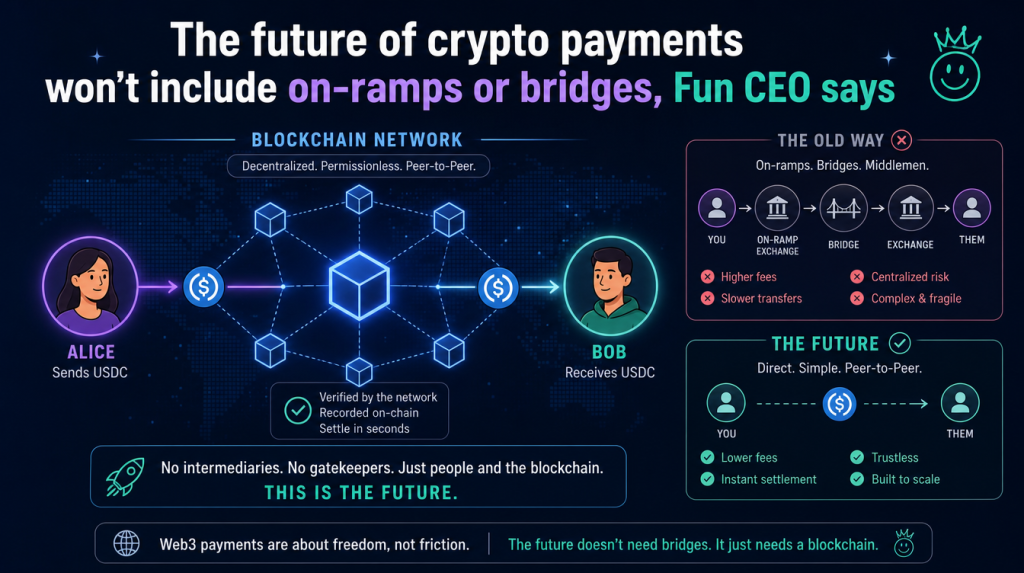
Fun CEO Alex Fine believes traditional crypto infrastructure, including standalone on-ramps and blockchain bridges, will eventually become outdated as digital asset platforms move toward unified payment systems that hide blockchain complexity from users.
Instead of requiring users to complete separate steps for funding, bridging, and asset conversion, future crypto applications will integrate payments directly into their interfaces. Fine said this approach will resemble Web2 payment experiences, where users interact with services without needing to understand the underlying transaction infrastructure.
“The era of on-ramps will completely disappear, and external bridge platforms will fade away,” Fine told CoinDesk. “Users do not want to use a bridge just for the sake of using a bridge. They want to access an application.”
Fun provides payment infrastructure that connects traditional financial systems with blockchain networks. Rather than serving as a consumer wallet or exchange, the company offers APIs that allow fintech firms and crypto platforms to add deposits, withdrawals, settlements, and checkout features directly into their products. The goal is to simplify movement between fiat currencies, stablecoins, and blockchain networks.
Building Infrastructure Behind Crypto Applications
Fine’s comments come as prediction markets such as Polymarket and Kalshi, along with tokenized stock platforms, continue gaining users and trading activity.
While these applications are becoming more visible, the payment infrastructure supporting deposits, withdrawals, and settlements largely remains hidden from users.
Fun is among the companies developing this underlying infrastructure. The company says it handles all deposits and withdrawals for Polymarket, supports deposit flows into Aave’s largest vaults, and processes more than $3 billion in monthly transaction volume.
The firm has raised more than $75 million in funding to date.
Moving From Payment Rails to Unified Funding Systems
Fine argued that today’s crypto payment landscape remains fragmented, requiring developers to combine multiple card processors, banking partners, digital assets, blockchains, and bridges to create user funding experiences.
He believes platforms should focus less on individual payment methods and instead optimize the overall process of getting users funded quickly and seamlessly.
“In Web2, payments are highly interchangeable,” Fine said. “In Web3, they are much more complicated because each payment method works differently. Teams keep rebuilding the same infrastructure instead of creating unified and optimized funding flows.”
According to Fine, many existing crypto payment companies could eventually lose relevance because they focus on intermediary steps users do not care about. Businesses built around fiat-to-crypto conversions or cross-chain transfers are solving technical problems rather than delivering the experience users actually want.
“People are not interested in converting fiat into crypto,” Fine said. “They want to complete an action within an application. The conversion is simply part of the process.”
He pointed to growing adoption of embedded payment systems as evidence that standalone on-ramp providers and bridge interfaces are becoming less important. Instead of redirecting users to external platforms, applications are increasingly adding native payment options that allow users to reuse payment details and complete transactions with minimal friction.
Fine added that payment infrastructure will also evolve around fraud prevention and risk management. Rather than applying the same security checks to every transaction, systems should adjust based on user behavior and history. Established users with larger balances, for example, could receive smoother experiences compared with new users, while platforms continue managing risk.
Prediction Markets and Tokenized Assets Still Have Room to Grow
Beyond payments, Fine identified prediction markets and tokenized equities as two of crypto’s most promising sectors, though he believes both remain in the early stages of development.
He estimated that prediction markets have reached only a fraction of their potential, with future growth expected to come from deeper liquidity, more specialized event contracts, and broader use cases as hedging tools.
“As liquidity grows, millions of potential event contracts could emerge,” Fine said, adding that expanded market depth will ultimately increase the value of these platforms.
About The Author





More Stories
CFTC Warns Prediction Platforms of Manipulation Risks in ‘Mention Markets’
Lummis Says Trump Opposition Helped Derail Crypto Clarity Act
XRP Ledger Retries Upgrade Designed to Split Payments and Compliance Roles