

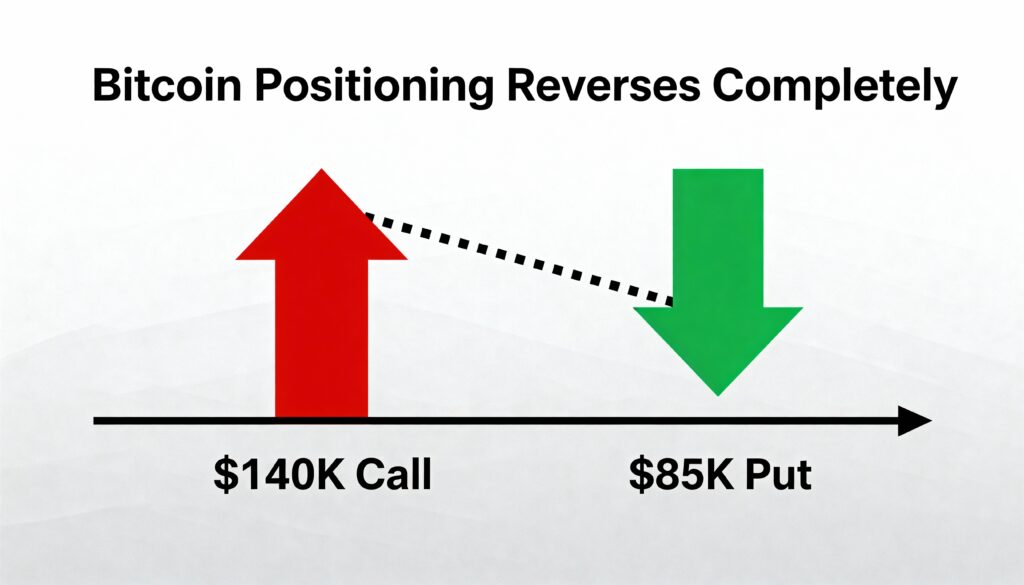
Bitcoin’s options market has flipped dramatically, moving from last year’s ultra-bullish positioning to a notably bearish stance as the cryptocurrency tumbles more than 25% from early October levels to around $91,000.
For much of the past year, traders on Deribit were confidently targeting aggressive upside, concentrating open interest in call options with strike prices of $100,000, $120,000 and even $140,000. The $140,000 call dominated sentiment, holding more than $2 billion in notional open interest through most of the year.
That dominance has now faded. Open interest on the $140,000 call has slipped to $1.63 billion, while bearish positioning has taken center stage. The $85,000 put is now the largest single strike on the board, with open interest swelling to $2.05 billion. Put options at the $80,000 and $90,000 strikes have also overtaken the once-favored $140,000 upside bet.
The shift reflects a market bracing for further weakness. Put options—contracts that give traders the right to sell at a predetermined level—are being accumulated as both hedges and directional bets on continued downside. The heaviest concentrations are in out-of-the-money puts, suggesting traders expect the slide to deepen or want protection against steeper declines.
Despite calls still outnumbering puts in raw count, bearish options are commanding far richer prices. The pronounced skew in favor of puts highlights growing anxiety about downside risk.
“Options positioning is showing clear caution as we approach year-end,” Deribit Chief Commercial Officer Jean-David Pequignot said. “Short-term puts between $84K and $80K are recording the strongest flows today. Implied volatility on the front end sits near 50%, and the curve shows a significant put skew of 5% to 6.5%.”
The defensive posture extends to decentralized venues as well. On Derive.xyz, the 30-day skew has slipped to -5.3% from -2.9%, underscoring mounting demand for downside insurance.
According to Dr. Sean Dawson, head of research at Derive.xyz, traders are increasingly clustering around the December 26 expiry, where a large block of puts—especially around the $80,000 strike—is forming.
Dawson said lingering macro uncertainty is driving the shift. Concerns about U.S. labor-market resilience and reduced odds of a December rate cut, now barely above 50%, have left little reason for bullish exposure into year-end.
Even so, several indicators suggest selling pressure could be nearing exhaustion. Measures of sentiment and momentum are approaching historically oversold territory.
“The Fear & Greed Index is hovering near 15, and RSI is approaching 30,” Pequignot said. “Whale wallets holding more than 1,000 BTC have risen notably over the past week, suggesting smart-money accumulation at discounted levels.”
Pequignot added that while near-term risks still tilt lower, extreme bearish setups like this have, in past cycles, created strong opportunities for contrarian traders.
About The Author



More Stories
Bitcoin holds near $68,300 while gold tumbles for a ninth session and Asian stocks fall
Resolv stablecoin drops 70% as exploiter siphons $25 million worth of ETH
Equities catch up to bitcoin’s drop toward $60,000 amid a surge in bond yields.